Partridges: Biology, Distribution, and Cultural Significance
Partridges are medium-sized galliform birds—members of the order Galliformes—found across a wide native range spanning Europe, Asia, and Africa. These ground-dwelling birds occupy a biological middle ground, typically larger than quail but smaller than pheasants. While they have been traditionally grouped within the Perdicinae subfamily of Phasianidae, modern molecular research indicates they are not a single distinct taxon. Instead, some species are more closely related to pheasants, while others share a closer lineage with junglefowl.
Key Facts
- Habitat: Native to Europe, Asia, Africa, and the Middle East, inhabiting steppes, agricultural lands, and forests.
- Diet: Primarily consume seeds and insects.
- Nesting: They are ground-nesting birds.
- Appearance: Generally feature grey and brown plumage for camouflage.
- Distribution: Naturally widespread in the Old World, with several species introduced to North America.
Physical Characteristics and Habitat
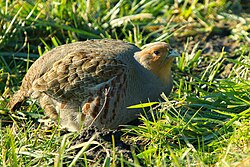
Partridges are characterized by their sturdy build and variable plumage, which mostly consists of earthy tones like grey and brown to blend into their environment. As ground-dwelling birds, they are adapted for life on the floor of their respective habitats, which range from open steppes and farmland to denser forested regions.
Their diet is omnivorous, consisting mainly of seeds and insects. Because of their utility as game birds, species such as the grey partridge and red-legged partridge are frequently reared in captivity and released for hunting, leading to their introduction into various regions of North America.
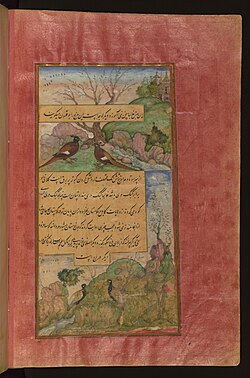
Taxonomy and Species Diversity
The classification of partridges is complex. While they belong to the superfamily Phasianoidea, they are spread across multiple genera. This diversity includes specialized birds like the snow partridge and various hill partridges.
| Genus | Example Species | Common Name |
|---|---|---|
| Perdix | Perdix perdix | Grey partridge |
| Alectoris | Alectoris rufa | Red-legged partridge |
| Arborophila | Arborophila javanica | Chestnut-bellied partridge |
| Tropicoperdix | Tropicoperdix chloropus | Scaly-breasted partridge |
| Ammoperdix | Ammoperdix heyi | Sand partridge |
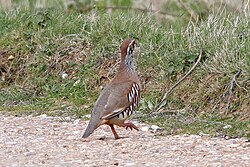
The Red-legged partridge is a prominent example of the Alectoris genus, known for its distinct coloration.
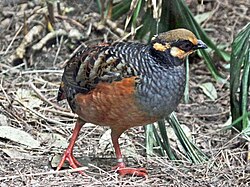
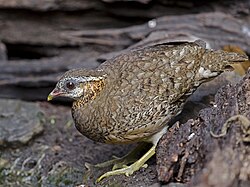
Other notable species include the Chestnut-bellied partridge and the Scaly-breasted partridge, which showcase the variety of plumage across different genera.
The Grey partridge remains one of the most recognized species in Europe.
Cultural and Historical Significance
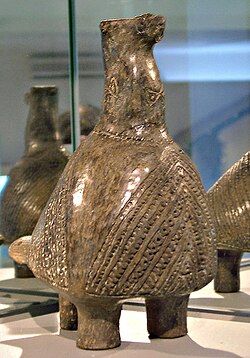
Partridges have appeared in mythology, religion, and folklore for centuries. In Greek legend, the first partridge was created when Daedalus threw his apprentice, Talos, from the sacred hill of Athena. This myth explains why the bird avoids high places and nests on the ground.
In the Middle Ages, medical practitioners viewed partridge meat as a "food of love," believing it could stimulate bodily fluids, raise spirits, and increase reproductive powers.
The bird also holds symbolic weight in national and religious identities:
- Kurdish Nationalism: The partridge (called Kew) is a symbol of Kurdish identity, often grouped with the oak and dagger.
- Hinduism: The Taittiriya Shakha of the Krishna Yajurveda is named after the tittiri (partridge), based on a legend where disciples transformed into partridges to gather scattered knowledge.
One of the most enduring cultural references is the Christmas carol "The Twelve Days of Christmas." The "partridge in a pear tree" is a biological paradox, as partridges are ground-nesting birds. Some historians suggest the phrase is a corruption of the French une perdrix.
Frequently Asked Questions
Do partridges actually live in pear trees?
No. Partridges are ground-nesting birds and are unlikely to be found in pear trees. The reference in the famous Christmas carol is likely a linguistic corruption or a poetic invention.
What is the difference between a partridge and a pheasant?
While both are in the superfamily Phasianoidea, partridges are generally medium-sized and ground-dwelling, whereas pheasants are typically larger. Molecular research shows that while some partridges are close to pheasants, others are closer to junglefowl.
Where are partridges natively found?
They are native to Europe, Asia, Africa, and the Middle East, though some species have been introduced to the Americas for hunting purposes.
What do partridges eat?
Partridges have a diet consisting primarily of seeds and insects.
Why are partridges used as symbols in Kurdish culture?
The partridge, known as Kew, serves as a national symbol to help distinguish Kurdish identity from other regional identities, such as those of the Arabs.