Partidos of Buenos Aires: Administrative Structure and History
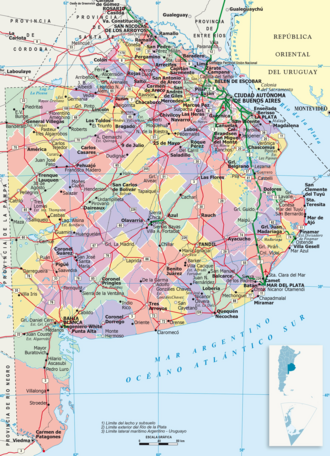
In the complex administrative landscape of Argentina, the province of Buenos Aires employs a unique system of second-level subdivisions known as partidos. Unlike other Argentine provinces, which utilize departamentos (departments) further divided into municipalities, a partido is treated as a single administrative unit. These units typically encompass one or more population centers, known as localidades, and serve as the primary engine for local governance.
Key Facts
- Unique Status: Partidos are used exclusively in the province of Buenos Aires.
- Total Count: There are currently 135 partidos within the province.
- Governance: Each is led by an elected Intendente (Mayor) and a Concejo Deliberante (Council).
- Structure: A partido is a single administrative unit divided into smaller localities.
- Term Limits: Mayors and councillors serve four-year terms with specific re-election restrictions.
Historical Evolution
The origins of the partido date back to the late 18th century. In 1779, the cabildo (town council) of Buenos Aires established the first rural partido in San Isidro del Pago de la Costa. This was followed in 1784 by the creation of several others, including San Vicente, Quilmes, Magdalena, La Matanza, Morón, Tigre, and San Pedro.
Initially, these areas were managed by an Alcalde de la Santa Hermandad, a rural judge appointed by the cabildo. The alcalde's primary responsibility was maintaining law and order and combating cattle raiders, supported by the Santa Hermandad (Holy Brotherhood) constabulary.
The system underwent significant changes in 1821 when Governor Martín Rodríguez and minister Bernardino Rivadavia dissolved the cabildos. The governor took over the appointment of judges, who were renamed Juez de Paz (Justice of the Peace). The territories they managed became known as Partido judicial (Judicial districts), which is where the modern term "partido" originates.
Further transitions occurred in 1856, replacing the Juez de Paz with a Presidente de la Municipalidad (Municipal President). By 1890, the leadership role evolved into the Intendente (Mayor), a position directly elected by the citizens. A landmark legislative act on October 24, 1864 (Law № 422), formally divided the province into 45 partidos, laying the groundwork for the current 135-unit structure.
Government and Administration
The governance of a partido follows a strong mayor-council model, consisting of an executive branch and a legislative branch.
The Executive Branch
The Intendente serves as the chief executive. They are elected to four-year terms and may be re-elected once. However, they cannot serve three consecutive terms; a one-period interval is required before they can run for the position again.
The Legislative Branch
The Concejo Deliberante is a unicameral body. Half of its members are elected every two years to serve four-year terms. Similar to the mayor, councillors can be re-elected once but must observe a one-period interval before seeking a third term.
Council Composition by Population
The size of the legislative council is determined by the population of the partido, as outlined in decree-law 6769/58:
| Population Range | Number of Councillors |
|---|---|
| Up to 5,000 | 6 |
| 5,000 - 10,000 | 10 |
| 10,000 - 20,000 | 12 |
| 20,000 - 30,000 | 14 |
| 30,000 - 40,000 | 16 |
| 40,000 - 80,000 | 18 |
| 80,000 - 200,000 | 20 |
| More than 200,000 | 24 |
Notable Partidos
The province contains a wide variety of partidos, ranging from massive urban centers to sparsely populated rural areas. For example, La Matanza is one of the most populous with over 1.8 million residents, while Tordillo is among the least populous with approximately 2,542 residents. Geographically, Patagones is the largest by area, covering 13,564 square kilometers, whereas Hurlingham is one of the smallest at 36 square kilometers.
Frequently Asked Questions
What is the difference between a partido and a departamento?
A partido is a second-level administrative subdivision used exclusively in the province of Buenos Aires and is treated as a single administrative unit. In all other Argentine provinces, the second-level subdivisions are called departamentos, which are further divided into separate municipalities.
Who leads a partido?
Each partido is led by an Intendente (Mayor), who is directly elected by the citizens for a four-year term.
How is the number of councillors determined?
The number of members in the Concejo Deliberante is based on the population of the partido, ranging from 6 councillors for populations under 5,000 to 24 councillors for populations exceeding 200,000.
What are localidades?
Localidades are the smaller population centers, such as towns and cities, that are contained within the larger administrative boundary of a partido.
Can an Intendente serve indefinitely?
No. An Intendente can be re-elected for one consecutive term, but must then wait for one full period to pass before they are eligible to be elected to the position again.