Parsifal: Richard Wagner's Final Masterpiece and the Quest for the Grail
Parsifal stands as the crowning achievement of Richard Wagner's career, a profound music drama that blends spiritual longing with orchestral grandeur. Conceived as a Bühnenweihfestspiel (a "stage-consecrating festival-play"), the work was designed specifically for the unique acoustics of the Bayreuth Festspielhaus. Based on the epic poem Parzival by Wolfram von Eschenbach, the opera explores timeless themes of compassion, rebirth, and self-renunciation.
Wagner's journey to complete the work was an arduous one, spanning twenty-five years from its initial conception in April 1857 to its premiere in 1882. The result is a work of immense spiritual depth, influenced by Wagner's study of Arthur Schopenhauer and Indian philosophies, particularly Buddhism.
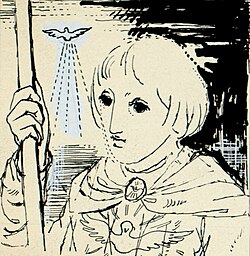
Key Facts
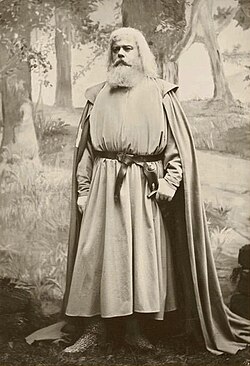
- Composer/Librettist: Richard Wagner
- Premiere Date: July 26, 1882
- Venue: Bayreuth Festspielhaus, Germany
- Source Material: Parzival by Wolfram von Eschenbach
- Language: German
- Original Conductor: Hermann Levi
The Long Road to Composition
The seeds of Parsifal were sown in 1845 when Wagner first read von Eschenbach's poem. However, the work's philosophical core evolved significantly after 1854, when Wagner encountered the writings of Schopenhauer. This led to an interest in Buddhism and the creation of Die Sieger (The Victors) in 1856, a sketch for an opera about the Buddha. Many of the themes found in Parsifal—such as the concept of exclusive social castes and the power of compassion—were first explored in this earlier sketch.
Wagner's creative process was fragmented. He produced a prose draft in 1865 but set the project aside for over a decade to complete the massive Ring cycle. It was only after the Ring premiered in 1876 that he returned to Parsifal with full focus. By April 1877, he had completed the verse libretto, which he preferred to call a "poem."
The Technical Process
Wagner employed a rigorous compositional method, working on prose drafts and music simultaneously to streamline the transition from text to sound. He developed the Gesamtentwurf (general draft) and Orchesterskizze (orchestral sketch) for each act before moving to the next. The final stage was the Partiturerstschrift, the full ink score. The prelude to Act 1 was scored in August 1878, and the rest of the opera was completed by January 13, 1882.
Performance History and the Bayreuth Monopoly
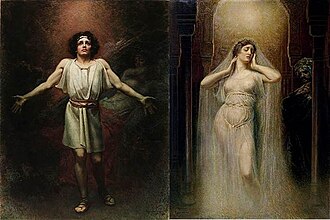
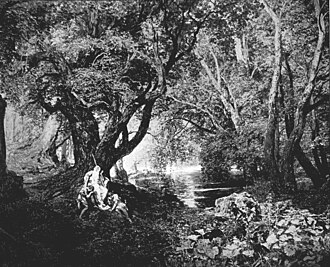
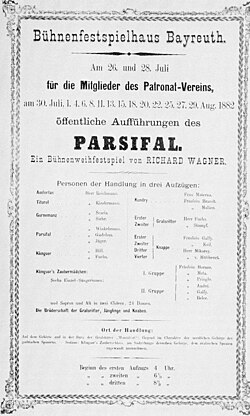
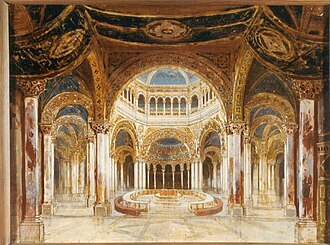
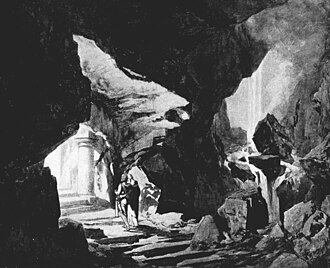
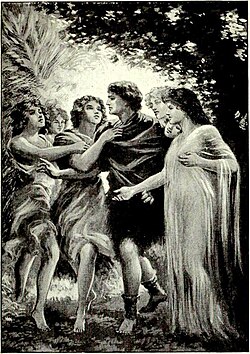
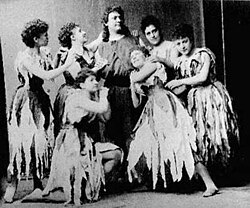
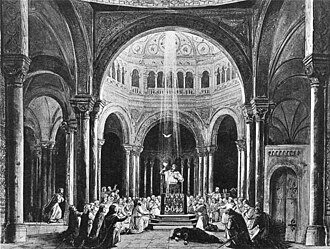
The premiere took place on July 26, 1882, conducted by Hermann Levi. The production was a massive undertaking, featuring an orchestra of 107 musicians, a chorus of 135, and 23 soloists. The visual design was heavily influenced by Wagner's own travels; the Grail hall was inspired by the interior of Siena Cathedral, while Klingsor's magic garden was modeled after the Palazzo Rufolo in Ravello.
Following the premiere, the Bayreuth authorities established a strict monopoly on the work, banning staged performances outside the Festspielhaus. While unstaged concert versions were permitted in cities like London and New York, the stage embargo remained until 1914. A notable exception occurred in 1903 when the Metropolitan Opera in New York staged the work after a US court ruled the ban unenforceable. This move led to a rift, as Cosima Wagner barred any performers involved in the New York production from returning to Bayreuth.
Cast and Roles
The roles in Parsifal require immense vocal power and dramatic range, particularly the role of Kundry, which demands a high dramatic soprano or dramatic mezzo-soprano.
| Role | Voice Type | 1882 Bayreuth Premiere | 1903 Met Premiere |
|---|---|---|---|
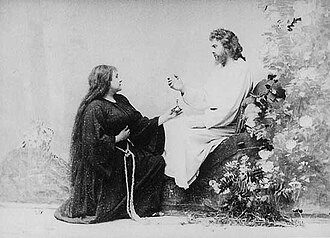
| Parsifal | Tenor | Hermann Winkelmann | Alois Burgstaller |
| Kundry | Soprano/Mezzo | Amalie Materna | Milka Ternina |
| Gurnemanz | Bass | Emil Scaria | Robert Blass |
| Amfortas | Baritone | Theodor Reichmann | Anton van Rooy |
| Klingsor | Bass-Baritone | Karl Hill | Otto Goritz |
| Titurel | Bass | August Kindermann | Marcel Journet |
Critical Reception and Legacy
Contemporary reactions to Parsifal were overwhelmingly positive. The conductor Felix Weingartner described the 1882 performances as "artistic events of supreme interest," and the composer Hugo Wolf called it Wagner's "most inspired, sublimest creation."
In the post-war era, Hans Knappertsbusch became the conductor most closely linked with the work at Bayreuth. His 1951 performances marked the reopening of the festival after World War II. Later recordings by Pierre Boulez and James Levine have highlighted the work's versatility, with Boulez opting for a faster tempo and Levine for a significantly slower interpretation.
Frequently Asked Questions
Why was Parsifal banned from other opera houses?
The Bayreuth authorities wanted to maintain a monopoly on the production to preserve its sacred, "festival-play" atmosphere and ensure it was performed exactly as Wagner intended.
What is a Bühnenweihfestspiel?
It is a term coined by Wagner, meaning a "stage-consecrating festival-play," reflecting the work's spiritual nature and its intended home at the Bayreuth Festspielhaus.
How did Buddhism influence the opera?
Wagner's interest in Indian philosophies and Buddhism introduced themes of self-renunciation, compassion, and rebirth, which are central to Parsifal's journey.
Who were the primary designers for the original production?
The stage designs were created by Max Brückner and Paul von Joukowsky, following the specific directions and inspirations provided by Richard Wagner.
Which recording is considered the classic version of Parsifal?
The 1962 stereo recording conducted by Hans Knappertsbusch for Philips is often regarded as the classic recording of the work.