Parliament of the United Kingdom of Great Britain and Northern Ireland
The Parliament of the United Kingdom is the supreme legislative body of the UK, operating as a bicameral system—meaning it consists of two separate houses. Based in the historic Palace of Westminster in London, it is responsible for creating laws, scrutinizing the government, and representing the interests of the British public.
Currently in its 59th Parliament, the institution is composed of the Monarch, the House of Lords, and the House of Commons. While the structure has evolved over centuries, it remains the central pillar of British democracy and governance.
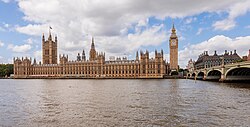
Key Facts
- Type: Bicameral (House of Lords and House of Commons).
- Meeting Place: Palace of Westminster, London.
- Commons Seats: 650 members elected via first-past-the-post.
- Lords Seats: Not fixed (currently 770).
- Current Monarch: King Charles III.
- Prime Minister: Andy Burnham (Labour).
- Next General Election: No later than 15 August 2029.
Historical Evolution
The modern Parliament was formed through a series of unions. The Parliament of Great Britain was established in 1707 following the Treaty of Union between the Parliaments of England (founded 1215) and Scotland (c. 1235). In 1801, the Acts of Union merged the Parliament of Great Britain with the Parliament of Ireland, creating the Parliament of the United Kingdom of Great Britain and Ireland.
Following the secession of the Irish Free State, the Royal and Parliamentary Titles Act 1927 formally renamed the body to the Parliament of the United Kingdom of Great Britain and Northern Ireland.
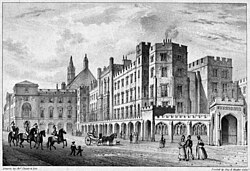
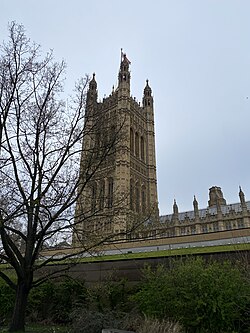
The Palace of Westminster
Parliament has long met at the Palace of Westminster, though the site has faced significant destruction. A major fire in 1834 and bombing during the Blitz in 1941 forced the two houses to relocate temporarily. For 17 years after the 1834 fire, the Commons sat in the former Lords Chamber. Following the 1941 bombings, both houses utilized the Church House annexe before returning to their permanent chambers by 1950.
Democratic Reforms
The 19th and 20th centuries brought pivotal changes to voting and membership:
- Ballot Act 1872: Introduced secret ballots.
- Abolish Property Qualifications Act 1858: Removed property requirements for MPs.
- Representation of the People Act 1918: Extended voting rights to all men over 21 and women over 30.
- Parliament Act 1911: Introduced payment for MPs and limited the House of Lords' power to block money bills.
Composition and Powers
The Monarch
The Monarch is a constitutive element of Parliament but does not participate in political debate. Their primary role is granting Royal Assent, the formal signing of a bill to make it law. While this is largely a formality—no assent has been refused since 1708—it is a legal requirement for any bill to pass.
The House of Lords
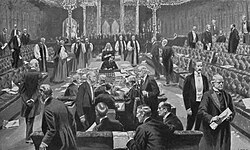
The House of Lords is the upper house and is subordinate to the Commons. It is divided into two groups:
- Lords Spiritual: 23 Bishops.
- Lords Temporal: Including life peers and a limited number of hereditary peers.
Significant reforms, such as the Life Peerages Act 1958 and the House of Lords Act 1999, shifted the chamber away from hereditary dominance. The Constitutional Reform Act 2005 further stripped the Lords of its judicial functions, leading to the creation of the Supreme Court of the United Kingdom in 2009.
The House of Commons
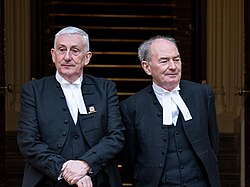
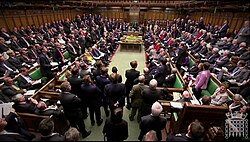
The House of Commons is the primary legislative chamber, consisting of 650 elected Members of Parliament (MPs). It is the site of intense political scrutiny, most notably during Prime Minister's Questions, where the Prime Minister must answer queries from other members.
Legislative and Judicial Functions
The Law-Making Process
For a bill to become law, it generally requires the assent of all three components of Parliament. The enacting formula is a specific phrase used at the start of each Act to certify that the King, the Lords, and the Commons have agreed to the legislation.
A unique challenge in UK governance is the West Lothian question. This refers to the paradox where Scottish MPs at Westminster can vote on laws affecting only England, but English MPs have no equivalent power over devolved Scottish laws. Under the Scotland Act 1998, Westminster retains the power to overturn devolved legislation, as seen in January 2023 with the Gender Recognition Reform (Scotland) Bill.
Judicial History
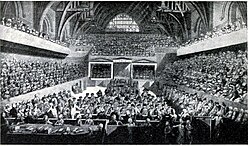
Historically, the House of Lords handled trials for peers accused of felonies or high treason, though the last such trial occurred in 1935. The Commons also possesses the power of impeachment, where an individual is charged by the Commons and tried by the Lords, though this practice has been largely defunct since 1806.
Parliamentary Oversight and Government
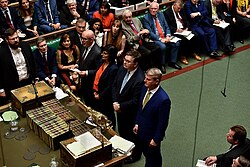
The UK Government is held accountable through daily question time. From Monday to Thursday, government departments follow a five-week rota to answer questions. Every Wednesday, the Prime Minister faces a dedicated session from noon to 12:30 pm.
| Year | Maximum Term | Governing Act | Notes |
|---|---|---|---|
| 1707 | 3 Years | Acts of Union | Initial ratification |
| 1715 | 7 Years | Septennial Act 1715 | Extended maximum term |
| 1911 | 5 Years | Parliament Act 1911 | Reduced maximum term |
| WWII | 10 Years | Prolongation Acts | Extended annually from 1940-1944 |
| 2011 | 5 Years | Fixed-term Parliaments Act | Set fixed intervals |
| 2022 | 5 Years | Dissolution and Calling of Parliament Act | Current framework |
Frequently Asked Questions
What is the difference between the House of Commons and the House of Lords?
The House of Commons consists of 650 elected representatives and is the primary legislative body. The House of Lords is an appointed or hereditary chamber that reviews and suggests amendments to legislation but is subordinate to the Commons.
What is Royal Assent?
Royal Assent is the final stage of the legislative process where the Monarch formally signs a bill passed by both houses, officially turning it into an Act of Parliament.
How are members of the House of Commons elected?
Members are elected using the first-past-the-post voting system, where the candidate with the most votes in a specific constituency wins the seat.
What is the West Lothian question?
It is a political paradox regarding the UK's devolved system: Scottish MPs at Westminster can vote on laws that only affect England, but there is no equivalent English-only parliament to prevent this, nor can English MPs vote on devolved Scottish matters.
Can the House of Lords block a law permanently?
Generally, no. Under the Parliament Acts of 1911 and 1949, the Lords can delay most bills for a maximum of two sessions, after which the bill can become law without their consent. However, they retain an absolute veto over bills that attempt to extend the life of a parliament.