Articles/Parasitism: The Complex Dynamics of Host-Parasite Relationships
parasitismendoparasiteectoparasiteparasitoidbiological control
Parasitism: The Complex Dynamics of Host-Parasite Relationships
Parasitism: The Complex Dynamics of Host-Parasite Relationships Parasitism is a specialized form of symbiosis—an intimate relationship between two different species—where one organism, th...
Parasitism: The Complex Dynamics of Host-Parasite Relationships
Parasitism is a specialized form of symbiosis—an intimate relationship between two different species—where one organism, the parasite, lives on or inside another organism, the host. Unlike predation, where the predator typically kills its prey immediately, parasites generally cause harm to their hosts without killing them instantly, often relying on the host's survival for their own continued existence and reproduction.
This biological interaction is incredibly diverse, spanning almost every taxonomic group. Parasites include single-celled protozoans (such as those causing malaria), animals (like hookworms and lice), fungi (such as honey fungus), and even plants (such as mistletoe and dodder). It is estimated that approximately 40 percent of all described species are parasitic.
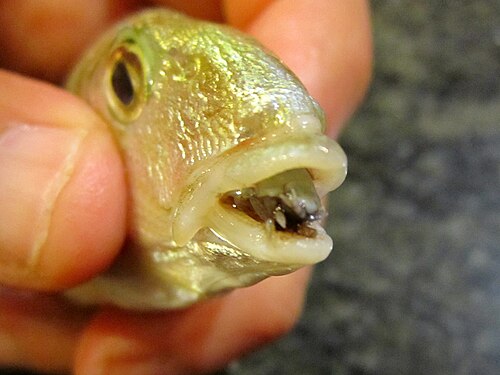
A fish parasite, the isopod Cymothoa exigua, replacing the tongue of a Lithognathus: A fish parasite, the isopod Cymothoa exigua, replacing the tongue of a Lithognathus
Key Facts
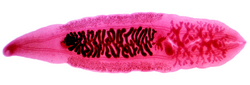
Clonorchis sinensis, the Chinese liver fluke, is trophically transmitted
Widespread Occurrence: Almost all free-living animals host at least one species of parasite.
Ecological Impact: Roughly three-quarters of food web links involve a parasite, making them critical for regulating host populations.
Diversity: Parasites range from microscopic viruses and bacteria to complex multicellular animals and plants.
Host Specificity: Many animal parasites are highly specialized, often evolving to live on a single specific host species.
Human Impact: Humans are hosts to 342 species of helminth (worm) parasites and 70 species of protozoan parasites.
Classifying Parasites
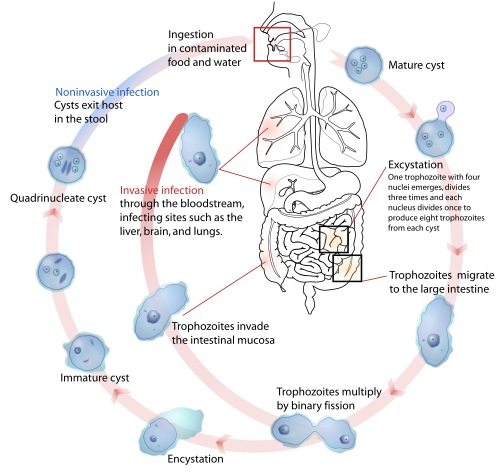
Life cycle of Entamoeba histolytica, an anaerobic parasitic protozoan transmitted by the fecal–oral route
Biologists categorize parasites based on their location relative to the host and their specific strategy of exploitation.
Invasiveness: Endoparasites vs. Ectoparasites
The primary axis of classification is where the parasite resides. An endoparasite lives inside the host's body, while an ectoparasite lives on the external surface.
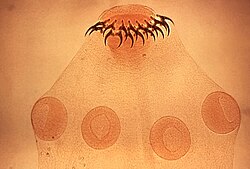
Head (scolex) of tapeworm Taenia solium, an intestinal parasite, has hooks and suckers to attach to its host: Head (scolex) of tapeworm Taenia solium, an intestinal parasite, has hooks and suckers to attach to its host
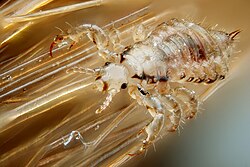
Human head-lice are directly transmitted obligate ectoparasites: Human head-lice are directly transmitted obligate ectoparasites
Major Exploitation Strategies
There are six primary strategies parasites use to exploit animal hosts:
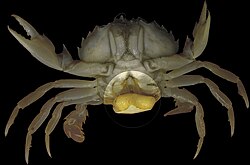
Parasitic Castration: The parasite destroys the host's reproductive ability to divert energy toward its own growth.
Directly Transmitted Parasitism: Transmission occurs through physical contact or the fecal-oral route.
Trophically Transmitted Parasitism: The parasite is transmitted when the current host is eaten by a predator (the next host).
Vector-Transmitted Parasitism: A third party, the vector (often an insect), carries the parasite to the host.
Parasitoidism: The parasite eventually kills the host as a necessary part of its development.
Micropredation: The parasite visits the host briefly to feed and then leaves.
The parasitic castrator Sacculina carcini (highlighted) attached to its crab host: The parasitic castrator Sacculina carcini (highlighted) attached to its crab host
Transmission and Life Cycles
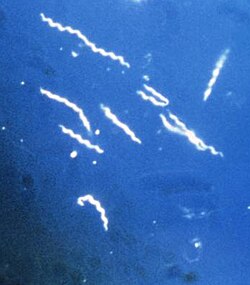
Borrelia burgdorferi, the bacterium that causes Lyme disease, is transmitted by Ixodes ticks.
The method of transmission is closely tied to the ecological context and social behavior of the host. For example, some nematodes use the fecal-oral route, which is facilitated by social grooming in primates.
Common Parasite Transmission Methods
Parasite
Host
Transmission Method
Ecological Context
Gyrodactylus turnbulli
Guppy
Physical contact
Social behavior
Nematodes (e.g., Strongyloides)
Japanese macaque
Fecal–oral
Social behavior (grooming)
Plasmodium (Malaria)
Humans/Mammals
Anopheles mosquito vector
Odour attraction
Amblyomma (Tick)
Tuatara
Free-living infectious stages
Social behavior
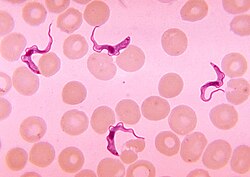
The vector-transmitted protozoan endoparasite Trypanosoma among human red blood cells: The vector-transmitted protozoan endoparasite Trypanosoma among human red blood cells
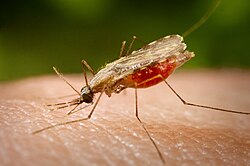
Mosquitoes are micropredators and important vectors of disease: Mosquitoes are micropredators and important vectors of disease
Evolutionary Ecology and Coevolution
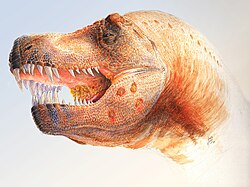
Restoration of a Tyrannosaurus with holes possibly caused by a Trichomonas-like parasite
Parasitism drives significant evolutionary changes in both the parasite and the host. This often results in cospeciation, where the parasite evolves in tandem with its host. However, host-switching can also occur, where a parasite jumps from one species to another.
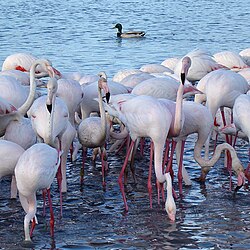
Biologists long suspected cospeciation of flamingos and ducks with their parasitic lice, which were similar in the two families. Cospeciation did occur, but it led to flamingos and grebes, with a later host switch of flamingo lice to ducks.: Biologists long suspected cospeciation of flamingos and ducks with their parasitic lice, which were similar in the two families. Cospeciation did occur, but it led to flamingos and grebes, with a later host switch of flamingo lice to ducks.
Behavioral Modification and Trait Loss
Some parasites can manipulate the central nervous system of their hosts to facilitate transmission. For instance, Toxoplasma gondii induces behavioral changes in rats to make them more susceptible to predation by their final host.
The protozoan Toxoplasma gondii facilitates its transmission by inducing behavioral changes in rats through infection of neurons in their central nervous system.: The protozoan Toxoplasma gondii facilitates its transmission by inducing behavioral changes in rats through infection of neurons in their central nervous system.
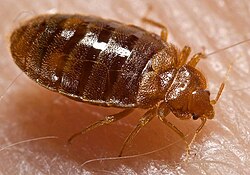
Over time, parasites may experience trait loss—the disappearance of organs or abilities that are no longer needed. Many insect ectoparasites, such as bedbugs, have become flightless.
Trait loss: bedbug Cimex lectularius is flightless, like many insect ectoparasites.: Trait loss: bedbug Cimex lectularius is flightless, like many insect ectoparasites.
Host Defenses
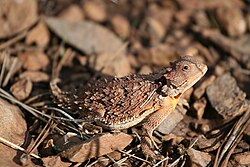
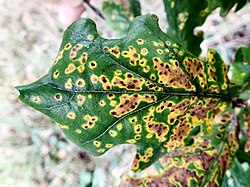
Hosts evolve various defenses to prevent infection. Vertebrates may develop dry skin to block entry, while plants produce defensive chemicals that limit the spread of fungal infections to small, circular patches.
The dry skin of vertebrates such as the short-horned lizard prevents the entry of many parasites.: The dry skin of vertebrates such as the short-horned lizard prevents the entry of many parasites.
Leaf spot on oak. The spread of the parasitic fungus is limited by defensive chemicals produced by the tree, resulting in circular patches of damaged tissue.: Leaf spot on oak. The spread of the parasitic fungus is limited by defensive chemicals produced by the tree, resulting in circular patches of damaged tissue.
Broad Taxonomic Range
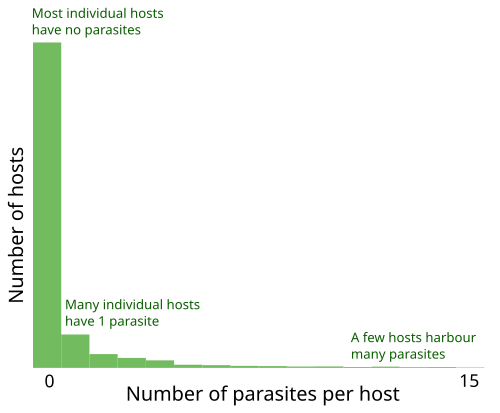
Parasites are distributed unevenly among their hosts, most hosts having no parasites, and a few hosts harbouring most of the parasite population. This distribution makes sampling difficult and requires careful use of statistics.
Parasitism is not limited to animals. It occurs across all kingdoms of life:
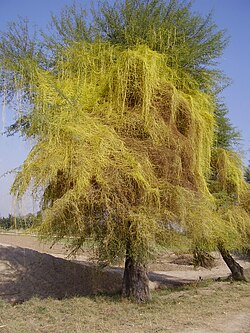
Plants: Stem holoparasites like Cuscuta (dodder) attach to other plants to extract nutrients. Cuscuta (a dodder), a stem holoparasite, on an acacia tree: Cuscuta (a dodder), a stem holoparasite, on an acacia tree
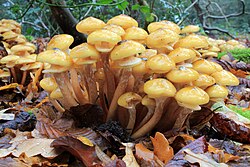
Fungi: The honey fungus (Armillaria mellea) acts as both a parasite and a saprophyte. The honey fungus, Armillaria mellea, is a parasite of trees, and a saprophyte feeding on the trees it has killed.: The honey fungus, Armillaria mellea, is a parasite of trees, and a saprophyte feeding on the trees it has killed.
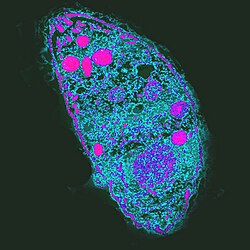
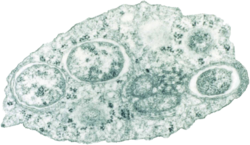
Bacteria:Wolbachia bacteria live within insect cells. Wolbachia bacteria within an insect cell: Wolbachia bacteria within an insect cell
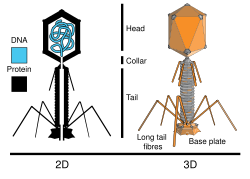
Viruses: Bacteriophages, such as the T4 phage, infect bacteria by injecting DNA. Enterobacteria phage T4 is a bacteriophage virus. It infects its host, Escherichia coli, by injecting its DNA through its tail, which attaches to the bacterium's surface.: Enterobacteria phage T4 is a bacteriophage virus. It infects its host, Escherichia coli, by injecting its DNA through its tail, which attaches to the bacterium's surface.
Applications and Conservation
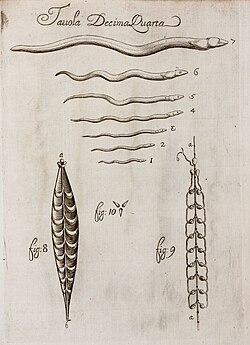
A plate from Francesco Redi's Osservazioni intorno agli animali viventi che si trovano negli animali viventi (Observations on living animals found inside living animals), 1684
While often viewed negatively, parasitism is used in biological control to manage pests. Encarsia formosa, for example, is used in greenhouse horticulture to control pest populations.
Encarsia formosa, widely used in greenhouse horticulture, was one of the first biological control agents developed.[139]: Encarsia formosa, widely used in greenhouse horticulture, was one of the first biological control agents developed.
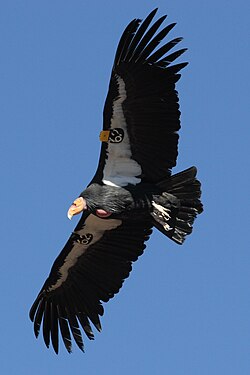
Conservation efforts can also have unintended consequences. The rescue of the California condor successfully saved the bird, but its specific ectoparasite, the louse Colpocephalum californici, went extinct.
The rescuing from extinction of the California condor was a successful and expensive project, but its ectoparasite, the louse Colpocephalum californici, was made extinct.: The rescuing from extinction of the California condor was a successful and expensive project, but its ectoparasite, the louse Colpocephalum californici, was made extinct.
Frequently Asked Questions
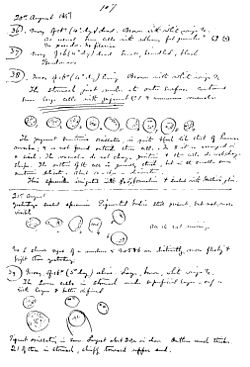
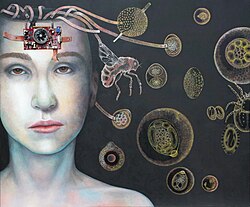
Ronald Ross won the 1902 Nobel Prize for showing that the malaria parasite is transmitted by mosquitoes. This 1897 notebook page records his first observations of the parasite in mosquitoes."An Old Parasite in a New Form": an 1881 Punch cartoon by Edward Linley Sambourne compares a crinoletta bustle to a parasitic insect's exoskeletonFictional parasitism: oil painting Parasites by Katrin Alvarez, 2011
What is the difference between a parasite and a predator?
Unlike predators, parasites are typically much smaller than their hosts, do not kill them immediately (with the exception of parasitoids), and often live on or in their hosts for extended periods.
What is a parasitoid?
A parasitoid is an organism that lives in or on a host, but unlike a conventional parasite, it eventually kills the host as a necessary part of its life cycle.
How do vector-transmitted parasites work?
These parasites rely on a vector—usually an arthropod like a mosquito or tick—to transport them from one host to another. An example is the malaria parasite, which is transmitted via the Anopheles mosquito.
Can plants be parasites?
Yes, some plants are parasitic. For example, dodder (Cuscuta) is a stem holoparasite that attaches to other plants to obtain nutrients.
What is parasitic castration?
Parasitic castration occurs when a parasite destroys the reproductive organs or functions of its host, ensuring that the host's energy is used for the parasite's growth rather than the host's reproduction.
![Encarsia formosa, widely used in greenhouse horticulture, was one of the first biological control agents developed.[139]](/images/12/5c/125c28772ad7aa7a172334802f16c57170c466b3681c5e06e2c9517596ee7331.jpg)