Panorama: The Evolution of Wide-Angle Visual Representation
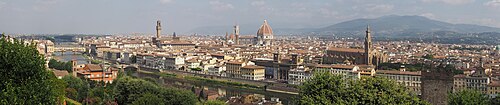
A panorama—derived from the Greek words pân ("all") and horama ("view")—is a wide-angle representation of a physical space. This visual format spans various mediums, including painting, drawing, photography, film, seismic imaging, and 3D modeling. While the concept of capturing a vast vista is ancient, the specific term was coined in the 18th century by Robert Barker, an English painter of Irish descent, to describe his expansive depictions of London and Edinburgh.
The influence of the panorama extends beyond static art; the common motion-picture term "panning" is directly derived from this concept.
Key Facts
- Origin: The term was coined by Robert Barker in the 18th century.
- Early Art: Immersive mural-style vistas existed as early as 20 A.D. in Pompeii.
- Technological Shift: Panoramic representation evolved from hand-painted cylinders to digital image stitching and VR.
- Scale: Historical cycloramas could reach over 100 meters in circumference.
- Modern Use: Digital elevation models (DEM) now allow for the generation of panoramas from geographic data.
The History of Panoramic Vision
The desire to create a "panoptic" or immersive experience is not new. Murals found in Pompeii from 20 A.D. demonstrate early attempts to simulate a wide vista. During the Enlightenment, cartographic experiments further pushed the boundaries of how humans depicted wide-scale vision.
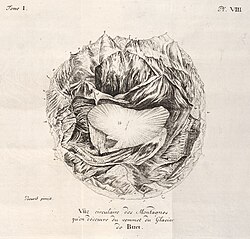
This perspective reached America through figures like Benjamin Franklin, who witnessed the first manned balloon flight by the Montgolfier brothers in 1783, and physician John Jeffries, who participated in aerial crossings of the English Channel in 1785. These aerial vantage points provided a real-world precursor to the panoramic perspective.
The Panorama as Popular Spectacle
In the mid-19th century, panoramas became a mass-market entertainment phenomenon. Robert Barker patented the "Apparatus for Exhibiting Pictures" in 1787, creating a 360° visual medium where paintings were displayed on a cylindrical surface. Viewers stood inside the cylinder, gaining a high-fidelity vantage point of the entire horizon.
Barker's first exhibition, a "View of Edinburgh" from Calton Hill, debuted in 1788 before moving to London in 1789. By 1793, he established "The Panorama" rotunda in Leicester Square, which operated for 70 years until 1863.
Technological Refinements and Massive Installations
To improve accuracy, Sir Francis Ronalds developed a machine in the early 1840s to correct perspective errors that occurred when planar sketches were converted into cylinders. This device also allowed drawings to be projected at a larger scale for more precise painting.
As the medium grew, the scale of installations became gargantuan to enhance the illusion of reality. Notable examples include:
- Bourbaki Panorama (Switzerland): Created in 1881, measuring 10 meters high and 112 meters in circumference.
- Panorama Mesdag (Netherlands): Established in 1881, featuring a diameter of roughly 40 meters.
- Atlanta Cyclorama (USA): First displayed in 1887, depicting the Battle of Atlanta with a circumference of 358 feet.
- Racławice Panorama (Poland): Created in 1893, measuring 15 by 120 meters.
The Transition to Photography
Following the introduction of the Daguerreotype in 1839, photography began to replace painting. Early photographers assembled multiple images into a single wide view. By the late 19th century, the advent of flexible film allowed for specialized panoramic cameras with curved holders and clockwork drives that could scan arcs of nearly 180°.
Alternative methods also emerged, such as the "oatmeal box" pinhole camera. By wrapping film around the inside of a cylindrical container, photographers could create egg-shaped images with views exceeding 180°.
In the 1970s and 1980s, multi-image slide projections (diaporamas) became popular. These used synchronized projectors and soft-edge density masks to merge 35mm slides seamlessly on a wide screen, often accompanied by audio tracks.
Digital Innovation and Virtual Reality
Modern digital photography has revolutionized the process through image stitching—the process of combining multiple overlapping images into a single wide-angle view. This technology enables the creation of gigapixel images and virtual reality (VR) experiences using JavaScript, Java, or Flash.
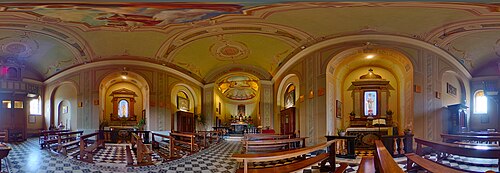
While rotating line cameras like the Panoscan can capture high-resolution images without stitching, fully immersive "spherical" panoramas (covering 360° horizontally and 180° vertically) still require the stitching of multiple images.

Specialized Formats
- Vertorama: A vertical panorama with an upright orientation.
- 360° Cinema: Specialized theaters, such as those created by Disney since 1955 or the Swiss Transport Museum, use cylindrical screen arrangements.
- Dome Projection: Systems like IMAX Dome and OMNIMAX project images onto a dome above the audience.
- Data-Driven Panoramas: Digital elevation models (DEM), such as SRTM, allow for the generation of panoramic views from specific geographic coordinates.
| Name | Location | Year | Approx. Dimensions |
|---|---|---|---|
| Bourbaki Panorama | Lucerne, Switzerland | 1881 | 10m (H) x 112m (C) |
| Panorama Mesdag | The Hague, Netherlands | 1881 | 14m (H) x 120m (C) |
| Atlanta Cyclorama | Atlanta, USA | 1887 | 42ft (H) x 358ft (C) |
| Racławice Panorama | Wrocław, Poland | 1893 | 15m (H) x 120m (C) |
Frequently Asked Questions
Who invented the panorama?
The term and the specific 360° cylindrical painting format were developed by the English painter Robert Barker in the late 18th century, with his first major exhibition appearing in 1788.
What is image stitching?
Image stitching is a digital process used in modern photography to combine multiple overlapping images with similar viewpoints into a single, seamless wide-angle or 360° image.
What is the difference between a panorama and a vertorama?
A standard panorama typically has a horizontal orientation to capture a wide landscape, whereas a vertorama is a panorama with an upright, vertical orientation.
How were panoramas created before digital cameras?
They were originally created as massive oil paintings on cylindrical walls. Later, photographers used curved film holders and rotating lenses to capture wide arcs of a scene on flexible film.
Can panoramas be created from data instead of photos?
Yes, panoramic representations can be generated from digital elevation models (DEM), such as SRTM data, which allow a view to be simulated from any given point in a digital landscape.