Pakistan: The Era of the Dominion (1947–1956)
The Dominion of Pakistan was the sovereign state that existed between August 14, 1947, and March 23, 1956. During this formative period, Pakistan operated as an independent federal dominion within the British Commonwealth of Nations. Established under the Indian Independence Act 1947, the dominion served as the political bridge between the end of British colonial rule and the eventual adoption of a republican constitution.
The transition to independence was marked by the division of British India into two separate sovereign states: India and Pakistan. While the dominion maintained a symbolic link to the British Crown, it exercised full internal and external autonomy, navigating the immense challenges of nation-building, mass migration, and territorial disputes.
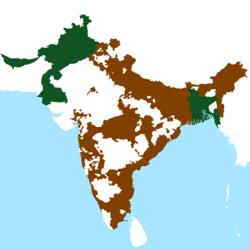
Key Facts
- Independence Date: 14 August 1947.
- Transition to Republic: 23 March 1956.
- Initial Capital: Karachi.
- Largest City: Dacca.
- Total Area: 1,030,373 km².
- First Governor-General: Muhammad Ali Jinnah.
- First Prime Minister: Liaquat Ali Khan.
The Path to Independence and Partition
Before 1947, the territory of present-day Pakistan was split between areas directly governed by the British Crown and various princely states. These princely states enjoyed semi-autonomous self-government through subsidiary alliances with the British. Upon the abandonment of these alliances in August 1947, these states became independent, and between 1947 and 1948, they all acceded to Pakistan.
The partition process triggered one of the largest mass migrations in human history, with over ten million people crossing the new borders. This period was marred by extreme communal violence, particularly in the Punjab region, resulting in deaths estimated between 200,000 and 2,000,000. The violence also included the abduction and rape of thousands of women; Pakistani government records cited 50,000 Muslim women abducted, while the Indian government cited 33,000 Hindu and Sikh women. In the 1950s, both governments worked to repatriate these women to their families.
Almost immediately, the dispute over Kashmir escalated into the first war between India and Pakistan. Although the United Nations helped end the conflict, the Kashmir dispute remained unresolved.
Governance and the Commonwealth
As a dominion, Pakistan was a federal constitutional monarchy. From 1947 to 1952, King George VI served as the sovereign, a position shared with the United Kingdom and other Commonwealth realms. He was succeeded by Queen Elizabeth II in 1952.
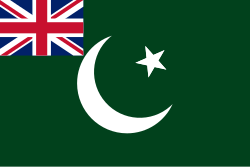
The executive leadership was split between the Governor-General, who represented the Crown, and the Prime Minister, who led the government. Muhammad Ali Jinnah served as the first Governor-General, establishing the foundational direction of the state before being succeeded by Khawaja Nazimuddin, Malik Ghulam Muhammad, and finally Iskander Mirza.
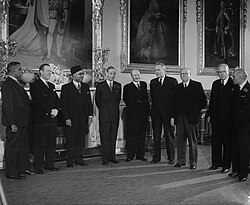
Legislative Evolution
The Constituent Assembly was tasked with drafting the nation's first constitution. This process took nearly a decade, during which the country was governed by provisional arrangements. The era of the dominion officially ended on March 23, 1956, when the assembly adopted a constitution that transformed Pakistan into an Islamic Republic.
Foreign Relations and Global Standing
Pakistan's early foreign policy was characterized by a desire to lead the Muslim world and secure diplomatic recognition. The Imperial State of Iran was the first country to recognize Pakistan in 1947. However, the Soviet Union, under Joseph Stalin, was initially cool toward the partition.
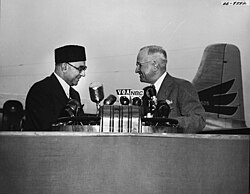
Pakistan vigorously championed the cause of self-determination for Muslims globally at the United Nations, supporting anti-colonial movements in Indonesia, Algeria, Tunisia, Morocco, and Eritrea. Some leaders even envisioned a pan-Islamic entity known as "Islamistan," though this idea met with little enthusiasm from Arab states, who were experiencing their own nationalist awakenings.
Economy and Demographics
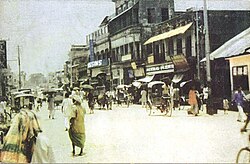
The early economy was predominantly agrarian. A 1955 study following the collapse of the first five-year plan revealed that over 90% of the population lived in rural areas. Urbanization was significantly lower in East Pakistan (4.0%) compared to West Pakistan (18.1%).
The 1951 census recorded a population of 75.64 million, making Pakistan the 7th most populated nation in the world at the time. The population was distributed between East Pakistan (55.6%) and West Pakistan (44.4%). Approximately 9.8% of the population were Muhajirs (migrants who moved to Pakistan during partition).
Language and Literacy
The linguistic landscape was diverse, with Bengali being the most spoken language (54.4%), followed by Greater Punjabi (27.6%), Pashto (6.61%), Sindhi (5.27%), and Urdu (3.25%). Despite this diversity, the literacy rate remained low at 13.2% during the early 1950s.
| Category | Details |
|---|---|
| Government Type | Federal Constitutional Monarchy |
| Sovereigns | George VI (1947–1952), Elizabeth II (1952–1956) |
| Official Language | English |
| National Languages | Urdu, Bengali |
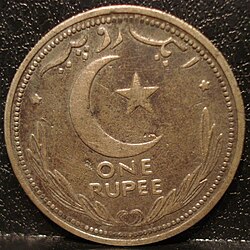
| Currency | Indian Rupee (1947–48), Pakistani Rupee (1948–56) |
| Population (1951) | 75.64 Million |
Frequently Asked Questions
When did Pakistan stop being a dominion?
Pakistan ceased to be a dominion on March 23, 1956, when the Constituent Assembly adopted a new constitution and established the country as a republic.
Who was the first head of state of the Dominion of Pakistan?
The sovereign was King George VI, while the first Governor-General, who acted as the head of state's representative, was Muhammad Ali Jinnah.
What was the population distribution between East and West Pakistan in 1951?
According to the 1951 census, 55.6% of the population lived in East Pakistan and 44.4% lived in West Pakistan.
What were the primary languages spoken during this period?
The most spoken languages were Bengali (54.4%) and Greater Punjabi (27.6%), while Urdu and English served as official and national languages.
How did Pakistan's currency change in its early years?
Pakistan initially used the Indian rupee from 1947 to 1948 before introducing the Pakistani rupee in 1948.