Painted Berrypeckers: The Colorful Avian Specialists of New Guinea
Deep within the mist-shrouded mountain forests of New Guinea live the painted berrypeckers (family Paramythiidae). These vibrant, medium-sized birds are a biological rarity, representing one of only two bird families entirely restricted to the island of New Guinea. Once grouped with flowerpeckers (Dicaeidae), modern DNA–DNA hybridization studies have revealed that they are a distinct lineage, though some classifications still associate them with the berrypecker family Melanocharitidae.
The family is composed of three species divided into two genera: the tit berrypecker (Oreocharis arfaki) and two species of crested berrypeckers, the eastern (Paramythia montium) and western (Paramythia olivacea). These birds are characterized by their soft, downy plumage and a diet primarily consisting of forest fruits.
Key Facts
- Endemism: Found exclusively in the montane forests of New Guinea.
- Diet: Primarily frugivorous (fruit-eating), though some consume insects and flowers.
- Physical Traits: Bright green backs, blue-grey tails, and strong black bills.
- Altitude Influence: Crested berrypeckers exhibit Rapoport's rule, where birds at higher altitudes are larger.
- Conservation Status: None of the species are currently listed as threatened on the IUCN Red List.
Physical Characteristics and Appearance
Painted berrypeckers are passerine birds that vary in size between the two genera. The tit berrypecker is the smallest, measuring 12–14 cm in length and weighing between 17–21 g. In contrast, the crested berrypeckers are larger, ranging from 19–22 cm and weighing 36–61 g. Both genera share plump bodies, short necks, and moderately long, broad rounded wings.
Their plumage is strikingly colorful, featuring green backs and wings with blue-grey tails. The tit berrypecker displays sexual dimorphism—a condition where males and females look different—with males sporting bright yellow patches on the chest, face, and wings, while females remain duller. The crested berrypeckers are more uniform between sexes but possess a distinctive erectile crest. Interestingly, both genera have unique filoplumes (hairlike feathers) on their flanks, though their biological purpose remains unknown.
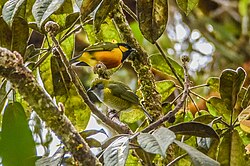
Comparison of Genera
While they share a general color palette, the two genera differ significantly in tail shape. The tit berrypecker has a short, square tail, whereas the crested berrypecker possesses a longer tail. Both utilize a strong, black bill suited for their specific diet.
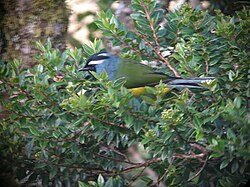
Distribution and Habitat
These birds are strictly arboreal, meaning they spend the majority of their lives in trees. They are primarily found in montane forests, specifically mossy forests. While the crested berrypecker typically stays above 2,200 meters—sometimes inhabiting alpine thickets and stunted alpine forests—the tit berrypecker is found at generally lower elevations, occasionally descending to 850 meters.
While it is not confirmed if these species migrate, evidence suggests that the tit berrypecker may be partly nomadic, moving across the landscape in search of resources.
Behavior and Ecology
Painted berrypeckers are active, diurnal (day-active) birds. They are social creatures, often found in pairs or small groups. Tit berrypeckers can gather in groups of up to 30, while crested berrypeckers typically form groups of up to 10. They are frequently seen in mixed-species feeding flocks, associating with honeyeaters, fantails, the blue-capped ifrit, and birds of paradise.
Dietary Habits
The diet of these birds is almost entirely frugivorous. Small berries and fruits are the primary food source. However, the tit berrypecker has been known to eat small flowers, and the crested berrypecker occasionally consumes insects. Insects are particularly important for the growth of nestlings in both genera.
Breeding and Life Cycle
Both genera are monogamous and seasonal breeders. The tit berrypecker nests during the transition from the dry season to the early wet season. The crested berrypecker breeds between August and February. Both build open-cup nests made from moss. In the case of the crested berrypecker, the female handles incubation for over 12 days, after which both parents share the responsibility of feeding the chicks and removing faecal sacs.
Summary of Painted Berrypecker Species
| Feature | Tit Berrypecker (Oreocharis) | Crested Berrypecker (Paramythia) |
|---|---|---|
| Length | 12–14 cm | 19–22 cm |
| Weight | 17–21 g | 36–61 g |
| Tail Shape | Short and square | Longish |
| Distinctive Feature | Sexual dimorphism (yellow patches) | Erectile crest |
| Typical Altitude | Lower montane (down to 850m) | Higher montane (usually above 2200m) |
Relationship with Humans
Interaction between humans and painted berrypeckers is minimal. While they are occasionally hunted for food by local tribes, they are not targeted for their feathers, unlike the famous birds of paradise. Today, their primary interaction with humans is through ecotourism, as they are sought after by birdwatchers.
Currently, the species are not considered threatened. Although some montane habitats have been cleared for agriculture, large portions of their native forest remain intact, ensuring stable populations within their ranges.
Frequently Asked Questions
Where can painted berrypeckers be found?
They are endemic to the island of New Guinea, specifically inhabiting the montane and mossy forests of the highlands.
What do painted berrypeckers eat?
They are primarily frugivorous, eating small fruits and berries. Some species also consume small flowers or insects, the latter of which are essential for feeding their young.
How do the tit berrypecker and crested berrypecker differ in appearance?
The tit berrypecker is smaller with a square tail and exhibits sexual dimorphism (males have yellow patches). The crested berrypecker is larger, has a longer tail, and possesses a distinctive erectile crest.
Why are some crested berrypeckers larger than others?
This is an example of Rapoport's rule, where individuals of a species living at higher altitudes tend to be larger than those living at lower altitudes.
Are painted berrypeckers endangered?
No, none of the species are currently listed as threatened on the IUCN Red List, as they remain common within their natural habitats.