Pitohuis: The Toxic Birds of New Guinea
Deep within the forests of New Guinea live the pitohuis, a group of brightly colored, omnivorous birds that possess a startling biological secret. While most birds are harmless to the touch, certain species of pitohui carry powerful toxins in their skin and feathers, making them some of the few known poisonous birds in the world.
The name "pitohui" is onomatopoeic, believed to be derived from the sounds used by the people of Dorey (Manokwari). While the genus Pitohui was established by French naturalist René Lesson in 1831, the common name now refers to a broader group of perching birds spanning several genera and families.
Key Facts
- Endemic Location: Found exclusively in New Guinea.
- Chemical Defense: Some species contain batrachotoxins, powerful neurotoxic alkaloids.
- Toxin Source: Toxins are likely acquired from eating beetles of the genus Choresine.
- Visual Warning: Bright plumage serves as aposematism to warn predators.
- Diet: They are omnivorous birds.
Taxonomy and Systematics
The classification of pitohuis has evolved significantly. Originally, all species were grouped under the genus Pitohui within the family Pachycephalidae. However, a 2013 taxonomic revision separated them into three distinct families based on their biological characteristics.
Oreoicidae
This family includes the Crested pitohui (Ornorectes cristatus).
Pachycephalidae
This family contains the Black pitohui (Melanorectes nigrescens), as well as the White-bellied (Pseudorectes incertus) and Rusty (Pseudorectes ferrugineus) pitohuis.
Oriolidae
The most diverse group in this context, including the Northern variable (Pitohui kirhocephalus), Raja Ampat (Pitohui cerviniventris), Southern variable (Pitohui uropygialis), and Hooded pitohui (Pitohui dichrous).
| Family | Genus | Species |
|---|---|---|
| Oreoicidae | Ornorectes | Crested pitohui |
| Pachycephalidae | Melanorectes | Black pitohui |
| Pachycephalidae | Pseudorectes | White-bellied and Rusty pitohuis |
| Oriolidae | Pitohui | Hooded, Northern variable, Southern variable, and Raja Ampat pitohuis |
Physical Description
Pitohuis are known for their striking appearances. The Hooded pitohui is particularly distinctive, featuring a jet-black head contrasted by a brick-red belly.
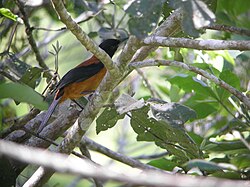
The Variable pitohui is more diverse in appearance; scientists have identified 20 different subspecies with varying plumage patterns. Interestingly, two of these subspecies closely resemble the Hooded pitohui.
Behavior and Ecology
The most remarkable feature of the Hooded and Variable pitohuis is the presence of batrachotoxins in their skin and feathers. These are neurotoxic alkaloids—the same type of toxin found in Colombian poison dart frogs (genus Phyllobates). These chemicals act as a defense mechanism against ectoparasites and predators such as raptors, snakes, and humans.
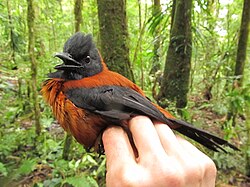
Research suggests that the birds do not produce these toxins internally. Instead, they likely accumulate them through their diet by consuming beetles from the genus Choresine.
The bright colors of these birds are an example of aposematism, which is the use of warning coloration to signal toxicity to potential predators. Furthermore, the visual similarity between the Hooded pitohui and certain forms of the Variable pitohui is believed to be Müllerian mimicry. In this biological phenomenon, two dangerous species evolve to look alike, ensuring that once a predator learns to avoid one, it will avoid both.
Relationship with Humans
Local populations in Papua New Guinea are well aware of the birds' toxicity, leading them to refer to pitohuis as "rubbish birds." Consequently, they are generally not eaten. However, in times of extreme necessity, they can be consumed if the skin and feathers are removed and the flesh is coated in charcoal before being roasted.
Frequently Asked Questions
Are pitohuis naturally poisonous?
While they carry toxins, they likely do not produce them. The batrachotoxins found in their skin and feathers are believed to come from the Choresine beetles they eat.
What happens if a human touches a pitohui?
Scientists who have handled hooded pitohuis have reported experiencing a numbing sensation upon contact.
Why do some pitohui species look so similar?
This is likely due to Müllerian mimicry, where different toxic species share similar warning colors so that predators more quickly learn to avoid all of them.
Can pitohuis be eaten?
They are generally avoided and called "rubbish birds" by locals. They can only be safely consumed if the toxic skin and feathers are removed and the meat is treated with charcoal and roasted.
Which family do most pitohuis belong to?
They are now split across three families: Oreoicidae, Pachycephalidae, and Oriolidae, depending on the specific species.