Oysters: Nature's Water Purifiers and Culinary Delicacies
Oysters are remarkable marine bivalves—mollusks with a hinged shell—that have existed for millions of years, with a temporal range spanning from 252 to 0 million years ago. Beyond their reputation as a luxury food item, these organisms serve as critical ecosystem engineers, shaping the environments they inhabit and providing essential services to the planet's oceans and estuaries.
From the depths of the Pacific to the shores of the Chesapeake Bay, oysters play a pivotal role in maintaining water clarity and supporting biodiversity. Their ability to transform water chemistry makes them indispensable for coastal health.
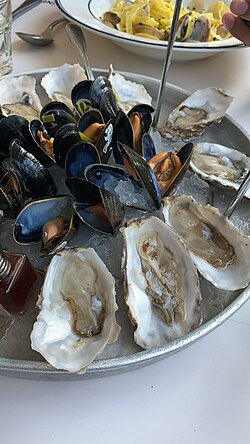
Key Facts

- Filter Capacity: A single oyster can filter up to 190 liters (50 US gallons) of water per day under ideal conditions.
- Nutrient Removal: They remove nitrates, ammonia, phosphates, and organic matter from the water column.
- Nutritional Powerhouse: Oysters are rich in zinc, iron, calcium, selenium, vitamin A, and vitamin B12.
- Ecological Role: Oyster reefs improve water quality and provide habitats for other marine species.
- Diverse Types: While "true oysters" (Ostreidae) are most common, the group includes pearl, saddle, and windowpane oysters.
Classification and Types
Oysters belong to the phylum Mollusca and the class Bivalvia. While many people use the term "oyster" generically, it encompasses several distinct groups:
- True Oysters (Ostreidae): The most common edible varieties.
- Pearl Oysters (Pteriidae): Known for their ability to produce pearls.
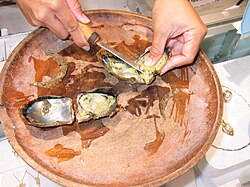
Removing a pearl from a pearl oyster - Saddle Oysters (Anomiidae): Also known as jingle shells.
- Other Varieties: Including foam oysters (Gryphaeidae), hammer oysters (Malleidae), spiny oysters (Spondylidae), and windowpane oysters (Placunidae).
Anatomy and Feeding Mechanisms
Oysters are filter feeders, meaning they extract food particles from the surrounding water. They achieve this by using cilia—tiny hair-like structures—to beat water over their gills. This process traps suspended plankton and organic particles in mucus, which are then transported to the mouth for digestion.
Feeding activity is highly temperature-dependent, peaking when water temperatures range from 20 to 26°C (high 60s to high 70s Fahrenheit). Particles that are not consumed are expelled as feces or pseudofeces, which settle on the ocean floor, effectively removing nutrients from the water column.
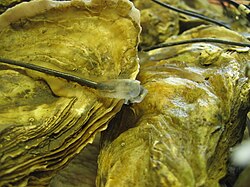
Environmental Impact and Nutrient Cycling
The ecological value of oysters lies in their ability to perform nutrient remediation. By consuming nitrogen-containing compounds, phosphates, and bacteria, they prevent the over-enrichment of water, which can otherwise lead to harmful algal blooms.
In the Chesapeake Bay, historical oyster populations were so vast that they could filter the entire estuary's water volume every three to four days. By 2008, however, population declines meant a complete cycle took nearly a year. To combat this, programs in Maryland have utilized oysters to reduce nitrogen entering the bay by an estimated 8,600 tonnes per year.
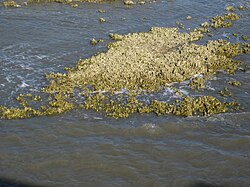
The Power of Aquaculture
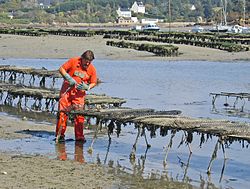
Aquaculture—the farming of aquatic organisms—is being explored as a tool for environmental recovery. In Delaware, it is estimated that one acre of oyster farming can produce nearly 750,000 oysters, capable of filtering between 57,000 to 150,000 cubic meters of water daily.
Restoration and Recovery Efforts
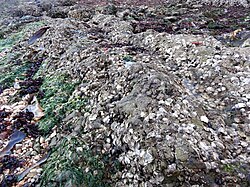
Restoring native oyster populations is a complex process. In the Great Wicomico River, artificial reefs have successfully harbored over 180 million native Crassostrea virginica. Success in these projects often depends on three key factors:
- Elevating the Reef: Using waste shells to raise the reef floor by 25–45 cm to keep spat (juvenile oysters) free from sediment.

Collected Oyster Shells at Galveston Bay for restoration project by the Galveston Bay Foundation's Oyster Shell Recycling Program - Scale: Building larger reefs, some reaching up to 8.1 hectares (20 acres).
- Genetics: Utilizing disease-resistant broodstock.
Human History and Culinary Use
Oysters have been a human food source for millennia. Archaeological evidence, such as the Whaleback Shell Midden in Maine, shows oysters were harvested for food between 1,000 and 2,200 years ago.

Culinary Preparation and Nutrition
Oysters are prepared in diverse ways globally, from raw "Fine de Claire" in Madrid to oyster omelettes in Southeast Asia and deep-fried Kaki Furai in Japan.
![Dishes with Oysters, Fruit, and Wine, a 1620s painting by Osias Beert[34]](/images/8b/48/8b486054a1747498afd386771edee87c465f165f392fe49c28a25a7296a77828.jpg)
Nutritionally, they are highly efficient. A dozen raw oysters provide only 110 kilocalories but are rich in protein (approx. 9g per 100g of Pacific oysters). Just two oysters (28 grams) can provide the Reference Daily Intake for both zinc and vitamin B12.
Handling and Safety
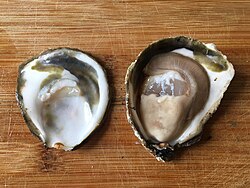
Opening live oysters requires specialized tools, typically short, stout knives designed for shucking.

| Feature | Detail/Value |
|---|---|
| Max Daily Filtration (Ideal) | 190 Liters (50 US gal) |
| Average Daily Filtration | 11–45 Liters (3–12 US gal) |
| Key Nutrients Provided | Zinc, Iron, Calcium, Selenium, Vit A, Vit B12 |
| Energy (per dozen raw) | 460 kJ (110 kcal) |
| Primary Feeding Method | Cilia-driven filter feeding |
Frequently Asked Questions
How do oysters clean the water?
Oysters use cilia on their gills to pump water through their bodies, trapping plankton, bacteria, and nitrogen-containing compounds. They digest the nutrients and expel the rest as solid waste, which removes pollutants from the water column.
What is the difference between a true oyster and a pearl oyster?
True oysters belong to the family Ostreidae and are primarily valued for food. Pearl oysters belong to the family Pteriidae and are specialized for the production of pearls.
What is "spat" in oyster farming?
Spat are juvenile oysters that have attached themselves to a substrate (like a shell or a reef) and begun to grow into adults.
Are oysters healthy to eat?
Yes, they are an excellent source of protein and essential minerals like zinc and vitamin B12, though they are low in overall calories.
What is depuration?
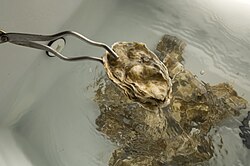
Depuration is the process of placing harvested oysters in tanks of clean, circulating seawater to allow them to filter out impurities and bacteria before they are sold for human consumption.