Osteospermum: The Vibrant Beauty of African Daisies
Known for their striking colors and resilience, Osteospermum—commonly referred to as African daisies, Cape daisies, or blue-eyed daisies—are a highlight of many summer gardens. These flowering plants belong to the Asteraceae family, the same family as sunflowers and common daisies, specifically within the smaller tribe known as Calenduleae.
Whether grown as hardy shrubs or colorful annuals, these plants bring a Mediterranean flair to landscapes with their unique "spooned" petals and vivid centers. From their origins in Africa to their presence in modern horticulture, Osteospermum offers a blend of botanical interest and ease of care.
Key Facts
- Common Names: African daisy, South African daisy, Cape daisy, and blue-eyed daisy.
- Origin: Native to the Arabian peninsula and southern and eastern Africa.
- Flower Structure: Composite flowers featuring both disc florets and ray florets.
- Hardiness: Many common cultivars are hardy down to -2°C (30°F).
- Key Care: Prefers full sun and rich soil, though it is highly tolerant of drought and salt.
Botanical Classification and Taxonomy
The genus Osteospermum was first named by Carl Linnaeus in 1753. The name is derived from the Ancient Greek words ostéon (meaning "bone") and spérma (meaning "seed"). While there are 74 accepted species, the taxonomy of these plants has evolved over time.
In the world of horticulture, some plants previously sold as Osteospermum have been scientifically reclassified into the genus Dimorphotheca. Notable examples include Dimorphotheca ecklonis (the blue-and-white daisybush) and Dimorphotheca fruticosa (the trailing African daisy). Despite these scientific shifts, many gardeners and nurseries continue to use the name Osteospermum as a general term for these closely related species.
Physical Characteristics
Osteospermum plants are characterized by their lanceolate leaves—meaning they are shaped like a lance head—which are typically green and alternate along the stem, though some variegated forms exist. While most leaves have entire (smooth) margins, hardier types may be toothed.
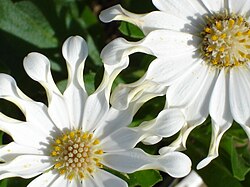
The most striking feature is the composite flower, a structure made up of many smaller flowers. This consists of:
- Disc florets: The center of the flower, which are pseudo-bisexual and appear in colors like purple, yellow, or blue. In hardy types, the center often remains dark blue until yellow pollen is released.
- Ray florets: The outer "petals," which are female and come in a wide array of colors, including white, cream, pink, mauve, purple, and yellow.
Some specific cultivars, such as 'Pink Whirls', feature "spooned" petals, adding a unique architectural element to the bloom. While hardy types flower profusely in the spring, many other species experience a second flush of blooms in late summer, triggered by cooler night temperatures.
Cultivation and Care
Osteospermum is highly valued in summer bedding schemes because it is adaptable. These plants thrive in warm, sunny positions and prefer rich soil, but they are remarkably resilient, tolerating poor soil, salt, and drought conditions.
For those growing African daisies in containers, moisture management is critical. If the soil dries out completely, the plant may enter a "sleep mode" to survive the drought. While this is a survival mechanism, it causes the plant to abort its flower buds, and it may struggle to bloom again. Conversely, gardeners should avoid overwatering immediately after a dry period, as the roots are susceptible to rotting.
Modern cultivars are often bred to flower continuously when provided with adequate water and fertilizer. Because these hybrids do not set seed easily, the traditional practice of dead-heading (removing spent flowers) is generally unnecessary.
Popular Cultivars and Varieties
Most commercially available Osteospermum are hybrids of O. jucundum, O. ecklonis, and O. grandiflorum. While often grown as annuals, they can be perennials or shrubs in climates where temperatures do not drop significantly below -2°C (30°F).
Several varieties have earned the Royal Horticultural Society's (RHS) Award of Garden Merit (agm) for their exceptional quality, including 'Blackthorn Seedling', 'Buttermilk', 'Hopleys', 'Lady Leitrim', and 'White Pim'. Other visually stunning varieties include 'Pink Whirls', 'Silver Sparkler', and 'White Spoon'.
Osteospermum Summary Table
| Feature | Details |
|---|---|
| Scientific Family | Asteraceae (Tribe Calenduleae) |
| Native Range | Southern/Eastern Africa and Arabian Peninsula |
| Light Requirement | Full Sun |
| Soil Preference | Rich soil (tolerates poor, salty, or dry soil) |
| Temperature Limit | Hardy to approximately -2°C (30°F) for many cultivars |
| Flower Types | Composite (Disc and Ray florets) |
Frequently Asked Questions
Why did my Osteospermum stop blooming?
If grown in containers, the plant may have entered "sleep mode" due to the soil drying out completely. This causes the plant to abort its flower buds to conserve energy and survive the drought.
Do I need to dead-head African daisies?
For most modern cultivars, dead-heading is not necessary because they do not set seed easily and are bred to flower continuously with proper water and fertilizer.
What is the difference between Osteospermum and Dimorphotheca?
While they are sister taxa and look very similar, some species previously classified as Osteospermum have been moved to the genus Dimorphotheca based on scientific reclassification.
Can Osteospermum be grown as a perennial?
Yes, if the plant is a hardy variety and the local climate stays above -2°C (30°F), they can be grown as perennials or shrubs rather than annuals.
What are "spooned" petals?
Spooned petals are a specific morphological trait found in certain cultivars, such as 'Pink Whirls', where the ray florets have a curved, spoon-like shape.