Osteichthyes: The Evolution and Diversity of Bony Fish
Osteichthyes (from the Ancient Greek ostéon meaning 'bone' and ikhthús meaning 'fish') is a vast and diverse clade of vertebrate animals characterized by endoskeletons primarily composed of bone tissue. While commonly referred to as bony fish, this group encompasses far more than just aquatic species; in a cladistic sense, it includes all tetrapods—the four-limbed vertebrates such as reptiles, birds, and mammals.
The group is immense in its diversity, consisting of 45 orders, over 435 families, and approximately 28,000 species. They are distinguished from cartilaginous fish (Chondrichthyes), such as sharks and rays, and extinct groups like placoderms and acanthodians, whose skeletons are primarily made of cartilage.
The earliest known bony fish fossils date back approximately 436 million years to the Early Silurian period. These transitional fossils reveal a tooth pattern intermediate between that of sharks and true bony fish. Interestingly, these basal species had not yet fully evolved ossification (the process of bone formation) and remained mostly cartilaginous. Their primary distinguishing feature was the development of foregut pouches, which eventually evolved into lungs and swim bladders.
![Guiyu oneiros, one of the earliest known bony fish, lived during the Late Silurian, 425 million years ago.[9]](/images/af/07/af07f986b2e95798f0323ebfa5a33be84e673db3381034ccc08f768e400c7993.jpg)
Key Facts
- Temporal Range: Early Silurian to the present (436 million years ago to 0 Ma).
- Composition: Endoskeletons made primarily of bone tissue.
- Major Groups: Divided into Actinopterygii (ray-finned fish) and Sarcopterygii (lobe-finned fish).
- Scope: Includes nearly 99% of all extant fish species and all land-dwelling vertebrates (tetrapods).
- Diversity: Spans from the tiny 8 mm Paedocypris to the massive giant sunfish.
Classification and Phylogeny
In modern science, Osteichthyes is broadly equivalent to the clade Euteleostomi. While ichthyologists previously viewed Osteichthyes as a paraphyletic group (excluding land animals), research since 2013 has widely adopted a phylogenetic tree that treats Osteichthyes as a monophyletic clade that includes tetrapods. This means that humans and other land vertebrates are essentially modified bony fish.
Ray-Finned Fish (Actinopterygii)
Actinopterygii represents the vast majority of living fish. They are named for their lepidotrichia, or fin rays—webs of skin supported by bony or horny spines. These rays attach to radials, which connect the fins to the internal skeleton. They inhabit nearly every aquatic environment on Earth, from the deepest oceans to high-altitude mountain streams.
Lobe-Finned Fish (Sarcopterygii)
Unlike the ray-finned variety, Sarcopterygii possess fleshy, lobed fins. This clade is of particular evolutionary importance as it gave rise to all terrestrial vertebrates.
Biological Characteristics
Respiration and Thermoregulation
While most bony fish rely on gills for respiration, some species, such as lungfish, can breathe using lungs or vascularized swim bladders. Others can absorb oxygen through their skin, stomach, or intestines.
Most Osteichthyes are ectothermic (cold-blooded), meaning their body temperature fluctuates with the surrounding water. However, some large marine species, including tuna, swordfish, and the opah, have independently evolved levels of endothermy (warm-bloodedness) to maintain higher internal temperatures.
Scale Types
Bony fish do not possess the placoid scales found in sharks. Instead, their scales lie beneath the epidermis. There are three primary categories:
- Teleost scales: The simplest form, consisting of a single layer of bone; these are further divided into cycloid and ctenoid scales.
- Ganoid scales: Composed of lamellar bone, vascular bone, and an outer layer of enamel.
- Cosmoid scales: Similar to ganoid scales but featuring a layer of dentin between the enamel and vascular bone.
Size and Extremes
The size variation within Osteichthyes is staggering. At one extreme, species like Paedocypris progenetica and the stout infantfish measure less than 8 millimeters. At the other, the giant sunfish holds the record for the heaviest bony fish; a specimen found in the Azores weighed 2,744 kilograms.
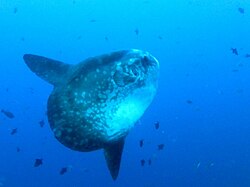
Other giants include the king of herrings (a type of oarfish), which is the longest, and the Atlantic blue marlin, which can exceed 820 kilograms. Historically, the largest bony fish to ever exist was Leedsichthys, which far surpassed any living species in size.
Comparison: Bony Fish vs. Cartilaginous Fish
The differences between Osteichthyes and Chondrichthyes (sharks and rays) extend beyond the skeleton to almost every biological system.
| Characteristic | Cartilaginous Fish (Sharks) | Bony Fish (Osteichthyes) |
|---|---|---|
| Endoskeleton | Cartilaginous | Mostly bony |
| Exoskeleton | Placoid scales | Cosmoid, ganoid, cycloid, or ctenoid scales |
| Swim Bladder | Absent | Usually present |
| Fertilization | Internal | Usually external |
| Gill Openings | 5 pairs of slits (no operculum) | Protected by an operculum |
| Habitat | Mainly marine | Marine, freshwater, and land (tetrapods) |
Frequently Asked Questions
Are humans considered bony fish?
In a cladistic sense, yes. Because tetrapods evolved from the lobe-finned fish (Sarcopterygii), they are members of the clade Osteichthyes. Modern phylogenetic trees treat the term as synonymous with Euteleostomi, which includes all land vertebrates.
What is the difference between ray-finned and lobe-finned fish?
Ray-finned fish (Actinopterygii) have fins supported by bony spines or rays. Lobe-finned fish (Sarcopterygii) have fleshy, lobed fins that are supported by a central skeletal structure, which eventually allowed for the evolution of limbs in land animals.
Do all bony fish have swim bladders?
Most do, but not all. The swim bladder (or lung) evolved from foregut pouches. While common in many species for buoyancy, some fish lack them or have evolved them into functional lungs for air-breathing.
Can bony fish be warm-blooded?
While most are ectothermic, some species like the opah, tuna, and swordfish have evolved regional or whole-body endothermy, allowing them to maintain body temperatures higher than the surrounding water.
What is the smallest bony fish?
Species such as Paedocypris progenetica and the stout infantfish are among the smallest, measuring less than 8 millimeters in length.