Osmia lignaria: The Essential Blue Orchard Bee for Spring Pollination
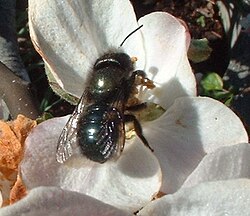
When the first blossoms of spring appear in orchards across North America, a tiny but mighty worker is often responsible for the success of the fruit crop. Osmia lignaria, commonly known as the blue orchard bee or orchard mason bee, is a specialized pollinator that plays a critical role in agricultural ecosystems. Unlike honey bees, these solitary bees are highly efficient at visiting the specific flowers required for early spring fruit production.
As a member of the Megachilidae family, the orchard mason bee is a solitary insect. This means they do not live in large colonies; instead, individual females work to build their own nests, creating separate cells for their offspring. While they are highly effective pollinators, they are also unique in their nesting requirements and biological cycles.
Key Facts
- Common Names: Blue orchard bee, orchard mason bee.
- Primary Role: Highly efficient pollinator for early spring fruit blooms.
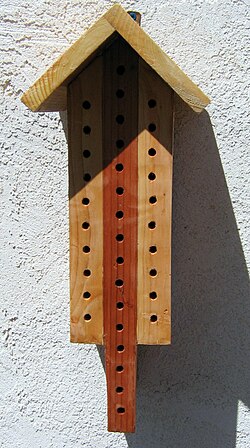
- Nesting Habit: Uses natural holes, reeds, or man-made tubes, sealing cells with mud.
- Temperament: Very docile and shy; rarely stings unless in extreme danger.
- Native Range: North America, divided into eastern and western subspecies by the Rocky Mountains.
Scientific Classification and Origins
The orchard mason bee belongs to the order Hymenoptera and the genus Osmia. In North America, the species is split into two distinct subspecies: O. l. propinqua (the western subspecies) and O. l. lignaria (the eastern subspecies). Most scientific research has focused on the western subspecies due to its prevalence in western orchards.
It is important to note that these bees are sensitive to their native environments. For example, in studies conducted in Virginia and North Carolina, the eastern subspecies showed a preference for native redbud trees over certain orchard fruits. Furthermore, they cannot overwinter in the Florida or Gulf Coast regions because they require specific cold winter temperatures to complete their development cycle.
The Lifecycle of the Orchard Mason Bee
The life of an O. lignaria is a race against the seasons, driven by temperature and the availability of floral resources.
Spring: Emergence and Nesting
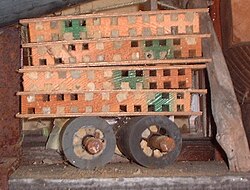
The cycle begins in spring when daytime temperatures reach approximately 14 °C (57 °F). Males emerge first, waiting near nesting sites for females. Once females emerge and mate, they begin the intensive process of nest building. Because they cannot drill into wood like carpenter bees, they rely on narrow holes, reeds, or specialized "bee condos" provided by beekeepers.
A female mason bee is a tireless worker. To create a single pollen provision, she may make 25 separate trips to nearby flowers, visiting up to 75 blossoms per trip. She uses mud—specifically silty or clayey mud with the correct moisture content—to create partitions between her eggs. She lays one egg per partition, typically placing males toward the front of the nest and larger females toward the back.
Summer and Winter: Development and Diapause
By early summer, the larvae have consumed their pollen provisions and spun cocoons to enter the pupal stage. As the adult mother dies off, the young bees remain in their cells. They undergo diapause—a period of suspended development—throughout the winter. During this time, they survive by burning through stored fat reserves. They are vulnerable to extreme weather; if it stays too cold for too long, they may starve, but if it warms too quickly, they may emerge before food is available.
Morphology and Behavior
Orchard mason bees are relatively small, with a dry weight of approximately 33.5 mg. Despite their importance to agriculture, they are not aggressive. Their stinger is actually an egg guide, and they are considered very docile, making them ideal for pollination in urban gardens and residential settings.
Natural Challenges: Parasites and Pests
The nesting cavities of O. lignaria are often shared with other organisms. Several species of kleptoparasites (parasites that steal food) inhabit their nests, including:
- Pollen mites: Such as Chaetodactylus krombeini, which can starve larvae by consuming their pollen.
- Cuckoo bees and wasps: Including Stelis montana and various Sapyga species.
- Parasitic wasps: Such as Monodontomerus species, which lay eggs inside the bee larvae.
- Six-spotted spider beetles: Ptinus sexpunctatus, which feed on decaying insects within the nest.
Summary of Osmia lignaria Characteristics
| Feature | Details |
|---|---|
| Emergence Temp | 14 °C (57 °F) |
| Nesting Material | Mud (silty/clayey) and reeds/tubes |
| Lifespan (Adult) | 4 to 8 weeks |
| Pollination Capacity | Up to 60,000 blossom visits per female |
| Subspecies | O. l. propinqua (West) and O. l. lignaria (East) |
Frequently Asked Questions
Do orchard mason bees sting humans?
They are very shy and docile. They do not attack to defend themselves and typically only sting if they perceive a serious, direct danger.
How do they build their nests?
They use mud to create partitions within narrow holes or tubes. Each partition contains one egg and a provision of pollen and nectar.
Why are they used in orchards?
A single female can visit nearly 60,000 blossoms in her lifetime, making them incredibly efficient at pollinating fruit trees during their early spring bloom.
Can they live in warm climates like Florida?
No, they generally do not overwinter in the Florida or Gulf Coast regions because they require a period of cold temperatures to complete their natural development cycle.
What is the difference between a mason bee and a carpenter bee?
Unlike carpenter bees, mason bees cannot drill holes into wood. They require pre-existing holes or artificial nesting materials like reeds and tubes.