Oscar Peterson: The Virtuoso Maharaja of the Keyboard
Oscar Emmanuel Peterson was more than just a musician; he was a force of nature on the piano. Widely regarded as one of the greatest jazz pianists of all time, the Canadian-born virtuoso blended technical brilliance with a deep, melodic inventiveness that redefined the boundaries of jazz improvisation—the art of creating music spontaneously during a performance. Over a career spanning more than 60 years, Peterson released over 200 recordings and earned the admiration of peers like Duke Ellington, who dubbed him the "Maharaja of the keyboard."
Key Facts
- Total Grammy Awards: 8, including a Lifetime Achievement Award.
- Career Span: Active from 1945 to 2007.
- Nickname: Known as "the King of inside swing" and "O.P."
- Nationality: Canadian (born in Montreal, Quebec).
- Musical Range: Specialized in jazz and classical music.
Early Life and the Path to Mastery
Born on August 15, 1925, in Montreal, Peterson displayed an extraordinary level of control over the piano by the age of nine. His ascent to mastery was fueled by a rigorous work ethic; for many years, he practiced between four and six hours every day. This dedication paid off in 1940 when, at just fourteen years old, he won a national music competition hosted by the Canadian Broadcasting Corporation.
Following this victory, Peterson left the High School of Montreal to pursue music professionally. He played in a band with Maynard Ferguson and later joined the Johnny Holmes Orchestra. During his early professional years, he developed a fondness for swing and boogie-woogie, drawing significant influence from artists like Teddy Wilson and Nat King Cole.
The Rise to International Fame
Peterson's global trajectory changed when he met Norman Granz. After hearing Peterson on a radio broadcast, Granz was so impressed that he sought out the pianist immediately. In 1949, Granz introduced Peterson to the New York City scene at a Jazz at the Philharmonic concert at Carnegie Hall. Granz became Peterson's manager and a steadfast ally, famously defending Peterson and other Black musicians against the racial segregation of the American South during the 1950s and 1960s.
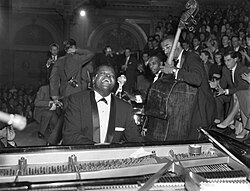
The Evolution of the Oscar Peterson Trio
In 1950, Peterson began a duo with double bassist Ray Brown, which soon expanded into the Oscar Peterson Trio. The group saw various iterations, most notably featuring guitarist Herb Ellis from 1953 to 1958. When Ellis left, the trio transitioned to a piano-bass-drums format with the addition of drummer Ed Thigpen, resulting in acclaimed albums such as Night Train (1963) and Canadiana Suite (1965).
In the 1970s, Peterson formed another legendary trio with guitarist Joe Pass and bassist Niels-Henning Ørsted Pedersen. This ensemble achieved immense critical success, winning the 1974 Grammy for Best Jazz Performance by a Group. Peterson also expanded this group into a quartet by adding British drummer Martin Drew.
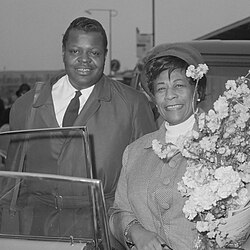
Collaborations and Experimental Works
While known for his trios, Peterson was an eclectic collaborator. He worked with jazz giants such as saxophonist Ben Webster, trumpeter Clark Terry, and vibraphonist Milt Jackson. In the 1980s, he performed in a duo with Herbie Hancock, and in his later years, he mentored and recorded with his protégé, Benny Green.
Musical Style and Artistic Influence
Peterson's style was a sophisticated blend of various genres. He was heavily influenced by Art Tatum, whom he considered his "musical God," and the classical compositions of Sergei Rachmaninoff. The harmonizations and direct quotations from Rachmaninoff's 2nd Piano Concerto are frequently heard throughout Peterson's discography.
Throughout the 1960s and 1970s, his recordings showcased a versatility that absorbed elements of popular music and classical structures, all while maintaining the driving energy of swing.

Later Years and Lasting Legacy
Despite his success, Peterson faced significant health challenges. He suffered from arthritis since his youth and underwent hip replacement surgery in the early 1990s. Despite limited mobility, he remained dedicated to music education, serving as the Chancellor of York University and publishing jazz piano etudes for students.
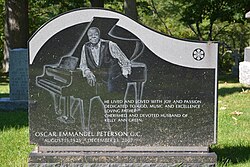
Peterson continued to tour the U.S. and Europe sparingly until his health declined in 2007. He passed away on December 23, 2007, due to kidney failure in Mississauga, Ontario.
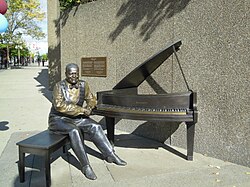
His legacy is cemented through numerous honors, including the Order of Canada and the Glenn Gould Prize. From the Oscar Peterson Concert Hall at Concordia University to a statue unveiled by Queen Elizabeth II in Ottawa, his impact on Canadian and global culture remains profound.
| Category | Details |
|---|---|
| Primary Instruments | Piano, Synthesizer, Clavichord |
| Major Awards | 8 Grammy Awards, Order of Canada (Companion) |
| Key Collaborators | Ray Brown, Joe Pass, Norman Granz, Herb Ellis |
| Notable Labels | Verve, Pablo, Telarc, RCA Victor |
| Key Influences | Art Tatum, Sergei Rachmaninoff |
Frequently Asked Questions
How many Grammy Awards did Oscar Peterson win?
Oscar Peterson won a total of eight Grammy Awards between 1975 and 1997, including a prestigious Lifetime Achievement Award from the Recording Academy.
Who was the "Maharaja of the keyboard"?
This was a nickname given to Oscar Peterson by the legendary jazz musician Duke Ellington, referring to Peterson's absolute mastery and virtuosity on the piano.
What was the role of Norman Granz in Peterson's career?
Norman Granz was Peterson's manager for most of his career. Beyond business, Granz was a crucial advocate for Peterson and other Black jazz musicians, fighting against racial segregation in the United States.
Which classical composer influenced Oscar Peterson's style?
Peterson was deeply influenced by Sergei Rachmaninoff, often incorporating Rachmaninoff's harmonizations and direct quotations from the 2nd Piano Concerto into his jazz performances.
What instruments did Oscar Peterson use?
While primarily known for the piano (specifically using Bösendorfer and Yamaha pianos), he also played the synthesizer and the clavichord, the latter of which appeared on the album Porgy and Bess with Joe Pass.