Orleans Parish
Orleans Parish is a unique administrative division of the U.S. state of Louisiana. Named after Philippe II, Duke of Orléans, it is most notable for its relationship with the city of New Orleans. Since 1870, the parish has been coterminous—meaning it shares the exact same boundaries—with the city of New Orleans, and the two are largely governed as a single consolidated city.
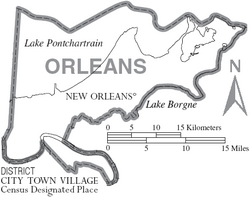
Key Facts
- Founded: April 14, 1807.
- Seat: New Orleans.
- Total Area: 349.85 square miles (including 180.43 square miles of water).
- 2020 Population: 383,997.
- Governance: Operates as a merged city-parish government.
- Geography: Bounded by Lake Pontchartrain to the north and the Mississippi River.
Historical Evolution
The administrative structure of Orleans Parish evolved through a complex transition from counties to parishes. On April 10, 1805, the Territory of Orleans was divided into 12 counties. By April 14, 1807, the territory was further divided into 19 civil parishes based on earlier ecclesiastical (church) boundaries. While counties initially handled taxation and elections, parishes managed judicial matters, including civil and criminal law.
The Louisiana Constitution of 1845 eventually removed references to counties, transferring all their powers to the parishes. Early governance was led by a police jury (a local governing body), but its authority within New Orleans was limited. Over time, the parish underwent several shifts: it was divided along the Mississippi River in 1840, and by 1870, the city of New Orleans and the parish were fully consolidated.
Geography and Boundaries
Orleans Parish is located within the New Orleans–Metairie metropolitan statistical area. Its current boundaries are defined by St. Tammany Parish and Lake Pontchartrain to the north, St. Bernard Parish and Lake Borgne to the east, Plaquemines Parish to the south, and Jefferson Parish to the south and west.
The parish's borders have shifted significantly since its inception. It originally extended as far west as Kenner and as far south as Grand Isle. A territorial dispute with Lafourche Interior Parish over Grand Isle and Cheniere Caminada was resolved in 1825 with the creation of Jefferson Parish. Additionally, the city of New Orleans annexed various areas over time, including the city of LaFayette in 1852 and Carrollton in 1874, eventually making the city and parish coextensive.
Demographics and Population
As of the 2020 census, Orleans Parish had a population of 383,997, with a median age of 36.2 years. The population is predominantly urban, with 99.6% of residents living in urban areas.
Racial and Ethnic Composition
The 2020 census reported the following racial makeup for the parish:
- Black or African American: 54.2%
- White: 32.9%
- Hispanic or Latino (of any race): 8.1%
- Two or more races: 6.4%
- Asian: 2.8%
- Other races: 3.2%
- American Indian and Alaska Native: 0.3%
Housing and Households
There were 165,125 households in the parish, with 38.3% consisting of individuals. Regarding housing units, 54.5% are renter-occupied, while 45.5% are owner-occupied.
| Year | Population | Percentage Change |
|---|---|---|
| 1810 | 24,552 | — |
| 1820 | 41,351 | +68.4% |
| 1830 | 49,826 | +20.5% |
| 1840 | 102,193 | +105.1% |
| 1850 | 119,460 | +16.9% |
| 1860 | 174,491 | +46.1% |
| 1870 | 191,418 | +9.7% |
Government and Administration
Orleans Parish maintains a sui generis (unique) status under Louisiana law, which guarantees the city's home rule. While the U.S. Census Bureau views New Orleans and Orleans Parish as a single consolidated city, some parish offices maintain a degree of independence. These include the Orleans Parish School Board and the Orleans Parish Sheriff's Office.
The Orleans Parish Civil Sheriff's Office is responsible for serving lawsuit papers, providing court security, and operating correctional facilities, such as the Orleans Parish Prison. In 2010, the parish merged its separate criminal and civil sheriff's offices into one entity. As of 2024, the sheriff is Susan Hutson.
Frequently Asked Questions
What is the difference between Orleans Parish and the city of New Orleans?
Since 1870, they have been coterminous, meaning they share the same boundaries. They are governed as a single consolidated city-parish government, although some specific parish offices remain independently operated.
Who is the current sheriff of Orleans Parish?
As of 2024, the sheriff is Susan Hutson, who was elected in the 2021 New Orleans City Election.
How did Orleans Parish get its name?
The parish was named after Philippe II, Duke of Orléans (1674–1723).
What are the geographical boundaries of the parish?
It is bounded by Lake Pontchartrain and St. Tammany Parish to the north, Lake Borgne and St. Bernard Parish to the east, Plaquemines Parish to the south, and Jefferson Parish to the south and west.
What was the role of the police jury in early parish history?
The police jury was the early governing body of the parish. Initially, it had limited authority within the city of New Orleans, and by 1846, the original police jury became inactive and was abolished as the city consolidated.