Orange-fronted Plushcrown
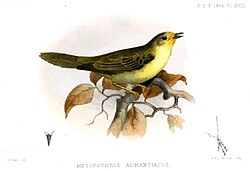
The orange-fronted plushcrown (Metopothrix aurantiaca) is a distinctive member of the ovenbird family, Furnariidae. While most ovenbirds are known for muted tones, this species stands out with its vibrant yellow and green plumage, often leading observers to mistake it for a tanager or a warbler. Found across the lush riverine forests of South America, it is a specialist of the canopy and mid-storey.
Key Facts
- Scientific Name: Metopothrix aurantiaca
- Conservation Status: Least Concern (IUCN 3.1)
- Distinctive Feature: The only furnariid with yellow/greenish plumage and yellow legs.
- Primary Habitat: Riverine forests, mature secondary forests, and forest edges.
- Diet: Primarily arthropods, occasionally fruit.
- Range: Bolivia, Brazil, Colombia, Ecuador, and Peru.
Taxonomy and Systematics
The orange-fronted plushcrown is the sole member of the genus Metopothrix and has no recognized subspecies. Because its physical appearance differs so drastically from other members of the Furnariidae family, its taxonomic placement was historically questioned by researchers.
Modern genetic data have clarified its lineage, revealing that it is a sister species to the two members of the genus Xenerpestes. Together, these groups are sisters to the pink-legged graveteiro (Acrobatornis fonsecai).
Physical Description
Measuring between 11 and 12 cm (4.3 to 4.7 in) in length and weighing 10 to 12 g (0.35 to 0.42 oz), the orange-fronted plushcrown is a small, agile bird. Both males and females share the same plumage, making them indistinguishable by sight.
The bird is characterized by an orange forehead and yellow lores, eyering, and supercilium (the stripe above the eye), which transitions to a greenish-yellow behind the eye. Its crown, back, rump, and tail are greenish olive, while the throat is a bright yellow. The underparts are a dull yellowish green, slightly paler on the belly. Its legs and feet are a striking bright yellow-orange to yellow, and its bill consists of a black maxilla and a black-to-gray mandible.
Juveniles differ from adults in that they possess little to no orange or yellow coloration on their faces.
Distribution and Habitat
This species is widely distributed across the Amazon basin. Its range includes the Putumayo and Amazonas departments of southeastern Colombia, eastern Ecuador and Peru, the Beni Department of northeastern Bolivia, and western Brazil, extending east to the upper Purus and lower Juruá rivers.
The orange-fronted plushcrown is rarely found far from water. It prefers forests along rivers, river islands, mature secondary forests, and the edges of clearings in both várzea (seasonally flooded forest) and terra firme (non-flooded upland forest). Its elevational range typically spans from 150 to 650 m (490 to 2,100 ft), though it only reaches up to 500 m (1,600 ft) in Colombia.
Behavior and Ecology
Movement and Feeding
The species is a year-round resident within its range. It primarily feeds on arthropods, though it has been observed eating fruit on occasion. Foraging typically occurs in pairs or small family groups, and the birds sometimes join mixed-species feeding flocks.
They are acrobatic foragers, often hanging from twigs and leaves in the forest's mid-storey and canopy to glean prey.
Breeding and Vocalization
While the exact breeding season is not fully defined, nest building typically begins in January. The nest is a large ball of sticks with a side entrance, positioned in a tree between 4 and 20 m (13 and 66 ft) above the ground.
The song of the orange-fronted plushcrown consists of a descending series of three to five high, thin notes, while its standard call is a thin "tsweet-tsweet".
Conservation Status
The IUCN classifies the orange-fronted plushcrown as Least Concern. It possesses a very large range, and while its exact population size is unknown, it is believed to be stable with no immediate threats identified.
Although generally uncommon, it is locally common in certain areas and is protected within several reserves. Interestingly, the species may actually benefit from limited deforestation, as this process increases the edge habitats it prefers.
| Feature | Details |
|---|---|
| Size | 11–12 cm; 10–12 g |
| Plumage | Greenish olive with orange forehead and yellow throat |
| Range | Bolivia, Brazil, Colombia, Ecuador, Peru |
| Habitat | Riverine, várzea, and terra firme forests |
| Diet | Mainly arthropods |
| IUCN Status | Least Concern |
Frequently Asked Questions
What makes the orange-fronted plushcrown unique among ovenbirds?
It is the only species in the furnariid family that possesses yellow or greenish plumage combined with yellow legs, giving it an appearance more similar to a warbler or tanager than a typical ovenbird.
Where can the orange-fronted plushcrown be found?
It is found in the Amazonian regions of Bolivia, Brazil, Colombia, Ecuador, and Peru, specifically in habitats close to rivers, such as várzea and terra firme forests.
What do orange-fronted plushcrowns eat?
Their diet consists primarily of arthropods, which they glean from leaves and twigs in the forest canopy, though they have been known to eat fruit.
Is the orange-fronted plushcrown an endangered species?
No, it is listed as Least Concern by the IUCN due to its large range and stable population, with no immediate threats identified.
How do juveniles differ from adults?
Juvenile birds lack the vibrant orange and yellow facial markings that characterize the adults.