Operation Thunderbolt: The UN Advance to the Han River
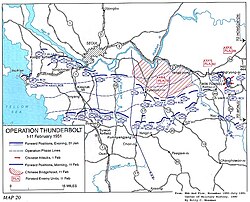
Between January 25 and February 11, 1951, United Nations (UN) forces executed Operation Thunderbolt, a strategic offensive during the Korean War designed to push enemy forces back to the Han River. Led by General Matthew B. Ridgway, the operation was the culmination of a series of carefully coordinated reconnaissance-in-force missions intended to identify enemy strengths and clear the southern approaches to Seoul.
The operation was characterized by a methodical approach, prioritizing lateral coordination and thorough ground searches over rapid territorial gains. This cautious strategy ensured that UN columns did not bypass significant enemy concentrations that could later threaten their flanks.
Key Facts
- Date: 25 January – 11 February 1951.
- Location: Han River region, South Korea.
- Outcome: United Nations victory.
- UN Strength: Approximately 94,147 personnel.
- Enemy Strength: Approximately 50,000 personnel.
- Estimated Casualties: US forces suffered ~7,000 total casualties; Chinese (PVA) estimates are around 20,000, with 18,600 reported losses.
The Prelude: Operation Wolfhound and Task Force Johnson
Before the main offensive, General Ridgway ordered a series of reconnaissance-in-force missions—operations designed to provoke the enemy into revealing their positions through combat.
Operation Wolfhound
Launched on January 15, Operation Wolfhound was led by the 25th Infantry Division, specifically the 27th Infantry Regiment (the "Wolfhounds"). The mission aimed to probe the Suwon-Osan area. While the operation met limited resistance, it successfully revealed that no large-scale enemy forces were located south of the Suwon-Kumnyangjang-ni line, though organized groups remained in place.
Task Force Johnson
Simultaneously, IX Corps deployed Task Force Johnson, a combined arms unit featuring the 70th Tank Battalion. This force pushed north of Route 20 between Kumnyangjang-ni and Ich’on. The engagement at Yangji-ri confirmed that while the area below Route 20 was largely unoccupied, organized enemy groups were defending the road itself.
The Strategic Advance to the Han
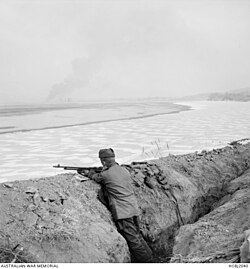
Operation Thunderbolt began in earnest on January 25. Ridgway assigned I Corps and IX Corps to reconnoiter as far as the Han River, advancing through five distinct phase lines spaced approximately five miles apart.
Initial Resistance and Coordination
The advance was a slow, deliberate process. The most intense fighting occurred at Kumnyangjang-ni and the heights above Yangji-ri. By January 27, intelligence from captives revealed that the Chinese 50th Army was acting as a screen, while the bulk of the XIII Army Group and the Korean People's Army (KPA) I Corps were resting and refurbishing just above and below the Han River.
The General Advance
From January 30 to February 5, UN forces pushed through isolated but stubborn defenses. The advance was supported by heavy artillery, air strikes, and naval gunfire from Task Force 95 off the coast of Inchon. By February 5, the front line reached a point just below Anyang on Route 1.
The Final Push and Capture of Kwanak Mountain
The climax of the operation focused on the Kwanak Mountain heights, the last defensible ground south of Seoul. General Ridgway urged a vigorous attack on these positions to secure the southern approaches to the capital.
On February 9, the 25th Division captured Kwanak Mountain. Simultaneously, Task Force Meyer raced up Route 55 to become the first UN troops to reach the Han River. By February 11, UN forces had established positions along the river, including the high ground between Yongdungp’o and Route 55, effectively completing the operation's objectives.
Operation Thunderbolt Summary
| Phase/Operation | Primary Objective | Key Units Involved | Result |
|---|---|---|---|
| Operation Wolfhound | Reconnaissance of Suwon-Osan | 25th Infantry Division | Identified enemy screening positions |
| Task Force Johnson | Probe north of Route 20 | 70th Tank Battalion | Confirmed enemy presence at Yangji-ri |
| Operation Thunderbolt | Advance to the Han River | I Corps, IX Corps, Turkish Brigade | UN Victory; reached the Han River |
Frequently Asked Questions
What was the primary goal of Operation Thunderbolt?
The primary goal was to conduct a coordinated advance to the Han River, clearing enemy forces from the southern approaches to Seoul and identifying the strength and location of the PVA and KPA forces.
Who were the main belligerents in this operation?
The operation involved United Nations forces (primarily from the USA, UK, Turkey, South Korea, and Colombia) against the forces of China (PVA) and North Korea (KPA).
Why was the advance described as "plodding" or slow?
General Ridgway insisted on strict lateral coordination and thorough ground searches to ensure that no significant enemy groups were bypassed, which would have endangered the columns during their northward movement.
What role did the navy play in Operation Thunderbolt?
The UN navy, specifically Task Force 95, provided naval gunfire support for I Corps and conducted an amphibious landing demonstration at Inchon on February 10 to distract and discourage the KPA screen.
What was the significance of Kwanak Mountain?
Kwanak Mountain represented the last major defensible terrain on the southern approach to Seoul; its capture by the 25th Division effectively climaxed the I Corps advance to the Han River.