Oliver Bierhoff: The Aerial Master of German Football
Oliver Bierhoff is a name synonymous with aerial dominance and clinical finishing in the history of German football. Known as a powerhouse target man—a striker used as a focal point for the attack—Bierhoff combined physical strength with an extraordinary ability to score with his head. From his early struggles in the Bundesliga to becoming a legend in Italy's Serie A and a national hero for Germany, Bierhoff's journey is one of persistence and specialization.
Key Facts
- Position: Striker / Target Man.
- International Glory: Winner of UEFA Euro 1996 and runner-up in the 2002 FIFA World Cup.
- Serie A Record: Most headed goals in a single season (15 goals in 1998–99).
- Historic Achievement: Scored the first golden goal in major international football history.
- Club Success: Serie A top scorer in the 1997–98 season.
- Post-Playing Career: Served as Technical Director for the Germany national team.
The Path to Professional Success
Born on May 1, 1968, in Karlsruhe, West Germany, Bierhoff's early career did not immediately signal the stardom that would follow. He spent his formative years with Essener SV 99 and Schwarz-Weiß Essen before entering the professional ranks. His initial stints in the Bundesliga with Bayer Uerdingen, Hamburger SV, and Borussia Mönchengladbach yielded modest results.
The turning point came when Bierhoff moved to the Austrian Bundesliga to play for Austria Salzburg. His prolific form there caught the attention of Italian scouts, leading to a move to Ascoli in Serie A. While Ascoli faced relegation, Bierhoff's resilience during three seasons in Serie B laid the groundwork for his eventual ascent.
Dominance in Italy and the AC Milan Era
Bierhoff's career reached new heights in 1995 when he joined Udinese under manager Alberto Zaccheroni. It was here that he became a household name, culminating in the 1997–98 season where he finished as the Serie A top scorer with 27 goals. His ability to dominate the air made him one of the most feared strikers in Europe.
In 1998, he signed with AC Milan, where he immediately contributed to a Serie A title win. During the 1998–99 campaign, he set a league record by scoring 15 headed goals in a single season. He eventually concluded his playing days with brief periods at Monaco and Chievo, retiring in 2003 after scoring a hat-trick in his final match against Juventus.
International Legacy and the Golden Goal
Bierhoff's international career is defined by a single, historic moment. Despite not being an initial choice for the UEFA Euro 1996 squad, he was included in the team and became the hero of the final against the Czech Republic. Coming on as a substitute, he scored both the equalizer and the legendary golden goal—a rule where the first goal scored in extra time wins the match—to secure the championship for Germany.
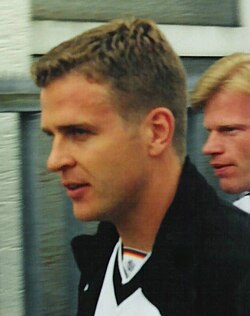
His international prowess continued with a record-breaking hat-trick against Northern Ireland in 1997, the fastest in the history of the German national team. He later captained the side following the retirement of Jürgen Klinsmann and helped lead Germany to the 2002 FIFA World Cup final.
Style of Play: The Aerial Specialist
Bierhoff was not characterized by technical footwork or intricate playmaking. Instead, he was a physical, aggressive presence in the penalty area. His game relied on exceptional movement, strength, and elevation. He was regarded as one of the world's best aerial players, capable of delivering pinpoint headers for both goals and assists (knock-downs) to his teammates.
Transition to Management and Administration
After retiring from the pitch, Bierhoff transitioned into the administrative side of the sport. From 2004 to 2017, he managed the public relations and organizational aspects of the Germany national team. In 2018, he was appointed as the Technical Director (Director Nationalmannschaften und Akademie), overseeing national teams and football development. His tenure ended in 2022 following Germany's early exit from the World Cup.
Career Summary
| Category | Details |
|---|---|
| Total Club Appearances | 444 (League) / 516 (Overall) |
| Total Club Goals | 185 (League) / 212 (Overall) |
| International Caps/Goals | 70 Apps / 37 Goals |
| Major Honors | Euro 1996 Winner, Serie A Title (1998-99) |
| Education | Degree in Business Economics, University of Hagen (2002) |
Frequently Asked Questions
What is Oliver Bierhoff's most famous international achievement?
Bierhoff is most famous for scoring the first golden goal in a major international tournament final, which won the UEFA Euro 1996 championship for Germany.
Which club did Bierhoff have the most success with in Italy?
While he won a league title with AC Milan and set a heading record, he achieved significant individual success at Udinese, where he became the Serie A top scorer in the 1997–98 season.
What was Bierhoff's specific role on the pitch?
He played as a striker, specifically as a target man, utilizing his height and strength to dominate aerial duels and score headers.
What did Oliver Bierhoff do after retiring as a player?
He moved into football administration, serving as a manager and later as the Technical Director for the Germany national team from 2004 until 2022.
Did Oliver Bierhoff pursue education during or after his career?
Yes, he completed a correspondence course and graduated from the University of Hagen in 2002 with a degree in business economics.