Oil Supply: Conventional and Unconventional Petroleum Production
Oil, or petroleum, is a complex mixture of hydrocarbon substances. Because the geology of a region dictates the composition of the oil underground, the nature of petroleum varies significantly from one oilfield to another. This variability affects how oil is extracted, refined, and valued in the global market.
Crude oil is generally categorized into grades—light, medium, heavy, and extra heavy—based on its density and API gravity (a measure of how heavy or light a petroleum liquid is compared to water). Light oil flows easily to the surface or can be pumped with minimal effort. In contrast, heavy oil is denser, often possessing a consistency similar to molasses, which requires more complex recovery methods.
In industry statistics, it is critical to distinguish between "crude oil" (or crude and condensate) and "total liquids production." While crude oil is refined into common fuels like gasoline and diesel, total liquids include natural-gas liquids (NGLs). Because NGLs are primarily used as chemical feedstocks rather than transport fuels, using total liquids figures to describe crude oil production can be misleading and may artificially inflate perceived global supply.
Key Facts
![Global liquids production 2000–2015, indicating the component of US tight oil (Energy Information Administration)[citation needed]](/images/24/86/248605a4f50be981263da42c0a2ecd9d5161a618bca9401cf98c15ab9ff67252.png)
- Conventional oil peaked around 2005–2006, but global supply was sustained by the rise of US tight oil and Canadian oil sands.
- Unconventional resources are estimated to be several times larger than conventional reserves.
- Global discoveries of new oilfields peaked in the 1960s, with 2021 marking one of the worst years for new discoveries since 1946.
- Energy Return on Investment (EROI) is significantly higher for conventional oil than for unconventional sources.
- Production concentration is high; just 25 oilfields account for 25% of global production.
Conventional vs. Unconventional Oil Sources
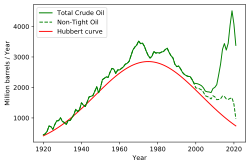
Conventional Oil
Conventional oil refers to petroleum extracted using traditional techniques established before 2000. These sources typically consist of onshore and shallow offshore oilfields where the oil is relatively easy to extract. While these sources were the primary driver of the 20th-century energy economy, their production peaked in the mid-2000s.
Unconventional Oil
Unconventional oil is more difficult and expensive to extract, requiring multiple processing steps. Major types include:
- Oil Sands: Unconsolidated sandstone containing bitumen (extra-heavy, viscous crude). This is recovered via surface mining or in-situ steam injection and must be upgraded or diluted before refining.
- Tight Oil: Oil trapped in low-permeability rock. Production is heavily concentrated in the US (particularly the Permian Basin) and Argentina (Vaca Muerta Formation).
- Oil Shale: Another difficult-to-extract source, though less common than tight oil or sands.
Other synthetic processes, such as coal liquefaction or gas-to-liquids (using the Fischer–Tropsch, Bergius, or Karrick processes), also produce unconventional fuels but are extremely costly.
![Unconventional resources are much larger than conventional ones.[66]](/images/8c/9a/8c9ae5df0f94e96847887093b9b79c70ec48a8853fd105e84d43d2642f93cea8.png)
Global Production Trends and Regional Impacts
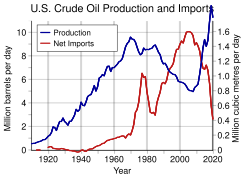
The United States experienced a production resurgence in the 2010s driven by tight oil. Although production dipped after a peak in March 2015, it recovered by September 2017 and has reached record highs as of 2024. In 2014, US crude production exceeded imports for the first time since the early 1990s.
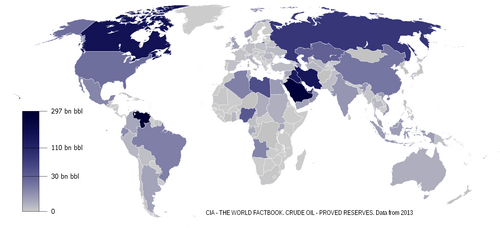
Canada and Venezuela both hold massive oil sands deposits. Venezuela's Orinoco Belt contains bitumen that is less viscous than Canada's Athabasca sands, though it is buried too deep for surface mining. Recoverable reserves in the Orinoco Belt have been estimated by the USGS to be as high as 513 billion barrels.
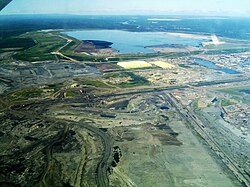
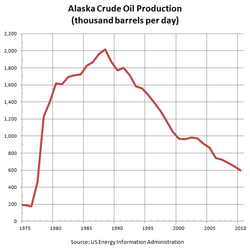
In contrast, some regions have seen steep declines. Alaska's production dropped 70% from its 1988 peak by 2007, and Texas saw a decline after 1972 before the tight oil boom of the 2010s brought a resurgence.
Oil Discoveries and Reserve Estimates
![Texas oil production declined after peaking in 1972 but had a resurgence in the 2010s due to tight oil production. Note: This chart is outdated, and as of 2024 Texas produces 5.7 million barrels per day (2,080 million barrels per year).[54]](/images/db/1d/db1d69591b26ffb606774c020729e8edfe18b35b9a887a5b5f8723665bd41838.png)
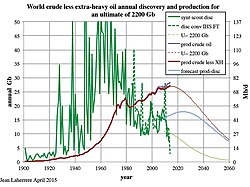
Finding "cheap" oil has become increasingly difficult. Global discoveries peaked in the 1960s, and new finds now occur in remote, inhospitable environments. However, reported proven reserves have actually increased over time. This is often due to "reserve growth," where new technology allows more oil to be extracted from existing fields, which is then backdated to the year the field was first discovered.
Reserves are categorized by the probability of technical recovery:
- 1P (Proven): 90% certainty of production.
- 2P (Proven and Probable): 50% probability.
- 3P (Proven, Probable, and Possible): 10% probability.
Controversies in Stated Reserves
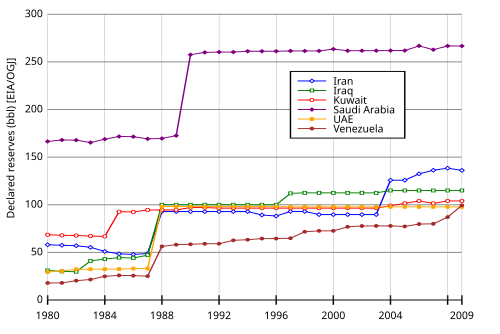
There is significant debate regarding the accuracy of proven reserves. Critics, including former Aramco VP Sadad Al Husseini, suggest that some reserves are actually speculative resources. Because reserves are often self-reported by companies or OPEC nations without outside audits, there are incentives to overstate them for political stature or to secure higher OPEC production quotas.
The Economics and Environment of Extraction
The viability of unconventional oil depends heavily on the market price of oil and the cost of production. While these sources expand the available supply, they come with higher environmental and energy costs. Unconventional oil can produce up to three times more greenhouse gas emissions per barrel on a "well to tank" basis compared to conventional oil.
| Feature | Conventional Oil | Unconventional Oil |
|---|---|---|
| Extraction Ease | Relatively easy / Traditional | Difficult / High-tech |
| Production Cost | Lower | Higher |
| EROI | High | Low |
| GHG Emissions | Lower | Up to 3x higher (well-to-tank) |
| Examples | Onshore/Shallow offshore fields | Tight oil, Oil sands, Shale oil |
This is reflected in the Energy Return on Investment (EROI). Conventional oil offers a high EROI, meaning less energy is spent to acquire more energy. Unconventional sources require more materials and energy for extraction, which typically results in lower monetary profits and higher environmental degradation.
Oil Field Decline and the Future of Supply
All oilfields eventually decline. A typical well follows a profile of initial increase, a plateau, and a final decline. Tight oil differs, often starting at maximum production and declining rapidly.
Because global production is concentrated in a few "giant" fields (those with over 500 million barrels), the decline of a single major field can impact global supply. For example, reports suggest the Ghawar field, the world's largest, may have entered a period of decline. On average, onshore fields decline at about 5% per year, while offshore fields decline at approximately 9.5%.
Frequently Asked Questions
What is the difference between crude oil and total liquids?
Crude oil refers to the petroleum that is refined into fuels like gasoline and diesel. Total liquids include crude oil plus natural-gas liquids (NGLs), which are primarily used as chemical feedstocks. Using total liquids to describe crude production can mislead observers by inflating the amount of fuel-grade oil available.
Why are unconventional oil reserves considered more environmentally damaging?
Unconventional oil requires more energy and resources to extract and refine. This results in a lower Energy Return on Investment (EROI) and significantly higher greenhouse gas emissions—up to three times more per barrel on a well-to-tank basis than conventional oil.
What is "reserve growth" in the oil industry?
Reserve growth occurs when new technology allows producers to extract more oil from a field that was already discovered. Because these additions are often backdated to the original discovery year, it can create the illusion that new discoveries are keeping pace with production even when new field discoveries are falling.
How does API gravity affect oil classification?
API gravity measures the density of oil. "Light" oil has a higher API gravity and flows easily, while "heavy" oil has a lower API gravity, is more viscous (like molasses), and often requires unconventional extraction methods.
What is the significance of the Permian Basin?
The Permian Basin is a primary driver of the US tight oil boom. Thanks to world-class geology and available capital, it has helped the US reach record-breaking levels of oil production in recent years.