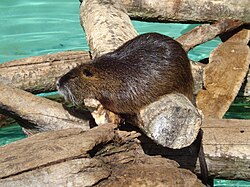
Nutria: The Global Impact of the Invasive Myocastor coypus
The nutria, scientifically known as Myocastor coypus, is a large semi-aquatic rodent that has become a significant figure in global ecology. While native to the wetlands of South America, this species—often referred to as the coypu—has established itself in various corners of the world, frequently transitioning from a commercial asset to a highly destructive invasive species.
Tracing its lineage back to the Late Pliocene, the nutria belongs to the family Echimyidae. Though it is currently classified as a species of Least Concern by the IUCN, its presence in non-native habitats poses serious challenges to local biodiversity and wetland stability.
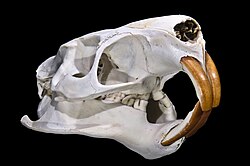
The anatomical structure of the nutria, including its specialized skull, reflects its adaptation to a semi-aquatic lifestyle.
Key Facts
- Scientific Name: Myocastor coypus
- Native Range: South America
- Conservation Status: Least Concern (IUCN 3.1)
- Primary Habitat: Wetlands, marshes, and coastal areas
- Major Ecological Impact: Herbivory leading to wetland degradation
Taxonomy and Subspecies
The nutria is categorized within the order Rodentia. Scientists generally recognize four distinct subspecies, which are distributed across different geographical regions:
- M. c. bonariensis: Found in northern Argentina, Bolivia, Paraguay, Uruguay, and southern Brazil.
- M. c. coypus: Located in central Chile and Bolivia.
- M. c. melanops: Endemic to Chiloé Island.
- M. c. santacruzae: Found in Patagonia.
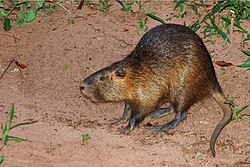
Physical Characteristics and Appearance
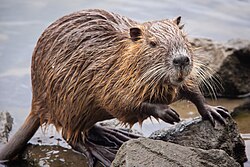
Nutrias are easily identified by several distinct physical traits. One of the most prominent features is their large, orange-colored incisors, which are essential for their heavy herbivorous diet. Unlike beavers, which possess large, flat, paddle-shaped tails, the nutria has a different tail structure suited to its specific movement patterns.
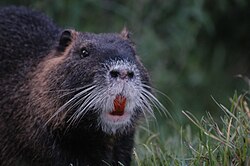
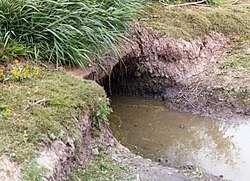
They are highly adapted for life in and around water, often utilizing burrows dug into riverbanks to seek shelter and protection.
Global Distribution and Invasive History
While the nutria is native to South America, its introduction to other continents has caused significant ecological shifts. The history of its spread is often linked to the fur trade and accidental escapes.
The United States and Louisiana
In the United States, the nutria's presence is most notable in the Southern states. They were introduced to Louisiana in the 1930s via fur farms. Following escapes by farmers and a hurricane in 1940, the population exploded. From Louisiana, they spread across the Southern U.S., causing extensive damage to coastal marshes and inland swamps.
Europe and Beyond
Nutrias have also established populations in Europe, including sightings and records in Ireland, Italy, Great Britain, and France. Other regions where they have been introduced include Japan and New Zealand. The spread in Europe has been documented through various occurrence records spanning several decades.
![Nutria occurrence records from 1980 to 2018 in Europe.[33]](/images/2b/64/2b64c4abfce8b04d81fd605ae2a53804aa47060112bfa0f15fb668ef458ccad8.jpg)
Ecological and Economic Impacts
The nutria's impact on the environments they inhabit is multifaceted, ranging from habitat destruction to public health concerns.
Habitat Degradation through Herbivory
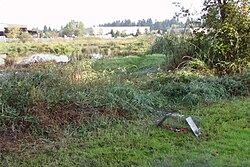
As intensive herbivores, nutrias consume vast amounts of vegetation. This heavy feeding can lead to significant habitat degradation, particularly in wetlands. By consuming the root systems of marsh plants, they can destabilize soil, leading to increased erosion and the loss of vital wetland ecosystems.
Zoonotic Disease Risks
Beyond physical habitat damage, nutrias can act as reservoirs for various pathogenic and viral zoonotic diseases—illnesses that can be transmitted from animals to humans. This makes their management a matter of public health as well as environmental conservation.
Management and Control Efforts
Due to the damage they cause, various control efforts have been implemented globally. In many regions, this includes trapping and specialized management programs to protect sensitive ecosystems. In some areas, the nutria has even been utilized for commercial purposes, such as the fur trade or as a food source, in an attempt to manage population numbers.
Summary of Nutria Information
| Category | Details |
|---|---|
| Scientific Classification | Kingdom: Animalia, Phylum: Chordata, Class: Mammalia, Order: Rodentia |
| Native Habitat | South America |
| Common Names | Nutria, Coypu |
| Key Threat | Wetland loss and habitat degradation |
| Primary Diet | Herbivorous (plants and vegetation) |
Frequently Asked Questions
How can I tell a nutria apart from a beaver?
The most reliable way to distinguish them is by their tails; beavers have large, flat, paddle-shaped tails, whereas nutrias do not. Additionally, nutrias possess distinctive large orange teeth.
Why are nutrias considered invasive in the United States?
They are considered invasive because they were introduced to non-native ecosystems (like Louisiana) where they lack natural predators and cause significant damage to local marshlands and vegetation.
What is the main cause of wetland loss related to nutrias?
Nutrias cause wetland loss through intense herbivory. By eating the plants that hold the soil together, they contribute to erosion and the physical breakdown of the wetland structure.
Are nutrias dangerous to humans?
While they are not typically aggressive toward humans, they can serve as reservoirs for zoonotic diseases, which are pathogens that can be transmitted from animals to people.
Where did the nutria come from originally?
The nutria is native to South America.