Nuriro: South Korea's Reliable Regional Rail Service
Since its debut on June 1, 2009, the Nuriro has become a vital component of South Korea's regional transportation network. Operated by Korail, the nation's primary railroad provider, this class of train was originally designed to modernize the passenger experience by replacing older service models such as the short-range Mugunghwa-ho and the legacy Bidulgi-ho and Tongil-ho systems.
While initially intended for routes between Seoul and Onyangoncheon, the Nuriro has evolved to serve critical regional corridors. Today, it plays a key role in connecting various parts of the country through the Yeongdong and Jungang lines, providing essential transit for commuters and travelers alike.
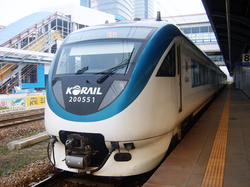
Key Facts
- Operator: Korail
- First Service Date: June 1, 2009
- Rolling Stock: Korail Class 200000
- Maximum Operating Speed: 150 km/h (93 mph)
- Track Gauge: 1,435 mm (Standard Gauge)
- Primary Lines: Jungang Line and Yeongdong Line
Technical Specifications and Rolling Stock
The Nuriro service utilizes the Korail Class 200000 rolling stock. The initial units were manufactured by Hitachi, incorporating their advanced A-train technology, which features an eco-friendly aluminum body designed for efficiency and durability.
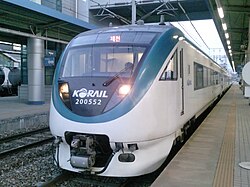
Train Configuration and Interior
The trains are organized into a four-car formation to accommodate various passenger needs. The interior is designed for comfort during regional travel, featuring a 2+2 abreast seating configuration. Passengers benefit from a generous seat pitch of 980 mm (39 inches), providing ample legroom.
The four-car layout is structured as follows:
- Car 1: Accommodation and facilities
- Car 2: Reserved seating
- Car 3: General seating and facilities
- Car 4: Facilities including wheelchair spaces and toilets
Current Service Routes and Schedules
The Nuriro currently operates on several key routes, providing connectivity across the Jungang and Yeongdong lines. Below is a summary of the active regular services:
| Route | Section | Daily Round Trips | Estimated Time |
|---|---|---|---|
| Jungang Line | Cheongnyangni - Andong | 2 | N/A |
| Yeongdong Line | Donghae - Yeongju | 1 | N/A |
| Yeongdong Line | Donghae - Gangneung | 10 | 50 minutes |
Detailed Station Stops
Depending on the specific line, the Nuriro serves a variety of stations. Stations marked in bold represent required stops for the service.
Jungang Line (Cheongnyangni to Andong)This route connects major hubs including Cheongnyangni, Deokso, Yangpyeong, Yongmun, Jipyeong, Seokbul, Ilsin, Maegok, Yangdong, Samsan, Seowonju, Wonju, Bongyang, Jecheon, Danyang, Punggi, Yeongju, and Andong.
Yeongdong Line (Yeongju to Donghae)Connecting the interior to the coast, this service stops at Yeongju, Bonghwa, Chunyang, Imgi, Hyeondong, Buncheon, Yangwon, Seungbu, Seokpo, Cheoram, Dongbaeksan, Dogye, Singi, and Donghae.
Yeongdong Line (Donghae to Gangneung)A shorter coastal service that includes stops at Donghae, Mukho, Jeongdongjin, and Gangneung.
Frequently Asked Questions
What is the purpose of the Nuriro train?
The Nuriro was introduced by Korail to modernize regional rail services, specifically replacing the older Mugunghwa-ho, Bidulgi-ho, and Tongil-ho operating systems.
What technology is used in the Nuriro rolling stock?
The Korail Class 200000 uses Hitachi's A-train technology, which utilizes an eco-friendly aluminum body for improved performance.
How much legroom is available on the Nuriro?
The trains feature a seat pitch of 980 mm (39 inches), arranged in a 2+2 seating configuration.
Which lines does the Nuriro currently serve?
The service currently operates on the Jungang Line and the Yeongdong Line.
What is the maximum speed of a Nuriro train?
The Nuriro has an operating speed of up to 150 km/h (93 mph).