Northern and Southern China: Regional Differences in Geography, Culture, and Economy
China is often conceptualized as a single entity, but it is characterized by a profound regional divide between the North and the South. These two approximate regions differ significantly across geography, demographics, economy, and culture, creating a diverse internal landscape that has shaped the nation's history and social fabric.
Defining the Divide
The transition between northern and southern China is not a single line but a zone defined by several geographic and climatic markers. The Qinling–Daba Mountains serve as the primary transition zone, roughly coinciding with the 0°C isotherm (the line where the average January temperature is zero degrees) in January, the 800-millimeter isohyet (a line connecting points of equal rainfall), and the 2,000-hour isohel (a line connecting points with equal sunshine duration).
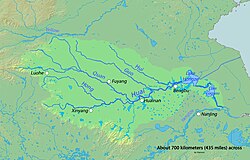
Additionally, the Huai River basin acts as a critical boundary. Historically, the course of the Huaihe has been used by governments to implement different administrative and economic policies for the north and south.
Historical Evolution and Stereotypes
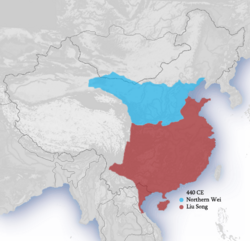
Historically, populations have migrated from the north toward the south, particularly along major rivers and coastal areas. A significant political split occurred after the fall of the Han dynasty during the Southern and Northern Dynasties (420–589), where the region was ruled separately before being reunited under the Sui dynasty.
During the Qing dynasty, regional identities solidified into stereotypes. These were often based on cosmology—such as the south being associated with fire, leading to the perception of Southerners as hot-tempered—or historical associations, such as people from Shandong being viewed as upright and honest. These perceptions were so ingrained that the Kangxi Emperor noted the physical and dietary differences between the "strong" Northerners and the "physically frail" Southerners in the Tingxun Geyan.
Later, during the Republican period, the writer Lu Xun observed that while Northerners were seen as sincere and honest, Southerners were viewed as skilled and quick-minded, though he noted that these virtues could slide into stupidity or duplicity, respectively.
Climate and Ecology
The climate varies drastically between the two regions. Northern China experiences long, cold, and dry winters—often dipping below freezing—and hot, humid summers. The ecology here is relatively simple and highly susceptible to droughts.
In contrast, much of southern China is subtropical and remains green year-round. Winters are short, while summers are characterized by the East Asian monsoon and frequent typhoons. This region possesses a complex ecology but is more prone to flooding.
Agriculture and Diet
The environmental differences directly dictate the food systems of each region. The north is easier to cultivate for hardy crops such as wheat, corn, soybeans, and sorghum. With a growing season of four to six months, farmers typically produce one to two crops per year. Consequently, wheat-based staples like noodles, dumplings, and bread dominate the northern diet.
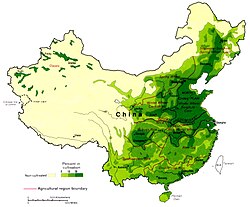
Southern cultivation began later in history but benefits from abundant rainfall and warmth. The growing season lasts nine to twelve months, allowing for two to three crops annually. This environment is ideal for rice and tropical fruits, making rice the primary staple of the southern diet.
Language, People, and Social Psychology
Physical and linguistic differences are also evident. Historical observations, such as those by Jones Lamprey in 1868, suggest that Northerners tend to be taller and have lighter skin tones than Southerners. Linguistically, the north is predominantly Mandarin-speaking, often featuring a rhotic accent. The south is more linguistically diverse, featuring various Mandarin variants (such as Southwestern and Eastern Mandarin) as well as non-Mandarin languages like Cantonese and Hokkien.
![Northern regions are predominantly Mandarin-speaking, while southern regions speak southwestern Mandarin, Eastern Mandarin, and non-Mandarin. ("Mandarin" and "Southern" on this map refer to Sinitic languages, while other groups are not Sinitic.)[14][note 2]](/images/61/c9/61c929da3655f76a49084d35be0b6c4f10d2ad1c5cc4584f3002ad0caaeef599.jpg)
Research suggests that these agricultural differences have influenced social psychology. People from wheat-growing northern regions tend to be more individualistic, analytical, and open to strangers. Conversely, those from rice-growing southern regions often exhibit more holistic and interdependent thinking. This is attributed to the nature of rice farming, which requires shared labor and the management of complex, shared irrigation infrastructure.
Economy and Health
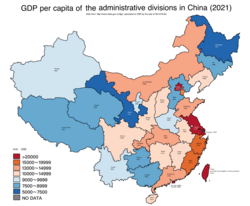
The economic trajectory of the two regions has shifted over time. During the era of planned economic policies and Soviet aid, the north developed faster, focusing on resource extraction and heavy construction. However, following the "reform and opening up" period, the south surged ahead through manufacturing and high-tech industries. This shift is reflected in the GDP; the north's share of China's GDP fell from 42.9% in 2012 to 35.4% in 2019.
Health outcomes also vary. Life expectancy was slightly higher in the south (77.35 years) than in the north (76.66 years) in 2018. This gap is partly attributed to outdoor air pollution caused by winter district heating in the north. Additionally, 2011 survey data indicated that people in southern China were 10.51% less likely to be overweight or obese than those in the north.
Key Facts
- Geographic Boundary: The Qinling–Daba Mountains and the Huai River basin mark the transition between North and South.
- Staple Crops: Wheat and corn dominate the North; rice and tropical fruits dominate the South.
- Climate: The North has cold, dry winters; the South is subtropical with high rainfall and monsoon seasons.
- Economic Shift: The South has overtaken the North in GDP share due to high-tech and manufacturing growth.
- Social Style: Rice-farming cultures (South) tend to be more interdependent, while wheat-farming cultures (North) are more individualistic.
| Feature | Northern China | Southern China |
|---|---|---|
| Primary Staple | Wheat, Corn, Soybeans | Rice, Tropical Fruits |
| Climate | Cold, dry winters; hot, humid summers | Subtropical, green year-round |
| Growing Season | 4 to 6 months | 9 to 12 months |
| Language | Mandarin (often rhotic) | Diverse (Mandarin variants, Cantonese, Hokkien) |
| Economic Focus | Resource extraction, heavy industry | Manufacturing, high-tech |
| Life Expectancy (2018) | 76.66 years | 77.35 years |
Frequently Asked Questions
What is the primary geographic boundary between Northern and Southern China?
The primary boundary is the Qinling–Daba Mountains, which align with the 0°C January isotherm and the 800mm isohyet. The Huai River basin also serves as a significant regional marker.
How does the diet differ between the two regions?
Northern diets are primarily wheat-based, featuring foods like noodles and dumplings. Southern diets are primarily rice-based, supported by a longer growing season and higher rainfall.
Why is there a difference in social psychology between the North and South?
Studies suggest that the labor-intensive nature of rice farming in the South requires more cooperation and shared irrigation management, fostering interdependent and holistic thinking, whereas wheat farming in the North allows for more individualistic social styles.
Which region is currently more economically dominant?
While the North initially led during the era of planned economies, the South has taken the lead in recent decades due to its strength in manufacturing and high-tech industries.
Are there health differences between people in the North and South?
Yes. People in the South generally have a slightly higher life expectancy and lower rates of obesity. The lower life expectancy in the North is partly linked to air pollution from winter heating systems.