Northeast Megalopolis: The Evolution of the BosWash Supercity
The concept of a megalopolis—a vast, integrated network of metropolitan areas—finds its most prominent example along the Northeastern seaboard of the United States. Rather than a single sprawling city, this region functions as a cohesive "supercity," blending independent urban centers into a singular economic and social powerhouse.
The Origins of the Megalopolis Concept
The term was popularized by French geographer Jean Gottmann in his 1961 seminal work, Megalopolis: The Urbanized Northeastern Seaboard of the United States. Gottmann derived the word from a Classical Era Greek town intended to be the largest of its kind. He argued that the cities stretching from Washington, D.C., to Boston were realizing this ancient dream, ascending to global prominence in politics, academia, and economics during the 1960s.
To define a true megalopolis, Gottmann established two primary criteria:
- Polynuclear structure: The presence of multiple urban nuclei that exist independently.
- Manifold concentration: A system where these nuclei are integrated in a specialized way relative to areas outside the region.
Connectivity and Integration
While cities like New York, Philadelphia, and Boston remain distinct entities, they are bound by intense transportation and telecommunications links. As early as 1961, researcher Neil Gustafson noted that the vast majority of phone calls originating within the region terminated elsewhere within the same region, rather than traveling abroad or to other parts of the U.S.
Modern transit patterns further illustrate this interdependence. In 2010, travel within the Boston-Washington corridor was distributed as follows: automobiles (80%), intercity buses (8–9%), Amtrak (6%), and airlines (5%). This interconnectedness has birthed specialized business ventures, including high-frequency airline shuttles between major hubs, Amtrak's Acela Express high-speed rail, and economy options like Chinatown bus lines, BoltBus, and Megabus.
The Rise of "BosWash" and Future Predictions
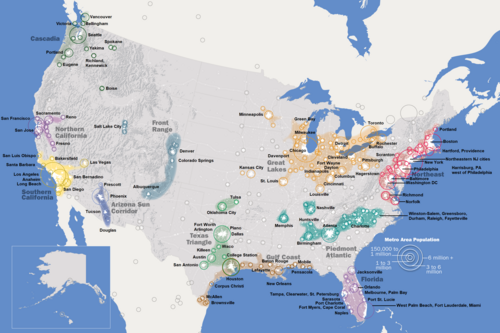
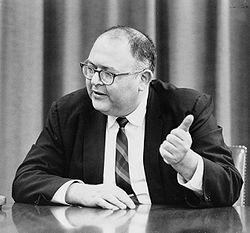
In 1967, futurists Herman Kahn and Anthony Wiener introduced the term BosWash to describe the narrow strip of the North Atlantic coast extending from Washington to Boston. This was part of a broader study for the American Academy of Arts and Sciences titled "Toward the Year 2000: Work in Progress." Kahn and Wiener predicted the emergence of three such gargantuan regions in the U.S.: BosWash, ChiPitts (Chicago to Pittsburgh, extending to Rochester, NY), and SanSan (the West Coast strip from San Francisco or Santa Barbara to San Diego).
Other thinkers have offered varying perspectives on the region's growth. In 1964, Isaac Asimov predicted that by 2014, the Boston-to-Washington area would merge into a single city with a population exceeding 40 million. Additionally, the term BosNYWash emerged as a variant to emphasize New York City's role as the region's central and largest hub.
Modern Academic Perspectives
The megalopolis theory continues to evolve. In 2007, John Rennie Short updated Gottmann's work in Liquid City: Megalopolis and the Contemporary Northeast. Meanwhile, a 2005 study by Virginia Tech's Metropolitan Institute, Beyond Megalopolis, suggested the region actually extends further—past Portland, Maine, and Richmond, Virginia. This study identified the Northeast as one of ten such megapolitan areas in the U.S., though the researchers rejected contrived portmanteaus like "BosWash" in favor of more formal regional labels.
Key Facts
- Founder: Jean Gottmann introduced the modern concept in 1961.
- Core Geography: Spans the Northeastern U.S. from Boston to Washington, D.C.
- Defining Traits: Characterized by a polynuclear structure and manifold concentration.
- Primary Transit: Dominated by automobiles (80% in 2010), supported by Amtrak and intercity buses.
- Alternative Names: Known informally as BosWash or BosNYWash.
| Term | Geographic Scope | Key Characteristics |
|---|---|---|
| BosWash | Washington, D.C. to Boston | Narrow North Atlantic coastal strip |
| ChiPitts | Chicago to Pittsburgh (to Rochester, NY) | Centered around Lake Erie, Michigan, and Ontario |
| SanSan | San Francisco/Santa Barbara to San Diego | Narrow West Coast strip |
Frequently Asked Questions
What is a megalopolis?
A megalopolis is a chain of roughly adjacent metropolitan areas that have grown together to form a cohesive, integrated "supercity" while maintaining individual urban nuclei.
What does "polynuclear structure" mean in this context?
It refers to a region that has multiple independent urban centers (nuclei) rather than one single dominant city that controls all surrounding areas.
Is "BosWash" an official name?
No, BosWash is an informal term coined by futurists Herman Kahn and Anthony Wiener; it is not used in an official capacity, though it appears in some dictionaries as an informal descriptor.
How do people primarily travel within the Northeast megalopolis?
As of 2010 data, the majority of travel (80%) is by automobile, followed by intercity buses, Amtrak rail, and airlines.
How has the definition of the region expanded over time?
While originally defined as the area between Boston and Washington, D.C., later research from Virginia Tech suggests the area extends further north to Portland, Maine, and south to Richmond, Virginia.