The Comprehensive Guide to North American Blueberries
Blueberries are more than just a vibrant addition to a breakfast bowl; they are a complex group of perennial flowering plants known for their striking blue or purple berries. Scientifically classified within the genus Vaccinium (specifically the section Cyanococcus), these plants are native to North America. While they are now grown globally, their journey from wild forest floors to international markets is a fascinating story of botany and agricultural innovation.

Key Facts
- Origin: Native to North America; highbush varieties were introduced to Europe in the 1930s.
- Primary Types: Lowbush (wild) and Highbush (cultivated).
- Global Production: Approximately 1.4 million tonnes produced worldwide in 2024.
- Leading Producers: The United States (29% of highbush supply) and Canada (leading lowbush producer).
- Soil Preference: Highly acidic soil, typically between 4.2 and 5.2 pH for wild varieties.
- Nutritional Profile: High water content (84%) and a moderate source of Vitamin K, Vitamin C, and manganese.
Understanding Blueberry Varieties
Commercial blueberries are generally divided into two main categories based on their growth habits and berry size.
Lowbush Blueberries
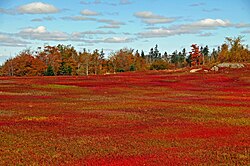
Often referred to as "wild blueberries," these are prostrate shrubs—plants that grow low to the ground—ranging from 10 centimeters to 4 meters in height. They produce small, pea-sized berries with an average mature weight of 0.3 grams. These plants are typically managed on "barrens" (natural berry fields) rather than being traditionally planted by farmers.
Highbush Blueberries
These are cultivated varieties that grow on taller bushes and produce larger fruit. Highbush blueberries prefer sandy or loam soils and have shallow root systems that benefit from fertilizer and mulch. Their leaves can be either deciduous (shedding annually) or evergreen.
Rabbiteye Blueberries
The rabbiteye blueberry (Vaccinium virgatum or V. ashei) is a distinct southern type produced primarily from the Gulf Coast states to the Carolinas. They differ biologically from both the highbush and lowbush varieties.
Botany and Growth Characteristics
Blueberries exhibit unique biological traits that allow them to thrive in specific environments. Wild blueberries reproduce via cross-pollination, but they also develop rhizomes—underground stems that allow a single plant to form a genetically identical network known as a clone.
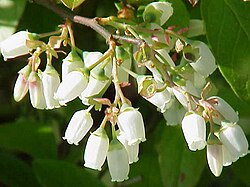
The flowers are bell-shaped and can range in color from white and pale pink to red or greenish.
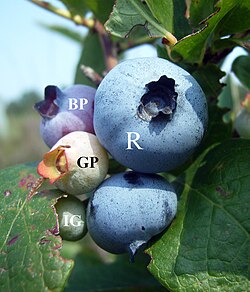
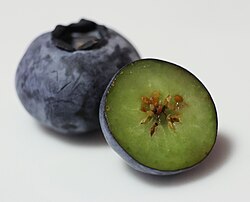
The fruit begins as a pale greenish berry, turns reddish-purple, and finally becomes uniformly blue upon ripening. A defining characteristic of the ripe berry is the "bloom," a protective coating of powdery epicuticular wax (a natural wax layer on the surface of the fruit).
Global Distribution and Production
While the genus Vaccinium has a circumpolar distribution (found across the Northern Hemisphere), the most commercially significant species originate in eastern and north-central North America.
North American Production
In the United States, Oregon and Washington are major producers of cultivated blueberries. New Jersey is also a historical hub; the town of Hammonton claims to be the "Blueberry Capital of the World." In Canada, British Columbia dominates highbush production, while Quebec is the leading producer of wild lowbush blueberries. Oxford, Nova Scotia, is recognized as the Wild Blueberry Capital of Canada.
International Expansion
North American species have been successfully introduced to the Southern Hemisphere. Countries such as Peru, Chile, Brazil, Australia, and New Zealand now grow blueberries commercially. In the Andes, a wild species known as Vaccinium meridionale is locally harvested.
![Vaccinium meridionale, a wild species of blueberry found in the Andes[36]](/images/97/b2/97b2cdbe15d5a5780435f59d2b1f115845d96fdd0a37d6b96d23b09067ccd727.jpg)
The transition to commercial cultivation began in the early 20th century in New Jersey, through the collaboration of Elizabeth Coleman White and USDA-ARS researcher Frederick Vernon Coville. Coville's research was pivotal in discovering the necessity of acidic soil and the fact that blueberries do not self-pollinate.

World Production Statistics (2024)
| Country | Production (Tonnes) |
|---|---|
| United States | 401,970 |
| Peru | 353,600 |
| Canada | 165,608 |
| Chile | 97,219 |
| Mexico | 80,534 |
| Spain | 60,950 |
| World Total | 1,392,534 |
Nutrition and Chemical Composition
Blueberries are composed of 84% water, 14% carbohydrates, and 1% protein, with negligible fat. A 100-gram serving provides approximately 57 calories.
They are particularly noted for providing a moderate percentage of the Daily Value (DV) for several essential micronutrients:
- Vitamin K: 16% DV
- Manganese: 15% DV
- Vitamin C: 11% DV
Pest and Disease Management
To maintain the premium cosmetic quality of the fruit, growers use Integrated Pest Management (IPM)—an ecosystem-based strategy that focuses on long-term prevention of pests. In North America, the most significant pests include Rhagoletis mendax, Acrobasis vaccinii, Grapholita packardi, and Conotrachelus nenuphar.
While some cultivars show natural resistance to certain insects, breeding programs have only recently begun to prioritize insect resistance, often utilizing marker-assisted breeding to identify desirable traits.
Frequently Asked Questions
What is the difference between "wild" and "cultivated" blueberries?
Wild blueberries (lowbush) are smaller, grow on prostrate shrubs, and are typically managed in natural barrens. Cultivated blueberries (highbush) are larger, grow on taller bushes, and are selectively bred for size and yield.
Why do blueberries have a powdery coating on them?
This coating is called the "bloom," which is actually epicuticular wax. It serves as a protective layer for the berry.
What kind of soil do blueberries need to grow?
Blueberries require highly acidic soil. For example, wild blueberries prefer a pH level between 4.2 and 5.2.
Are blueberries only grown in North America?
No. While native to North America, they are now grown commercially in Europe and the Southern Hemisphere, including Peru, Chile, Brazil, Australia, and New Zealand.
What are the primary nutritional benefits of blueberries?
They are a moderate source of Vitamin K, Vitamin C, and manganese, and are low in fat and calories.
What is a "rhizome" in the context of blueberries?
A rhizome is an underground stem. In wild blueberries, these stems allow the plant to spread and create a genetically identical patch or "clone."