Nizam's Contingent: The Evolution of a British-Officered Force in Hyderabad
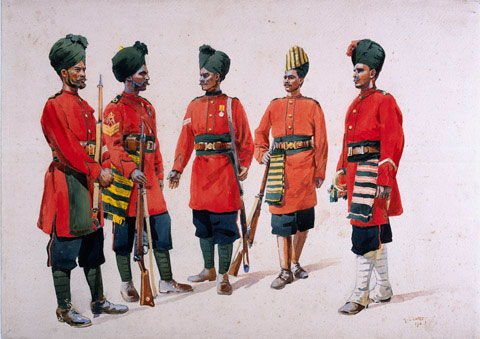
The Nizam's Contingent was a specialized military force officered by the British and maintained for the Nizam of Hyderabad. Spanning nearly 150 years of active service from 1798 to 1945, this unit evolved from a strategic tool to eliminate foreign influence in India into a distinguished component of the British Indian Army, eventually forming the basis of the modern Kumaon Regiment.
Key Facts
- Active Period: 1798 to October 27, 1945.
- Primary Allegiances: Hyderabad State, East India Company, and British India.
- Founding Purpose: Established by Governor-General Richard Wellesley to remove French influence from Hyderabad.
- Key Transitions: Renamed the Hyderabad Contingent in 1853 and later became the 19th Hyderabad Regiment in 1922.
- Final Evolution: Redesignated as the Kumaon Regiment following Indian independence.
Origins and the Removal of French Influence
The formation of the Nizam's Contingent was a calculated political move by Governor-General Richard Wellesley, the 1st Marquess Wellesley. Upon his arrival in India in 1798, Wellesley sought to purge British India of French influence. He achieved this by disbanding the Nizam of Hyderabad's existing Indian units, which were then under the command of the Frenchman Monsieur Raymond and other non-British Europeans.
These disbanded units were reorganized into a British-officered army. The force quickly proved its utility during the Mysore campaign (1790–1792). Their performance during the Siege of Seringapatam against Tipu Sultan in the Fourth Anglo-Mysore War was notably praised by Arthur Wellesley, the 1st Duke of Wellington, who recorded that the troops "behaved well." Because of this reliability, the Madras Presidency found it unnecessary to raise its own irregular troops, relying instead on the Nizam's forces.
Expansion: The Russell and Elichpur Brigades
The force expanded significantly in the early 19th century. In 1813, Sir Henry Russell, the British Resident to the court of the Nizam, raised the Russell Brigade, which initially consisted of two battalions. This was later expanded by four additional battalions, collectively known as the Berar Infantry. The soldiers of the Russell Brigade were primarily Hindus recruited from Oudh and other regions of Uttar Pradesh.
Simultaneously, Nawab Salabat Khan, the Subedar (provincial governor) of Berar, raised two battalions known as the Elichpur Brigade. These units were eventually integrated into the broader Nizam's forces.
Transition to the Hyderabad Contingent
By 1853, the force had grown to eight battalions. A pivotal treaty signed between the Nizam and the British shifted the administrative burden of the army. The East India Company assumed responsibility for maintaining the force, renaming it the Hyderabad Contingent. In exchange for this financial and administrative commitment, the British gained the rights to administer the Berar Division. During this era, the contingent operated in close coordination with the East India Company's Madras Army.
Loyalty and Global Deployment
The Hyderabad Contingent played a critical role during the Indian Rebellion of 1857. By remaining loyal to Company rule, the unit effectively prevented the revolt from spreading into the Mysore and Carnatic regions.
Under the British Raj, the contingent's operational scope expanded far beyond the borders of Hyderabad. The unit saw active service in several major conflicts, including:
- The Burma campaigns (1885–1887)
- Operations on the North-West Frontier (1897)
- The Boxer Rebellion in China (1900)
In 1902, seven of its regiments were officially transferred to the British Indian Army.
The World Wars and the Kumaon Regiment
During World War I, the force expanded further. On October 23, 1917, a Kumaon Battalion was raised at Ranikhet as the "4/39th Kumaon Rifles." By 1918, this became the 1st battalion, 50th Kumaon Rifles, with a second battalion following shortly after. In 1922, these units merged with the Hyderabad Contingent to form the 19th Hyderabad Regiment.
While some units were demobilized after the first Great War, the regiment expanded again during World War II. As the historical and geographical ties to the Deccan region weakened, the regiment was renamed the 19th Kumaon Regiment on October 27, 1945. Following India's independence, it was finally designated as the Kumaon Regiment.
Summary of Organizational Evolution
| Period/Year | Unit Name | Primary Allegiance | Key Change |
|---|---|---|---|
| 1798–1853 | Nizam's Contingent | Hyderabad State | Formed to replace French-led units |
| 1853–1858 | Hyderabad Contingent | East India Company | Company took maintenance for Berar rights |
| 1858–1922 | Hyderabad Contingent | British India | Integrated into British Indian Army (1902) |
| 1922–1945 | 19th Hyderabad Regiment | British India | Merged with Kumaon Rifles |
| 1945–Present | Kumaon Regiment | India | Renamed post-independence |
Frequently Asked Questions
Why was the Nizam's Contingent originally created?
It was created by Governor-General Richard Wellesley in 1798 to remove French military influence from the Hyderabad State by replacing French-led units with a British-officered force.
What was the Russell Brigade?
The Russell Brigade was a component of the Nizam's forces raised in 1813 by Sir Henry Russell. It consisted of battalions primarily recruited from Hindus in Oudh and Uttar Pradesh.
How did the unit contribute during the Indian Rebellion of 1857?
The Hyderabad Contingent remained loyal to the East India Company, which helped stop the rebellion from spreading into the regions of Mysore and the Carnatic.
What happened to the contingent after World War I?
In 1922, the Hyderabad Contingent merged with the Kumaon Rifles (which had been raised in 1917) to form the 19th Hyderabad Regiment.
What is the modern successor to the Nizam's Contingent?
The modern successor is the Kumaon Regiment of the Indian Army, which took its final name after the 19th Hyderabad Regiment was renamed in 1945 and subsequently adjusted after independence.