Niels Bohr: The Architect of Modern Atomic Theory
Niels Bohr was a transformative figure in theoretical physics whose work fundamentally altered our understanding of the microscopic world. From his early days in Copenhagen to his leadership of one of the world's most influential physics institutes, Bohr bridged the gap between classical physics and the strange, probabilistic realm of quantum mechanics—the branch of physics dealing with the behavior of matter and light on the atomic and subatomic scale.
His journey was not merely one of mathematical discovery but of deep philosophical inquiry, as he sought to reconcile the contradictory nature of particles and waves in the universe.
Key Facts
- Born: Copenhagen, Denmark.
- Died: November 18, 1962 (aged 77).
- Major Achievement: Developed the Bohr model of the atom.
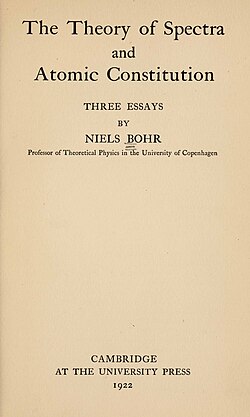
- Nobel Prize: Awarded the Nobel Prize in Physics in 1922.
- Core Philosophy: Introduced the principle of complementarity.
- Legacy: Founded the Niels Bohr Institute in Copenhagen.
The Bohr Model and the Structure of the Atom
At the start of the 20th century, scientists struggled to explain why atoms were stable and why they emitted light at specific frequencies. In 1913, Bohr introduced a revolutionary model of the hydrogen atom. He proposed that electrons do not spiral into the nucleus but instead move in fixed, circular orbits.
Central to this theory was the concept of the quantum jump: the idea that an electron can move from one orbit to another by absorbing or emitting a specific amount of electromagnetic radiation. This explained the Balmer series—the visible spectral lines of hydrogen—and provided a theoretical basis for the structure of the periodic table.
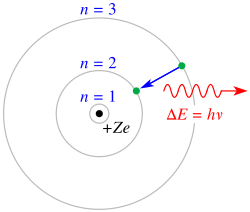
While the Bohr model was later refined by more complex theories, it served as a critical stepping stone in the evolution of atomic science, moving from the simpler Thomson and Rutherford models toward the modern wave-mechanical descriptions provided by Heisenberg and Schrödinger.

The Copenhagen Interpretation and Quantum Philosophy
Bohr's influence extended beyond specific models to the very interpretation of quantum physics. He established the Copenhagen interpretation, which suggests that physical systems do not have definite properties until they are measured.
He also developed the principle of complementarity, arguing that objects have complementary properties (such as being both a particle and a wave) that cannot be observed simultaneously. This philosophy was so central to his worldview that he incorporated a yin-yang symbol into his personal coat of arms with the motto Contraria sunt complementa ("opposites are complementary").
![Bohr's coat of arms, 1947. Argent, a taijitu (yin-yang symbol) Gules and Sable. Motto: Contraria sunt complementa ("opposites are complementary")[148]](/images/5f/ae/5fae9fff59cf37e1e19a62fad9b15c59cb50fad694e76deeddd6b8b77cb7ad8d.webp)
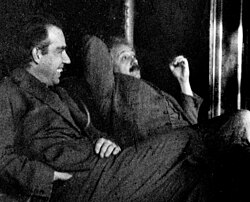
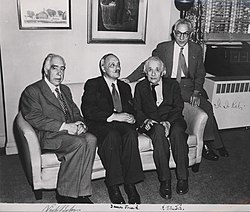
This perspective led to a famous, long-running intellectual debate with Albert Einstein, who was uncomfortable with the inherent randomness and lack of determinism in Bohr's quantum world.
Academic Leadership and Global Impact
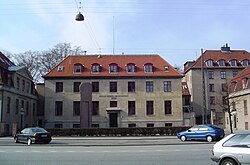
In 1921, Bohr founded the Institute of Theoretical Physics (now the Niels Bohr Institute) at the University of Copenhagen. The institute became a global hub for the brightest minds in physics, hosting a legendary roster of students and collaborators, including Werner Heisenberg, Wolfgang Pauli, and Linus Pauling.
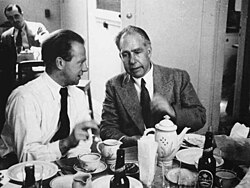
Bohr's career was marked by immense recognition, including the Hughes Medal, the Copley Medal, and the Nobel Prize. His commitment to science was matched by his humanitarian efforts; during World War II, he provided assistance to refugee scholars and became involved in the complex political landscape surrounding the Manhattan Project.
Summary of Niels Bohr's Contributions
| Contribution | Description | Significance |
|---|---|---|
| Bohr Model | Electrons orbit the nucleus in quantized levels. | Explained atomic stability and spectral lines. |
| Complementarity | Wave-particle duality as complementary views. | Foundation of quantum philosophy. |
| Copenhagen Interpretation | Properties are defined upon measurement. | Dominant view of quantum mechanics. |
| Correspondence Principle | Quantum laws merge into classical laws at large scales. | Linked classical and quantum physics. |
| Niels Bohr Institute | Research center in Copenhagen. | Trained a generation of Nobel laureates. |
Frequently Asked Questions
What is the Bohr model of the atom?
The Bohr model describes the atom as a small, positively charged nucleus surrounded by electrons that travel in circular orbits. Electrons can jump between these orbits by absorbing or emitting energy, which explains the specific light spectra emitted by elements.
What was the Copenhagen interpretation?
It is a philosophical framework in quantum mechanics suggesting that a particle does not possess definite physical properties until it is measured, and that the act of observation determines the outcome.
Why did Bohr and Einstein disagree?
Einstein believed in a deterministic universe where "God does not play dice," whereas Bohr argued that randomness and probability are fundamental characteristics of the quantum world.
What is the principle of complementarity?
Complementarity is the idea that some properties of a system are mutually exclusive but both necessary for a complete description. A primary example is the wave-particle duality of light and electrons.
Which awards did Niels Bohr receive?
Bohr received numerous prestigious awards, most notably the Nobel Prize in Physics in 1922, as well as the Hughes Medal (1921), the Franklin Medal (1926), and the Copley Medal (1938).