Newberry Library: The Early History and Evolution of a Chicago Landmark
The Newberry Library stands today as a premier destination for humanities research, but its origins were born from a unique set of circumstances and a vision that evolved over decades. Established in 1887, the institution was not the result of a lifelong passion for curation, but rather a testamentary bequest from a prominent Chicago businessman.
The Vision of Walter Loomis Newberry
The library was founded through the will of Walter Loomis Newberry, a leader in Chicago's banking, shipping, and real estate sectors. Newberry passed away at sea in 1868 during a voyage to France. His will stipulated the creation of a "free public library," provided that his daughters died without heirs. Following the death of his widow, Julia Butler Newberry, in 1885, estate trustees William H. Bradley and Eliphalet W. Blatchford were tasked with bringing this vision to life.
The founders faced a significant challenge: Newberry had left very few specific instructions regarding the library's character. Furthermore, they lacked a foundational collection, as Newberry's own personal books had been destroyed in the Great Fire of 1871. This left the early staff with a blank canvas to define the institution's purpose.
Architectural Evolution and the Poole-Cobb Conflict
The early trajectory of the Newberry was heavily influenced by its first librarian, William Frederick Poole. A prominent figure in the library world, Poole viewed the institution as an opportunity to implement his theories on library design and accessibility.
Before settling into its permanent home, the library moved through three temporary locations between 1887 and 1893: 90 La Salle Street, 338 Ontario Street, and the corner of State and Oak Streets. In 1893, the library opened its current doors at 60 West Walton Street, across from Washington Square. Designed by Poole and architect Henry Ives Cobb, the building is a striking example of the Spanish Romanesque style, constructed from Connecticut granite.
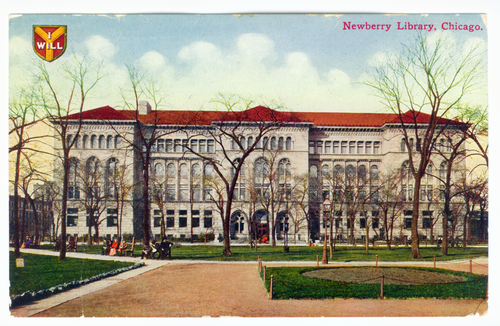
The construction process was marked by a bitter feud between Poole and Cobb. Poole advocated for a modern approach featuring multiple reading rooms and open shelving—where patrons could access materials directly. Conversely, Cobb favored the European trend of "majestic grandiosity" and centralized storage. While Poole's influence initially forced Cobb to scale back the grand staircase and include open shelving, the library eventually transitioned to a centralized system due to security concerns and staff strain.
Building a World-Class Collection
Under Poole's leadership until 1894, the Newberry focused on two primary goals: serving the practical needs of Chicago's professionals and acquiring rare materials for scholars. This dual approach led to the creation of a medical department in 1890 and the acquisition of prestigious private collections from Henry Probasco and Count Pio Resse.
These acquisitions brought legendary works into the library, including incunables (books printed before 1501), Shakespeare folios, and early editions of Horace, Dante, and Homer.
Strategic Specialization and Cooperation
To prevent the duplication of resources within the city, the Newberry entered into a cooperative agreement in 1896 with the Chicago Public Library and the John Crerar Library. This agreement divided academic territories to ensure each institution could specialize.
- The Newberry Library: Specialized in the humanities.
- The John Crerar Library: Specialized in the natural sciences.
As a result of this partnership, the Newberry transferred its natural science holdings—including a copy of Audubon's Birds of America—to the Crerar. The medical department followed in 1906, cementing the Newberry's identity as a sanctuary for humanities research.
Key Facts
- Founded: 1887 via a bequest from Walter Loomis Newberry.
- Architecture: Spanish Romanesque style built with Connecticut granite.
- Key Figures: William Frederick Poole (First Librarian) and Henry Ives Cobb (Architect).
- Specialization: Humanities (established via an 1896 agreement).
- Notable Holdings: Incunables, Shakespeare folios, and works by Homer and Dante.
| Period/Date | Milestone | Key Detail |
|---|---|---|
| 1887 | Establishment | Founded by trustees following the terms of Walter Loomis Newberry's will. |
| 1893 | Permanent Building | Opened at 60 West Walton Street in Spanish Romanesque style. |
| 1894 | End of Poole Era | Death of first librarian William Frederick Poole. |
| 1896 | Cooperative Agreement | Specialized in humanities; transferred sciences to John Crerar Library. |
| 1906 | Department Transfer | Medical department moved to the John Crerar Library. |
Frequently Asked Questions
Why was the Newberry Library established?
It was created from a bequest by Walter Loomis Newberry, who left funds for a "free public library" to be established if his daughters died without heirs.
What is the architectural style of the Newberry building?
The building is designed in the Spanish Romanesque style and is constructed using Connecticut granite.
What are "incunables" in the context of the library's collection?
Incunables are early printed books produced before the year 1501, many of which were acquired through the collections of Henry Probasco and Count Pio Resse.
How did the Newberry decide to focus on the humanities?
In 1896, the Newberry entered a cooperative agreement with the Chicago Public Library and the John Crerar Library to avoid duplicating resources, resulting in the Newberry specializing in the humanities while the Crerar took the natural sciences.
Who were the primary figures involved in the building's design?
The building was a collaborative, though often contentious, effort between the first librarian, William Frederick Poole, and the architect Henry Ives Cobb.