New Statesman: A Century of Political and Cultural Influence
Founded in 1913, the New Statesman has served as a cornerstone of British intellectual and political discourse for over a century. Established by Sidney and Beatrice Webb with the support of George Bernard Shaw and the Fabian Society—a socialist organization dedicated to gradualist reform—the publication was born from a need for a dedicated voice for Fabian politics after their previous outlet, The New Age, shifted its focus away from issues like women's suffrage.
From its early days as a provocative anti-war voice to its role as a key player in Labour Party politics, the magazine has navigated the complexities of the 20th and 21st centuries, evolving from a print weekly into a modern print-digital hybrid.
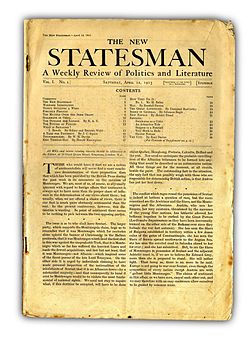
Key Facts
- Founded: 1913 by Sidney and Beatrice Webb.
- Longest-serving Editor: Kingsley Martin, who led the publication for 30 years (1930–1960).
- Political Leanings: Historically associated with the left and the Labour Party, though it has occasionally adopted neutral or centrist stances.
- Notable Contributors: George Bernard Shaw, H.G. Wells, and more recently, Andrew Marr.
- Modern Status: A print-digital hybrid with a significant online presence and a paid circulation of 34,451 as of January 2021.
The Early Years and the Impact of World War I
The magazine's first editor, Clifford Sharp, steered the publication until 1928. During the First World War, J.C. Squire managed the magazine while Sharp was on wartime duty. One of the publication's first major international successes occurred in November 1914, when it published George Bernard Shaw's "Common Sense About The War." This scathing critique of the conflict's causes sold 75,000 copies by the end of the year and was reprinted by The New York Times.
By the late 1920s, the magazine faced internal instability. Sharp's struggle with chronic alcoholism led his deputy, Charles Mostyn Lloyd, to handle editorial duties before the appointment of Kingsley Martin in 1930.
The Kingsley Martin Era (1931–1960)
Under Kingsley Martin's 30-year tenure, the New Statesman underwent significant expansion and political shifts. In 1931, it merged with The Nation and Athenaeum, bringing economist John Maynard Keynes into its orbit. In 1934, it absorbed The Week-end Review, introducing the famous "Weekly Competition" where readers submitted parodies—a feature that once saw author Graham Greene win second prize for parodying his own work.
Political Shifts and Soviet Controversy
During the 1930s, the magazine moved sharply to the left, championing pacifism and anti-fascism. However, its relationship with the Soviet Union was fraught with tension. While the magazine defended Soviet collectivization policies, Keynes criticized Martin for being too sympathetic toward Joseph Stalin. This tension peaked in 1938 when Martin refused to publish George Orwell's dispatches from the Spanish Civil War, fearing that criticism of the Soviet regime would be viewed as propaganda against socialism.
Post-War Influence and the Labour Party
By the end of World War II, circulation had grown to 70,000. The magazine became an essential voice for the Labour left, particularly through the work of Richard Crossman. In the 1950s, it remained a critic of British foreign policy and the leadership of Hugh Gaitskell. Notably, an article by J.B. Priestley in the magazine directly contributed to the formation of the Campaign for Nuclear Disarmament (CND).
Transition and Turbulence (1960–1996)
Following Martin's retirement in 1960, the magazine saw a series of editors, including John Freeman and Paul Johnson. Under Johnson, the publication reached its highest-ever circulation. Between 1964 and 1981, chairman Jock Campbell established the Jock Campbell-New Statesman Award, supporting writers from Africa and the Caribbean, such as Chinua Achebe and Wole Soyinka.
The latter part of the century was marked by declining circulation and legal battles. In 1993, a lawsuit brought by Prime Minister John Major over reports of an extramarital affair nearly bankrupted the magazine. Additionally, in 1994, KGB defector Yuri Shvets claimed the Soviet intelligence agency had used the magazine to spread disinformation through journalist Claudia Wright.
Modern Era and Digital Transformation
After being rescued from bankruptcy and sold to Labour MP Geoffrey Robinson in 1996, the magazine shifted toward supporting Tony Blair's "New Labour" under editor Ian Hargreaves. Subsequent editors, including Peter Wilby and John Kampfner, attempted to reposition the paper's political identity while managing financial volatility.
Since 2008, under the leadership of Jason Cowley, the New Statesman has seen a revitalization. Cowley has been recognized multiple times as "Current Affairs and Politics editor of the year" by the British Society of Magazine Editors. The publication has successfully transitioned into a "print-digital hybrid," expanding its web presence with sites like CityMetric and reaching peak online traffic of over 4 million unique visitors per month.
| Era/Editor | Key Focus/Event | Notable Outcome |
|---|---|---|
| Clifford Sharp (1913–1928) | Founding & WWI | International sensation with Shaw's anti-war supplement. |
| Kingsley Martin (1930–1960) | Left-wing activism | Growth to 70,000 circulation; influence on Labour politics. |
| Paul Johnson (1965–1970) | Peak Circulation | Reached highest ever circulation numbers. |
| Jason Cowley (2008–2025) | Digital Hybridization | Highest paid circulation in 40 years (as of 2021). |
Frequently Asked Questions
Who founded the New Statesman?
The magazine was founded in 1913 by Sidney and Beatrice Webb, with support from George Bernard Shaw and other members of the Fabian Society.
Why did the magazine refuse to publish George Orwell in 1938?
Editor Kingsley Martin refused Orwell's dispatches from the Spanish Civil War because they criticized the communists for suppressing anarchists and the POUM, which Martin feared would be seen as propaganda against socialism.
What was the 'Weekly Competition'?
Inherited from The Week-end Review, it was a popular feature where readers submitted jokes, parodies, and pastiches of famous authors.
How has the magazine changed in the digital age?
The New Statesman now operates as a print-digital hybrid, significantly increasing its online reach to millions of unique monthly visitors while maintaining a steady paid print circulation.
Who is the current editor?
As of 2025, Tom McTague has taken over as editor, succeeding Jason Cowley.