New Korean Orthography: The Short-Lived Linguistic Reform of North Korea
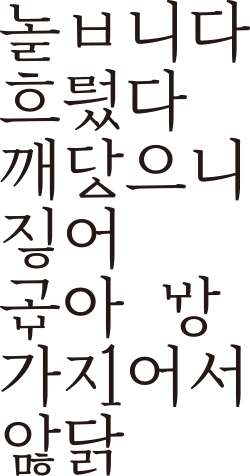
Between 1948 and 1954, North Korea implemented a radical linguistic experiment known as the New Korean Orthography. This spelling reform sought to fundamentally alter the Hangul alphabet to better reflect the underlying structure of the Korean language. While the system was eventually discontinued, it remains a significant historical marker of the cultural and political divergence between North and South Korea.
At its core, the reform was an attempt to address morphophonology—the study of how the sound patterns of a language interact with its grammatical structure. In standard Hangul, certain word roots change their spelling when they encounter different suffixes. The New Korean Orthography aimed to create invariable roots, ensuring that the core meaning of a word remained visually consistent regardless of its grammatical context.
The History of Language Planning in North Korea
Following the establishment of the North Korean government in 1945, the North Korean Provisional People's Committee launched an intensive language planning campaign modeled after Soviet methods. Initially, both North and South Korean scripts were based on the 1933 Unified Plan. However, the North Korean leadership sought to use language as a "cultural weapon of revolution.'
The campaign had several primary objectives:
- Increasing national literacy rates.
- Standardizing a "New Korean" to serve revolutionary goals.
- Eliminating Hanja (Chinese characters) to purify the language.
In 1949, a ban on Hanja was implemented, except for specific technical and scientific references. This movement aimed to replace Sino-Korean vocabulary and Japanese loanwords with native neologisms, viewing the former as "reactionary" elements that separated the intelligentsia from the masses. This era also saw the introduction of communist terminology and the compulsory study of Russian.
The Rise and Fall of the Reform
Promulgated in 1948 alongside the Standard Language Orthography Dictionary, the New Korean Orthography was championed by the Communist Party of Korea as the first script to represent the language of the proletariat. However, the system's lifespan was cut short by the Korean War and shifting political tides. By 1958, the reform's creator, Kim Tu Bong, was purged from the party, and the orthography fell out of official use.
Following the purge, linguistic focus shifted toward ethnic nationalism. In the 1960s, Kim Il Sung directed that language planning be bound to Korean nationalism, leading to the selection of the Pyongan dialect as the standard, as it was perceived to be less contaminated by foreign influences.
Technical Mechanics of the New Orthography
The most striking feature of the New Korean Orthography was the addition of five consonants and one vowel. These letters were not intended to represent entirely new sounds, but rather to act as markers for instances where a sound might change during inflection. For example, instead of changing a root from kŏt- to kŏl-, a new letter was used to keep the root stable.
New Letters and Their Functions
The reform introduced several specific characters to handle phonetic shifts:
- ㅿ (soft riŭl): Used to stabilize roots where sounds shift between /l/ and /t/.
- ㆆ (soft hiŭt): Used to represent specific phonetic transitions.
- ㅸ (wiŭp): A new vowel/consonant hybrid.
- Other additions: Included ㅿ, ㆆ, ㅸ, ㅿ, and a numeral-based character.
The system also introduced two new digraphs (two-letter combinations): ㅭ (/lʔ/) and ᇬ (/ŋk/).
Comparison of Orthographic Approaches
| Feature | Standard Hangul Approach | New Korean Orthography Approach |
|---|---|---|
| Root Stability | Roots change spelling based on suffixes (e.g., 걷다 vs. 걸어). | Roots remain invariable using new letters (e.g., 거ᇫ다). |
| Morpheme Separation | Morphemes are integrated into a single syllable block. | Politeness morphemes (like ㅂ) are often separated into their own blocks. |
| Hanja Usage | Commonly used in South Korea. | Strictly banned in North Korea (except for technical use). |
| Standard Dialect | Based on Seoul dialect. | Based on Pyongan dialect. |
Key Facts
- Period of Use: The New Korean Orthography was used in North Korea from 1948 to 1954.
- Primary Goal: To create a morphologically consistent writing system that reflected the language's roots.
- Key Figure: The system was created by linguist Kim Tu Bong.
- Linguistic Impact: It introduced six additional letters to the Hangul alphabet.
- Current Status: Discontinued; North Korea now uses a version of Hangul similar to South Korea, though with different morphological tendencies.
Frequently Asked Questions
Did the new letters represent new sounds?
No. The additional letters were primarily used to maintain consistent spelling for roots that would otherwise change their appearance due to phonetic shifts.
Why was the reform discontinued?
The reform was interrupted by the Korean War and eventually abandoned following the political purge of its creator, Kim Tu Bong, in 1958.
How does North Korean Hangul differ from South Korean Hangul today?
While the basic alphabet is similar, North Korean usage tends to reflect morphology (the structure of words) more closely than the pronunciation-based approach often seen in the South.
Is there an effort to preserve this orthography?
Yes, linguists have recognized its historical significance and have proposed adding the six additional letters into the Unicode system to ensure the script is preserved digitally.
What was the role of Hanja in this period?
As part of a language purification movement, North Korea banned the use of Hanja in 1949 to replace Sino-Korean vocabulary with native Korean words.