Koreanic Languages: History, Evolution, and Linguistic Classification
The Koreanic language family represents a significant linguistic group primarily distributed across the Korean peninsula and Northeast China. As one of the world's primary language families, it encompasses a diverse range of extant and extinct varieties that have shaped the cultural and historical landscape of East Asia.
From the well-documented modern Korean language to the more mysterious remnants of ancient tongues like Goguryeo, the Koreanic family offers a window into the migration, conquest, and social evolution of Northeast Asian peoples.
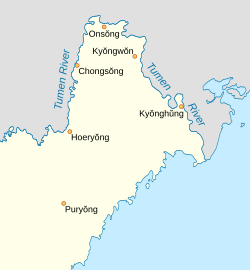
![Dialect zones[4][5][6]](/images/58/48/5848a99f5f7436959c81f912f65b64d217cfb82c518556789f88b1bbd890c2dc.webp)
Key Facts
- Primary Distribution: Korea and Northeast China.
- Major Extant Languages: Korean, Jeju, and Yukjin.
- Historical Varieties: Proposed extinct languages include Baekje and Goguryeo.
- Linguistic Milestone: The introduction of the Hangul alphabet in the 15th century provided precise documentation for the language.
- Vocabulary Composition: Sino-Korean (Chinese-derived) loanwords account for over 50% of the Korean lexicon, though they comprise only about 10% of basic vocabulary.
The Evolution of the Korean Language
The history of the Korean language is categorized into distinct periods based on the availability of written records. The most extensively documented era is the Late Middle Korean period, following the creation of the Hangul alphabet in the 15th century.
Prior to Hangul, Korean was written using various strategies involving Chinese characters. This led to a significant absorption of Chinese loanwords, which deeply influenced the language's development. Key sources for the Early Middle Korean period (10th to 14th centuries) include the Chinese text Jilin leishi (1103–1104) and the mid-13th-century pharmacological work Hyangyak kugŭppang.
Old and Middle Korean Records
The Old Korean period (6th to early 10th centuries) is much more sparsely attested. Most of our knowledge from this era comes from stone inscriptions and 14 hyangga songs, which were composed between the 7th and 9th centuries and later recorded in the 13th-century text Samguk yusa.
Subdivisions and Regional Varieties
The Koreanic family is not a monolith; it consists of several distinct branches and dialects:
- Korean: The most widely spoken member of the family.
- Jeju: A distinct language spoken on Jeju Island.
- Yukchin: A group of varieties found in the six garrisons of far northeastern Korea.
- Extinct Varieties: Scholars debate the linguistic nature of Baekje and Goguryeo, with some suggesting they were Koreanic, others Japonic, or an intermediate form.
Global Korean Communities
The Koreanic diaspora includes unique linguistic developments. In the Russian Far East, Korean speech was documented by scholars like Mikhail Putsillo in 1874. Following the forced deportations to Soviet Central Asia in the 1930s, small communities in Uzbekistan and Kazakhstan maintained forms of Korean known as Koryo-mar. Additionally, a Korean population exists on Sakhalin, descended from those transferred there before 1945.
Linguistic Foundations: Proto-Koreanic
Linguists reconstruct Proto-Koreanic to understand the ancestral state of these languages. The reconstructed consonant inventory is relatively simple, featuring stops, nasals, fricatives, a tap, and an approximant.
| Type | Bilabial | Alveolar | Palatal | Velar |
|---|---|---|---|---|
| Stop | *p | *t | *c | *k |
| Nasal | *m | *n | *ŋ | |
| Fricative | *s | *h | ||
| Tap | *r | |||
| Approximant | *j |
Historical Context and External Relations
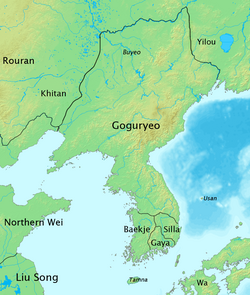
The early history of the Koreanic-speaking regions is closely tied to Chinese political influence. In 108 BC, the Han dynasty established the Four Commanderies of Han in northern Korea, with Lelang being the most prominent until 314 AD.
![Chinese commanderies (in purple) and their eastern neighbours mentioned in the Records of the Three Kingdoms[148]](/images/31/d7/31d70dca8fe58afe1b9cf5f203f5473070dace07ec09dc53a8d59349153225eb.webp)
The Three Kingdoms period is a major focus of linguistic study. The Samguk sagi (compiled in 1145) provides evidence for the Goguryeo language through place names. While the pronunciations are recorded using Chinese characters and are difficult to interpret, they offer clues to whether Goguryeo was Koreanic, Japonic, or a hybrid.
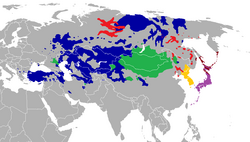
Regarding external relationships, while some have proposed links to the Altaic family or Japonic languages, other theories—such as connections to Dravidian or Austronesian languages—have historically attracted very little scholarly interest.
Frequently Asked Questions
What is the difference between Korean and Jeju?
Jeju is considered a distinct language within the Koreanic family, separate from the standard Korean spoken on the mainland.
How much of the Korean language comes from Chinese?
Sino-Korean vocabulary makes up more than half of the total Korean lexicon, though it represents only about 10% of the language's basic, everyday vocabulary.
What was the Goguryeo language?
The exact nature of the Goguryeo language is unknown. Scholars use place names from the Samguk sagi to debate whether it was Koreanic, Japonic, or an intermediate language.
What is Koryo-mar?
Koryo-mar refers to the specific forms of Korean maintained by Korean communities living in Central Asia, following their forced deportation from the Russian Far East in the 1930s.
When did the Korean language become easy to read?
The language became much more precisely documented in the 15th century with the introduction of the Hangul alphabet.