New Jersey Legislature: Structure, History, and Governance
The New Jersey Legislature serves as the legislative branch of the government for the state of New Jersey. Operating as a bicameral system—meaning it consists of two separate houses—the legislature is responsible for creating state laws and overseeing the state's budget. Based in the state capital of Trenton at the New Jersey State House, the body is currently governed by the New Jersey Constitution of 1947.
Key Facts
- Structure: Comprised of the Senate (40 members) and the General Assembly (80 members).
- Meeting Place: New Jersey State House, Trenton.
- Election Cycle: Held in November of every odd-numbered year.
- Senate Terms: Generally four years, following a unique "2-4-4" cycle.
- Assembly Terms: Two years.
- Youth Representation: The New Jersey Legislative Youth Council provides advisory input from citizens aged 15 to 23.
Historical Evolution
Colonial Origins and Early Governance
The legislature was established in 1702 after the Proprietors of East and West Jersey surrendered government rights to Queen Anne. This created a royal colony with a fusion of powers, where executive, legislative, and judicial authorities often overlapped. The early system featured an appointed Council and an elected General Assembly, which grew from 24 to 30 members by 1768.
The Revolutionary Era and the 1776 Constitution
As tensions rose during the American Revolution, a Provincial Congress was formed in 1775 to replace the Royal Governor. This led to the Constitution of 1776, which established a bicameral legislature where all state officials, including the governor, were appointed by the legislative body.
The 1844 and 1947 Constitutions
The Constitution of 1844 introduced a significant shift by allowing the direct popular election of the governor and granting the governor veto power. The Legislative Council was renamed the Senate, and the General Assembly was expanded to 60 members.
The modern era began with the New Jersey Constitution of 1947. This document strengthened the governor's veto powers and consolidated independent agencies into 20 executive departments. It also set the stage for the current term lengths for Senators and Assembly members.
Organization and Membership
The New Jersey Senate
The Senate serves as the upper house. It consists of 40 members, each representing one of the state's 40 legislative districts. To be eligible for the Senate, a candidate must be at least 30 years old, a resident of the state for four years, and a resident of their specific district for two years.
The General Assembly
The General Assembly is the lower house, consisting of 80 members. Each of the 40 legislative districts elects two members to the Assembly. Candidates must be at least 21 years old, have resided in the state for two years, and have lived in their district for at least one year.
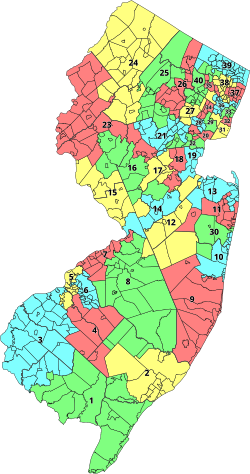
Legislative Terms and the "2-4-4" Cycle
New Jersey employs a unique "2-4-4" election cycle for the Senate. Senators serve a two-year term at the start of a new decade, followed by two four-year terms. This ensures that Senate boundaries, which are redrawn every ten years based on the U.S. Census, are updated quickly and remain accurate.
Compensation and Costs
Legislative service in New Jersey is considered part-time. As of 2002, the base salary was $49,000, though this is scheduled to increase to $82,000 beginning in 2026. The Senate President and Assembly Speaker earn an additional one-third over the base salary. Each legislator is also provided an annual allowance of $150,000 for staff salaries.
In 2008, the legislature banned "double dipping," the practice of holding a state legislative seat and a county or municipal office simultaneously. A few legislators who held multiple offices prior to February 1, 2008, were grandfathered into the system.
| Feature | Senate | General Assembly |
|---|---|---|
| Total Seats | 40 | 80 |
| Members per District | 1 | 2 |
| Standard Term Length | 4 Years (2-4-4 cycle) | 2 Years |
| Minimum Age | 30 | 21 |
| State Residency Req. | 4 Years | 2 Years |
Frequently Asked Questions
How many members are in the New Jersey Legislature?
The legislature has a total of 120 members: 40 in the Senate and 80 in the General Assembly.
What is the "2-4-4" cycle in the New Jersey Senate?
It is a term structure where Senators serve one two-year term at the beginning of a decade and two four-year terms thereafter. This allows Senate districts to be updated more frequently following the decennial census.
Is being a New Jersey legislator a full-time job?
No, service in the New Jersey Legislature is considered part-time, and most members maintain other employment.
What is the New Jersey Legislative Youth Council?
Established by the New Jersey Legislative Youth Council Act of 2022, this is an advisory body consisting of 40 public members aged 15 to 23, representing each of the state's legislative districts.
What is "double dipping" in New Jersey politics?
Double dipping refers to the practice of concurrently holding a state legislative office and another elected office at the municipal or county level. This practice was banned in 2008, except for those grandfathered in.