New Jersey Department of Transportation
The New Jersey Department of Transportation (NJDOT) is the primary agency responsible for the state's transportation policy and infrastructure. From the maintenance of thousands of miles of public roads to the strategic planning of intermodal freight systems, NJDOT ensures the safe and efficient movement of people and goods across the Garden State.
Headquartered in Ewing, New Jersey, the agency is led by the Commissioner of Transportation, currently Priya Jain. The department oversees a vast network of highways and coordinates with various state and federal entities to modernize New Jersey's transit landscape.

Key Facts
- Established: December 12, 1966, as the first state transportation agency in the U.S.
- Road Network: Managed 2,316.69 miles of owned and operated roads as of July 2015.
- Leadership: Led by Commissioner Priya Jain, supported by Deputy Commissioner Joseph D. Bertoni and CFO Charles Maciejunes.
- Scope: Oversees public roads, freight planning, aviation facilities, and statewide traffic management.
- Exclusions: Toll routes (e.g., NJ Turnpike, Garden State Parkway) are managed by the New Jersey Turnpike Authority.
Evolution of New Jersey Transportation
Colonial and Post-Colonial Foundations
The roots of New Jersey's road system date back to the 17th century. The Public Roads Act of 1676 established a route from Middletown to Piscataway in East Jersey, while the 1681 and 1684 acts in West Jersey created essential links between Burlington, Salem, and towns along the Delaware River.
By 1891, New Jersey became a pioneer in transportation funding with the State Road Aid Law, which allocated $75,000 to help counties build highways. Initially, road oversight fell under the President of the New Jersey State Board of Agriculture, with Edward Burrough serving in this capacity from 1892 to 1894.
The Rise of Formal Commissions
The Public Roads Act of 1894 separated road management from the Board of Agriculture, creating the position of Commissioner of Public Roads. This evolved into the State Highway Commission in 1909. By 1917, the State Highway Department was formed, governed by an eight-member commission appointed by the governor, with John Warne Herbert Jr. serving as the first chairman.
Over the following decades, the governance structure shifted. In 1923, the commission was reduced to four members, and by 1935, authority was consolidated under a single State Highway Commissioner.
The Modern Era of NJDOT
The current iteration of the agency was established via the Transportation Act of 1966. This landmark legislation created NJDOT on December 12, 1966, marking the first time a U.S. state had a dedicated comprehensive transportation agency.
Since its inception, NJDOT has undergone several structural changes. In 1979, the agency's rail division was folded into the newly created New Jersey Transit. Additionally, the Division of Motor Vehicles (DMV) remained part of NJDOT until 2003, when it was reorganized into the independent New Jersey Motor Vehicle Commission (MVC).
Divisions, Programs, and Services
Public Roads and Engineering
NJDOT is responsible for the development and maintenance of the state's public road system, including Federal and State highways. This involves rigorous technical planning, design, and research through its engineering division. Since the late 1970s, the agency has also worked to modify or phase out many of the state's traditional traffic circles to improve safety and flow.
Freight and Aviation
The agency develops strategic policies for intermodal transportation—the use of two or more modes of transport—covering trucking, rail, maritime, and air freight. Furthermore, the Bureau of Aeronautics provides oversight for public-use airports, heliports, and balloon ports, managing everything from safety to aerial advertising licenses.
Traffic Management and Capital Programs
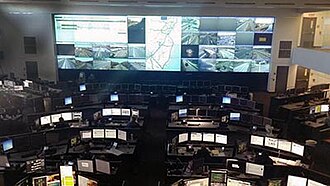
To manage real-time road conditions, NJDOT operates the Statewide Traffic Management Center (STMC) in Woodbridge Township. This 24/7 facility coordinates logistics during major incidents and houses representatives from the New Jersey State Police and the New Jersey Turnpike Authority.
Funding for these initiatives is managed through the Transportation Capital Program and the Statewide Transportation Improvement Program (STIP), which allocate state and federal funds for projected investments and grants for local projects, such as transit villages.
Agency Summary
| Category | Details |
|---|---|
| Founded | December 12, 1966 |
| Headquarters | 1035 Parkway Avenue, Ewing, NJ |
| Current Commissioner | Priya Jain |
| Roads Managed | 2,316.69 miles (as of 2015) |
| Key Facilities | Statewide Traffic Management Center (STMC) |
Frequently Asked Questions
Does NJDOT manage the New Jersey Turnpike?
No. While NJDOT manages most state and federal highways, toll routes such as the New Jersey Turnpike, Garden State Parkway, and Atlantic City Expressway are managed by the New Jersey Turnpike Authority.
What is the role of the Statewide Traffic Management Center (STMC)?
The STMC, located in Woodbridge Township, is a 24/7 hub that coordinates statewide resources and logistics during major traffic incidents, working alongside the New Jersey State Police.
When did the DMV separate from NJDOT?
The Division of Motor Vehicles was part of NJDOT until 2003, at which point it was reorganized as the self-operating New Jersey Motor Vehicle Commission (MVC).
What does the Bureau of Aeronautics oversee?
The Bureau of Aeronautics manages public-use airports and restricted facilities like heliports and airstrips, while also handling licensing for aerial activities and aviation safety.
How does NJDOT handle rail transportation?
While NJDOT previously funded and supported passenger rail (including procuring rolling stock), these responsibilities were transferred to New Jersey Transit in 1979. NJDOT remains a member of the Northeast Corridor Commission.