Neuquén: The Dynamic Capital of Argentina's Patagonia
Located in the extreme east of its namesake province, Neuquén serves as the capital of both the Neuquén Province and the Confluencia Department. The city is strategically positioned west of the confluence of the Limay and Neuquén rivers, which merge to form the Río Negro. This unique geography places the city within the Alto Valle del Río Negro ecoregion, a fertile strip of land in an otherwise arid landscape.
As of the 2022 Census, the city had 287,787 inhabitants. When combined with the surrounding Neuquén–Plottier–Cipolletti conurbation, the population exceeds 500,000, establishing it as the largest urban agglomeration in Patagonia.
Key Facts
- Founded: 1904, making it the newest provincial capital in Argentina.
- Etymology: Named after the Neuquén River; in Mapudungun, it means "water that has strength."
- Unique Feature: It is the only Argentine city with a palindrome name.
- Economic Drivers: Agriculture (apples and pears) and a massive petrochemical industry.
- Global Significance: Proximity to Vaca Muerta, one of the world's three largest shale gas and oil reserves.
History and Evolution
The region was originally inhabited by mobile groups who moved according to seasonal food availability. By the 16th century, these populations were largely assimilated by the Mapuche people, who utilized the river confluence as a vital trail.
European exploration began in the 17th century. In 1604, Hernando Arias de Saavedra explored the Patagonian trails, and later, in 1783, Basilio Villarino reached the confluence of the Limay and Neuquén rivers via the Río Negro.
The modern city began to take shape in 1885 when lands in the area, then known as Confluencia, were auctioned. Following the Conquest of the Desert military campaign, the Argentine government partnered with the British-owned Buenos Aires Great Southern Railway to populate the region. The railroad arrived in 1904, the same year Neuquén was officially founded and designated as the capital, replacing Chos Malal.
While the town remained small until 1930, the discovery of oil by the state company YPF in the 1960s sparked massive demographic growth. This era also saw the establishment of the National University of Comahue in 1971. In a more recent milestone, 2020 saw the founding of the Costa Limay Sustainable Complex for Transgender Women, the world's first permanent housing program for transgender people.
Economy and Industrial Growth
Neuquén operates as a dual economic powerhouse. It is a critical agricultural center within the Alto Valle region, producing high-quality pears and apples through irrigation from the Limay and Neuquén rivers.
Simultaneously, the city is a petrochemical hub. The discovery of the Vaca Muerta shale fields has triggered an unprecedented boom in construction and real estate. As the primary urban center in the region, Neuquén is evolving into the operational headquarters for global oil and gas companies and their suppliers.
Transport and Infrastructure
The city is well-connected by road, rail, and air. National Route 22 (RN22) is the primary artery, linking the city to Bahía Blanca on the Atlantic coast and Temuco in Chile. Within the city, Avenida General Mosconi serves as a major fast-transit divide.
Air travel is facilitated by the Presidente Perón Airport, located 8 kilometers west of the center, offering flights to major cities including Buenos Aires, Córdoba, and Mendoza. For local transit, the Tren del Valle commuter rail connects Neuquén with Plottier and Cipolletti, while a network of 30 bus lines serves the urban area.
Climate and Geography
Neuquén is characterized by an arid climate (Köppen BWk). It experiences low annual precipitation, averaging 200 millimeters (8 inches), and high thermal amplitude due to its distance from large bodies of water.
Summers are warm and windier, with mean temperatures around 23°C (73°F) in December and January. Winters are cold, with July temperatures often dropping below 6°C (43°F). The city is known for strong westerly and southwesterly winds that increase evapotranspiration.
| Metric | Winter (July) | Summer (January) | Annual Average |
|---|---|---|---|
| Mean Daily Max Temp | 13.1°C (55.6°F) | 32.1°C (89.8°F) | 22.6°C (72.7°F) |
| Mean Daily Min Temp | 0.5°C (32.9°F) | 15.9°C (60.6°F) | 8.1°C (46.6°F) |
| Average Precipitation | 17.9 mm | 13.5 mm | 211.7 mm |
| Daily Sunshine Hours | 4.8 hours | 10.4 hours | 7.4 hours |
Culture, Sport, and Landmarks
The city blends historical railway architecture with modern art. Museums such as the Gregorio Álvarez and Paraje Confluencia are housed in early 20th-century railroad buildings. In contrast, the Museo Nacional de Bellas Artes, opened in 2004, is a contemporary facility showcasing international and national art.
Neuquén is also a significant sporting venue. The 8,000-seat Estadio Ruca Che hosted the 2001 FIBA Americas Championship, where Argentina won the gold medal.
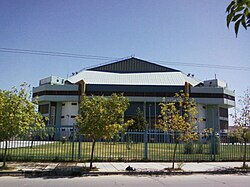
Additionally, the city has hosted the FIM Motocross World Championship since 2015, with its Villa La Angostura track receiving high international acclaim.
Frequently Asked Questions
What does the name Neuquén mean?
The name comes from the Mapudungun word "nehuenken," which translates to "water that has strength" or "drafty," referring to the Neuquén River.
Why is Neuquén economically important?
It is a major agricultural producer of fruits in the Alto Valle region and a critical industrial hub for the petrochemical sector due to the Vaca Muerta shale oil and gas reserves.
What is the climate like in Neuquén?
The city has an arid climate with low rainfall, high temperature variations between day and night, and strong winds, particularly during the summer months.
How do people travel within and to Neuquén?
Visitors can arrive via the Presidente Perón Airport or National Route 22. Locally, the city is served by the Tren del Valle commuter rail and an extensive network of 30 bus lines.
Is Neuquén a large city?
With a city population of 287,787 and a wider urban agglomeration of over 500,000, it is the largest urban center in the Patagonia region.