Nepenthes smilesii: The Resilient Pitcher Plant of Indochina
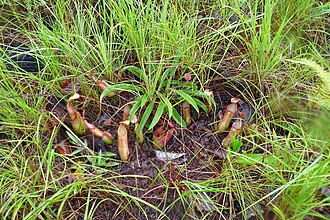
Among the diverse array of carnivorous flora in Southeast Asia, Nepenthes smilesii stands out as a remarkably hardy species. This tropical pitcher plant is native to the Indochinese region, specifically spanning northeastern Thailand, southern Laos, Cambodia, and Vietnam. Unlike many of its more delicate relatives, this species is well-adapted to challenging environments, including open sandy savannahs and grasslands.
Named after the plant collector Frederick Henry Smiles, who first documented the species, N. smilesii is recognized for its ability to withstand extended dry seasons and significant temperature fluctuations, making it a fascinating subject for botanists and horticulture enthusiasts alike.
Key Facts
- Conservation Status: Least Concern (IUCN 3.1).
- Native Range: Cambodia, Vietnam, southern Laos, and northeastern Thailand.
- Habitat: Open grasslands and sandy savannahs.
- Growth Habit: A climbing plant reaching up to 5 meters in height.
- Altitude: Found from 16 to 1,500 meters above sea level (typically around 800 m).
Botanical Description and Identification
Nepenthes smilesii is a climbing plant that can reach a maximum height of 5 meters. Its physical characteristics are distinct, particularly its foliage. The leaves are sessile (attached directly to the stem without a stalk) and coriaceous, meaning they have a tough, leathery texture.
The leaves are very narrowly linear, typically growing up to 40 cm in length but remaining quite slim, with a maximum width of 4 cm. These adaptations help the plant thrive in the exposed, sunny environments of the savannah.
Distinguishing N. smilesii from Similar Species
This species is closely related to N. kongkandana, and the two can be difficult to tell apart. However, they differ in a few key botanical details:
- Laminae (Leaf Blades): N. smilesii has linear to lanceolate leaves with an acute apex (pointed tip), whereas N. kongkandana has obovate leaves with an acuminate apex.
- Tendrils: N. smilesii possesses shorter tendrils.
- Peristome: The peristome (the rim around the mouth of the pitcher) is narrower in N. smilesii.
Ecology and Distribution
The distribution of N. smilesii is widespread across Indochina. While it can be found at extreme elevations ranging from 16 to 1,500 meters above sea level, it is most commonly encountered at approximately 800 meters. One of its most notable ecological traits is its ability to survive extreme temperature lows, a rarity among Indochinese Nepenthes.
In the wild, this species occasionally interacts with other pitcher plants. Natural hybrids between N. smilesii and N. mirabilis have been recorded in Cambodia, showcasing the genetic fluidity of these carnivorous plants in their native habitats.
Botanical History and Taxonomy
The taxonomic history of N. smilesii has been marked by some confusion. For much of the 20th century, it was referred to as Nepenthes anamensis, which is now considered a heterotypic synonym. Additionally, plants of this species were erroneously labeled as N. thorelii within the horticultural trade.
There has also been debate regarding its relationship with N. mirabilis. While some sources list N. mirabilis f. smilesii and N. mirabilis var. smilesii as synonyms of N. smilesii, other experts, such as Marcello Catalano, argue that these are simply normal forms of N. mirabilis.
| Feature | Detail |
|---|---|
| Scientific Name | Nepenthes smilesii |
| Family | Nepenthaceae |
| Max Height | 5 meters |
| Leaf Texture | Coriaceous (Leathery) |
| Typical Altitude | ~800 m asl |
| IUCN Status | Least Concern |
Frequently Asked Questions
Where is Nepenthes smilesii naturally found?
It is native to Indochina, specifically in Cambodia, Vietnam, southern Laos, and northeastern Thailand, typically inhabiting open sandy savannahs and grasslands.
How does N. smilesii differ from N. kongkandana?
It differs primarily by having linear to lanceolate leaves with an acute apex, shorter tendrils, and a narrower peristome compared to N. kongkandana.
Is Nepenthes smilesii an endangered species?
No, according to the IUCN 3.1 Red List, its conservation status is listed as Least Concern.
What makes this species ecologically unique?
N. smilesii is notable for its ability to tolerate extended dry seasons and experience extreme temperature lows compared to other Nepenthes species in the Indochinese region.
What is the relationship between N. smilesii and N. anamensis?
Nepenthes anamensis is a heterotypic synonym of N. smilesii; the plant was referred to by this name throughout most of the 20th century.