Nazi Germany Administrative Divisions: Gaue and Reichsgaue
The administrative landscape of Nazi Germany was defined by a complex overlap of party and state structures. Central to this system were the Gaue, regional divisions that evolved from simple party associations into the primary instruments of government control across the Reich.
The Evolution of the Gau
The term Gau was revived by 18th and 19th-century German historians who viewed it as an ancient administrative structure used by Germanic peoples. In the 1920s, the National Socialist German Workers' Party (NSDAP) adopted the term to name its regional associations. Formally established by a party statute on May 22, 1926, each Gau served as a specific administrative region headed by a Gauleiter.
Initially, there were 33 Gaue. These regions were generally coterminous with the Reichstag election districts of the Weimar Republic, based on the provinces of Prussia and the constituent states, known as Länder.
The role of the Gau shifted dramatically following the Gleichschaltung—the process of "coordination" used by the Nazi regime to bring all aspects of society and government under party control. With the suppression of the political institutions of the Länder and the appointment of Reichsstatthalter (Reich Governors) in 1933, the Gaue became the de facto administrative regions of the government. This transition granted each Gauleiter significant power within their respective territories.
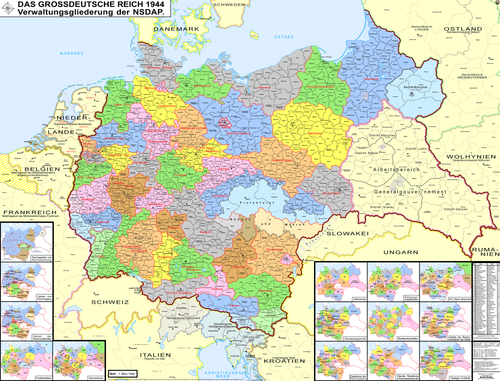
The Establishment of Reichsgaue
As Nazi Germany began annexing neighboring territories in the late 1930s, a new civil administration unit was created: the Reichsgau. While the original Gaue were primarily party structures that evolved into state roles, the Reichsgaue were designed from the outset to formally combine party and state administration.
Annexation of Austria and Czechoslovakia
Following the 1938 annexation of Austria, the country was briefly renamed Ostmark (until 1942) and divided into seven Reichsgaue. These boundaries largely mirrored the former Austrian Länder, with some modifications:
- Tyrol and Vorarlberg were merged into Reichsgau Tyrol-Vorarlberg.
- Burgenland was split between Reichsgau Styria and Reichsgau Niederdonau (the renamed Lower Austria).
- Upper Austria became Reichsgau Oberdonau (Upper Danube).
These renaming efforts were intentional, effectively removing the name "Austria" (Österreich) from official maps. Additionally, the official territory of Vienna was significantly expanded at the expense of the Lower Danube region.
Territories annexed from Czechoslovakia were primarily organized as the Reichsgau Sudetenland, though southern annexed areas were incorporated into the Reichsgaue of Lower and Upper Danube.
Expansion into Poland and Western Europe
After the 1939 invasion of Poland, the Nazi regime reannexed the western half of the Łódź voivodeship and the Pomeranian and Poznań voivodeships. These became the Reichsgau Wartheland and Reichsgau Danzig-Westpreussen, the latter of which included the former Free City of Danzig. Other Polish areas were absorbed into existing Gaue, such as Zichenau into East Prussia and the Silesian voivodeship (including Biała and Oświęcim) into Upper Silesia.
Following the 1940 invasion of France, Alsace-Lorraine was re-annexed. The département of Moselle was integrated into the Gau Saar-Palatinate, while Bas-Rhin and Haut-Rhin joined Gau Baden. Similarly, Luxembourg was annexed to Gau Koblenz-Trier, and the Belgian territories of Malmedy and Eupen were incorporated into Gau Cologne-Aachen.
Key Facts
- Gau: Originally an NSDAP party regional association established in 1926.
- Gauleiter: The high-ranking party official who headed each Gau.
- Gleichschaltung: The process of synchronizing state and party institutions to consolidate Nazi power.
- Reichsgau: Administrative units created for annexed territories that merged party and state functions.
- Ostmark: The temporary name for annexed Austria between 1938 and 1942.
| Unit Type | Origin/Purpose | Key Characteristic | Example Regions |
|---|---|---|---|
| Gau | NSDAP Party Statute (1926) | Evolved from party to de facto state administration | Baden, East Prussia, Cologne-Aachen |
| Reichsgau | Annexed Territories (post-1938) | Formal merger of party and state administration | Wartheland, Sudetenland, Tyrol-Vorarlberg |
Frequently Asked Questions
What was the difference between a Gau and a Reichsgau?
A Gau began as a regional association of the Nazi Party (NSDAP) and later became a de facto state administrative region. A Reichsgau was a unit created specifically for annexed territories, formally combining party and state administration from its inception.
Who was a Gauleiter?
A Gauleiter was the regional leader of a Gau, possessing considerable power over their territory, especially after the political institutions of the German states (Länder) were suppressed.
Why was Austria renamed Ostmark?
The renaming of Austria to Ostmark and the renaming of its states (such as Upper Danube and Lower Danube) were intended to eliminate the name "Austria" from official maps following its annexation in 1938.
How did the Gleichschaltung process affect the Gaue?
Gleichschaltung was the process of coordinating all state and social institutions under Nazi control. This led to the suppression of the traditional state governments (Länder), allowing the Gaue and their Gauleiters to become the primary administrative authorities.
Which Polish territories became Reichsgaue?
The territories of the Pomeranian and Poznań voivodeships, along with the western half of the Łódź voivodeship, were organized into the Reichsgaue of Danzig-Westpreussen and Wartheland.