NAVWAR: Powering the U.S. Navy's Information Warfare Capabilities
In the modern era of naval combat, victory depends as much on data and connectivity as it does on firepower. The Naval Information Warfare Systems Command (NAVWAR) serves as the technical backbone of the United States Navy, ensuring that sailors and commanders have the critical information they need to make decisive actions in real-time.
Based in San Diego, California, NAVWAR is one of six SYSCOM (Systems Command) Echelon II organizations. In naval hierarchy, Echelon II signifies that the command reports to an authority who then reports directly to the Chief of Naval Operations on the military side, while reporting to the Assistant Secretary of the Navy for Research, Development and Acquisition (RDA) from a civilian perspective.
Key Facts
- Primary Role: Technical authority and acquisition command for C4ISR, business IT, and space systems.
- Workforce: Over 11,000 professionals deployed globally.
- Headquarters: San Diego, California.
- Former Name: Space and Naval Warfare Systems Command (SPAWAR), renamed in June 2019.
- Core Mission: Designing and developing communications and information systems to integrate Navy, Marine, joint forces, and international allies.
Core Responsibilities and Technical Scope
NAVWAR is responsible for the engineering and technical support of C4ISR—an acronym for Command, Control, Communications, Computers, Intelligence, Surveillance, and Reconnaissance. These systems are integrated into ships, aircraft, and vehicles to enable seamless information sharing.
Strategic Domains of Operation
- Command and Control: Organizing and directing forces to accomplish specific missions.
- Intelligence, Surveillance, and Reconnaissance (ISR): Collecting and processing data regarding adversary capabilities and intent.
- Cyberspace Operations: Protecting naval networks while disrupting the command and control of adversaries.
- Space Systems: Managing narrowband communication satellites for the Department of Defense and other government agencies.
- Business IT and Enterprise Systems: Ensuring standard IT capabilities and efficient business processes.
- Communications and Networks: Providing essential voice, video, and data transmission.
Beyond technical development, NAVWAR has provided critical operational support in conflict zones. During the war in Afghanistan, the command managed air traffic control contractors, including the Kabul en route center and radar facilities in Kabul, Kandahar, and Bagram.
Organizational Structure and PEOs
To move technology from the drawing board to the fleet, NAVWAR works with three Program Executive Offices (PEOs). These offices handle the prototyping, procurement, and fielding of equipment. While they report to the NAVWAR commander for in-service support, they report to the Assistant Secretary of the Navy (RDA) for acquisition matters.
The affiliated PEOs include:
- PEO C4I and Space Systems: Focused on command, control, communications, computers, intelligence, and space capabilities.
- PEO Digital: Focused on digital and enterprise services.
- PEO MLB: Focused on manpower, logistics, and business solutions.
Global Reach: The Warfare Centers
NAVWAR operates through two primary Naval Information Warfare Centers (NIWC):
- NIWC Atlantic: Headquartered in Charleston, South Carolina, with additional facilities in Norfolk, Virginia; New Orleans; and Stuttgart, Germany.
- NIWC Pacific: Headquartered in San Diego, with facilities in Hawaii, Guam, and Japan.
Evolution and Future Development
The current structure of NAVWAR is the result of decades of mergers. Its roots trace back to the Naval Electronics Laboratory Center (NELC) at the Point Loma Military Reservation after World War II. In the 1960s, NELC focused on the "4C" (Command, Control, Communications, and Computers) before merging into the Naval Ocean Systems Center (NOSC) and eventually becoming SPAWAR.
In 1997, following a BRAC '95 (Base Realignment and Closure) decision, the command moved from Virginia to San Diego to be closer to its engineering and research organizations.
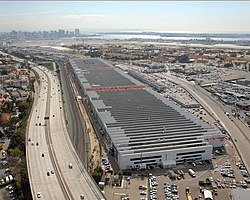
The San Diego Site Redevelopment
In May 2021, the Navy proposed a massive redevelopment of the 70-acre NAVWAR site. The plan envisions 19.6 million square feet of total development, including:
- 1.7 million square feet for new Navy cybersecurity buildings and parking.
- A mixed-use area featuring up to 10,000 residential units for over 14,000 people.
- 1.3 million square feet of commercial office space and 250,000 square feet of retail stores.
- A 140,000 square foot transit center and two hotels with 450 rooms.
| Category | Details |
|---|---|
| Headquarters | San Diego, California |
| Key Leadership | Rear Adm. Seiko Okano (Commander), John W. R. Pope III (Executive Director) |
| Primary Focus | C4ISR, Space Systems, and Business IT |
| Global Centers | NIWC Atlantic and NIWC Pacific |
| Workforce Size | 11,000+ professionals |
Frequently Asked Questions
What does C4ISR stand for?
C4ISR stands for Command, Control, Communications, Computers, Intelligence, Surveillance, and Reconnaissance. It represents the integrated systems used to share information across naval and joint forces.
What is the difference between NAVWAR and SPAWAR?
There is no difference in entity; SPAWAR (Space and Naval Warfare Systems Command) was simply renamed to NAVWAR (Naval Information Warfare Systems Command) in June 2019 to better align the name with its mission.
Where are the Naval Information Warfare Centers located?
NIWC Atlantic is based in Charleston, South Carolina, with sites in Norfolk, New Orleans, and Stuttgart. NIWC Pacific is based in San Diego, with sites in Hawaii, Guam, and Japan.
What is the role of the Program Executive Offices (PEOs)?
PEOs are responsible for the prototyping, procurement, and fielding of the technology developed by NAVWAR, ensuring that state-of-the-art equipment is affordable and sustainable for the fleet.
What is the purpose of the proposed San Diego site redevelopment?
The proposal aims to modernize the 70-acre site by adding new cybersecurity buildings while creating a mixed-use community with housing, commercial offices, and transit facilities.