Naval Stores: The History and Evolution of the Pine Resin Industry
During the Age of Sail, the survival of global trade and naval supremacy depended on specialized materials known as naval stores. These were the essential articles and materials used in shipping and the navy to build and maintain wooden vessels. While the term originally covered a broad range of supplies—including hemp and flax for ropes and sails—it eventually became synonymous with the resins extracted from conifer trees.
The demand for these materials sparked a global industry, as European powers sought reliable sources of waterproofing agents to keep their fleets seaworthy during an era of intense maritime conflict.
Key Facts
- Definition: Naval stores are materials used for shipping, primarily resins, pitch, and tar derived from pine trees.
- Primary Uses: Waterproofing wooden hulls, sealing planks, and maintaining masts and cordage.
- Economic Hubs: North Carolina became a primary producer in the 18th century; Savannah, Georgia, was the world's leading port for these products between 1880 and 1920.
- Key Products: Turpentine and rosin (resin) were the primary outputs of the pine tapping process.
- Industrial Shift: The industry transitioned from maritime use to lighting fuel (camphine) before declining due to the rise of kerosene and synthetic alternatives.
The Rise of the Colonial Industry
By the 17th century, England faced a crisis: most of its forests had been depleted for lumber and firewood. This left the Royal Navy vulnerable, especially as Sweden—a major supplier—established a monopoly that drove prices upward. To secure its naval interests, England turned to its North American colonies.
In 1705, the Parliament of England passed the Importation Act 1704, which incentivized the development of a colonial industry by requiring the Royal Navy to pay higher prices for colonial stores. While New England and New York found other industries more profitable, the Southern Colonies—particularly the Carolinas—embraced the trade. By the 1770s, naval stores had become the most significant industry in North Carolina.
Production and "Industrial Slavery"
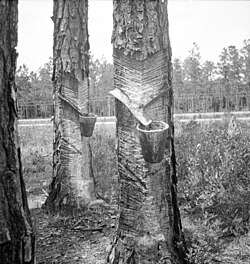
The production of turpentine and rosin involved tapping pine trees for sap. Workers scored the trees with a ledge called a "box" to collect the resin, which was then doubly distilled. This labor-intensive process relied heavily on enslaved people, a system described as industrial slavery because it differed from traditional agricultural labor. This legacy is reflected in the nickname "tar heels," referring to the resinous nature of the work.
From Ships to Lamps: The Camphine Era
As the maritime demand evolved, the industry found a new market in lighting. By the 1840s, camphine—a mixture of turpentine and grain alcohol—became the primary lamp fuel for average American families. Wilmington, North Carolina, emerged as a central hub for camphine production.
This expansion further increased the demand for enslaved labor, with workers often leased to turpentine camps during the slower agricultural winter months. However, this era ended abruptly with the American Civil War. The combination of emancipation, the burning of flammable camps during General William Tecumseh Sherman's march, and new government taxes on alcohol made camphine less viable. Simultaneously, the discovery of oil in Pennsylvania led to the rise of kerosene, which replaced camphine as the dominant fuel.
Organizational Structure and Global Trade
The industry was historically managed by "factors"—large-scale operations that controlled vast tracts of forest. These factors leased land to smaller "operators," providing them with tools and capital in exchange for barrels of resin. In Savannah, Georgia, the "Factors Walk" remains a historical reminder of where thousands of barrels were collected for shipment. Savannah remained the global price-setter for naval stores until 1950.
Beyond the United States, France also became a major producer. Napoleon encouraged the planting of pines in sandy dune regions to bolster domestic supply. By 1927, France exported approximately 20 percent of the world's resin.
Summary of Naval Store Materials
| Material | Source/Composition | Primary Use |
|---|---|---|
| Pine Pitch | Conifer Resin | Waterproofing hulls and caulking planks (often mixed with hemp) |
| Turpentine | Distilled Pine Sap | Industrial solvent and component of camphine fuel |
| Rosin | Distilled Pine Resin | Adhesives and various industrial applications |
| Hemp/Flax | Plant Fibers | Manufacturing sails and cordage (ropes) |
The Modern Era and Decline
The transition away from wooden ships ended the original purpose of naval stores, but the industry persisted through the late 20th century as a mainstay of the southeastern United States. However, the "gum" naval stores industry (tapping live trees) began a steep decline in the 1960s.
Today, the traditional method of tapping trees has been largely replaced by industrial processes that yield resins as byproducts of other operations. As of 2001, only one large-scale facility, located in Baxley, Georgia, continues to serve the remaining producers in the region.
Frequently Asked Questions
What exactly are naval stores?
Naval stores are materials used for the construction and maintenance of ships. While this originally included hemp and flax for ropes, it primarily refers to pine-derived resins, pitch, and tar used for waterproofing wooden vessels.
Why was North Carolina so important to this industry?
North Carolina possessed pine forests perfectly suited for resin production. By the 1770s, it had become the most important industry in the colony, providing a critical supply of pitch and turpentine to the British Royal Navy.
What was camphine and how did it relate to naval stores?
Camphine was a lamp fuel made from a blend of turpentine and grain alcohol. It allowed the naval stores industry to pivot from maritime use to domestic lighting in the mid-19th century.
How did the Civil War affect the turpentine industry?
The war disrupted the industry through the emancipation of the enslaved workforce, the destruction of flammable camps during military marches, and the imposition of alcohol taxes, which made camphine more expensive than the newly available kerosene.
What is the difference between turpentine and rosin?
Both are derived from the distillation of pine sap; turpentine is the volatile liquid spirit, while rosin (or resin) is the solid residue left after distillation.