Naval Power: The Evolution and Strategy of Maritime Forces
A navy, also known as a naval or maritime force, is the specialized branch of a state's armed forces dedicated to naval and amphibious warfare. These forces operate across a diverse range of environments, including lakes, rivers, littoral zones (coastal areas), and the open ocean. A modern navy encompasses a vast array of assets, from surface ships and submarines to seaborne aviation and the critical support infrastructure required to maintain them.
Strategically, navies serve two primary roles. Offensively, they project force far beyond a nation's shores to protect sea-lanes, deter piracy, transport troops, or attack enemy ports and installations. Defensively, they act as a shield to frustrate enemy attempts at seaborne force projection. Additionally, many navies provide a critical layer of nuclear deterrence through the use of submarine-launched ballistic missiles.
Naval operations are often categorized by their strategic scope into three types: brown-water navies (riverine and littoral), blue-water navies (open-ocean), and green-water navies, which operate in the space between the two.
Key Facts
- Oldest Marine Force: The Spanish Infantería de Marina, formed in 1537, is the oldest active marine force.
- US Dominance: In the late 20th and early 21st centuries, the US Navy possessed over 70% of the world's total tonnage for vessels 1,000 tons or larger.
- Paradigm Shift: The aircraft carrier replaced the battleship as the dominant force of naval warfare by the end of World War II.
- Strategic Scope: Navies are divided into brown-water (coastal), green-water (intermediate), and blue-water (oceanic) capabilities.
The History of Maritime Warfare
Ancient and Medieval Naval Power
Naval combat has deep roots in ancient civilizations. In China, large-scale battles were recorded as early as the Qin dynasty, with the Han dynasty utilizing the war junk. However, China's first official standing navy appeared during the Southern Song dynasty in the 12th century, coinciding with the revolutionary use of gunpowder. Similarly, the Chola Dynasty of Southern India utilized a navy of trade ships to invade Sri Lanka and Southeast Asia under the leadership of Rajendra I.
In Southeast Asia, Nusantaran thalassocracies (maritime empires) demonstrated immense reach. The Malays of Srivijaya and Javanese of Mataram launched expeditions as far as East Africa. The Majapahit Empire later deployed massive fleets; for example, the 1398 invasion of Singapura involved 300 jong (large sailing ships) and approximately 200,000 men. These jongs were formidable, reaching lengths of nearly 80 meters and carrying up to 700 men.
The Age of Sail and European Hegemony
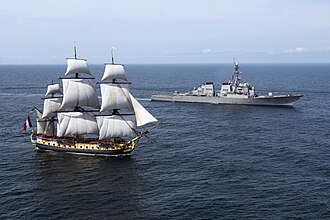
The development of sail-powered ships equipped with cannons fueled the expansion of European colonialism, led initially by Spain and Portugal in the 16th century. A turning point occurred in 1588 when the English fleet defeated the Spanish Armada using a guns-only strategy, forcing a total overhaul of Spanish naval tactics.
By the 17th century, the Dutch Republic challenged Spanish dominance, eventually breaking it at the Battle of the Downs in 1639. England subsequently rose as a major power through a series of Anglo-Dutch Wars. While France achieved notable victories in the late 17th century, a strategic focus on land forces allowed the British Royal Navy to gain a decisive advantage in size and experience from 1695 onward.
Throughout the 18th century, the Royal Navy consolidated its power through conflicts like the Seven Years' War, eventually achieving uncontested supremacy following the Battle of Trafalgar in 1805. This era refined the line of battle, a tactical formation where ships followed one another in a line to maximize broadside firepower.
The Industrial Revolution and the Steel Age
The transition from wood to metal plating and the introduction of steam engines sparked an arms race in armor and firepower. The French Gloire and British HMS Warrior rendered wooden ships obsolete. The invention of rotating turrets further revolutionized combat by allowing guns to aim independently of the ship's heading, a shift highlighted by the battle between the CSS Virginia and USS Monitor during the American Civil War.
The early 20th century saw the launch of HMS Dreadnought in 1906, which set a new standard for battleship design. Meanwhile, the Russo-Japanese War demonstrated the lethal potential of offensive mines at the Battle of Port Arthur and the vulnerability of fleets at the Battle of Tsushima.
Submarines and the Rise of the Aircraft Carrier
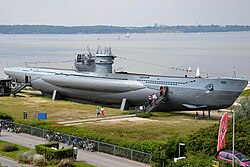
Practical military submarines emerged in the late 19th century. During World War II, Nazi Germany's U-boats attempted to blockade the UK and targeted US coastal shipping. Conversely, British X-Craft (miniature submarines) successfully damaged the German battleship Tirpitz.
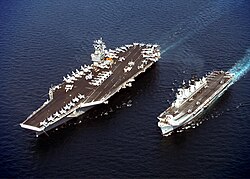
The most significant paradigm shift occurred with the aircraft carrier. Attacks on Taranto (1940) and Pearl Harbor (1941) proved that carriers could strike enemies from beyond the horizon. The Battle of Leyte Gulf in 1944, the largest naval battle in history, marked the end of the battleship's era of dominance.
Modern Naval Organization and Assets
Vessels and Personnel
Modern navies utilize a wide spectrum of craft, from small 9-foot dinghies to 135-foot landing craft, constructed from aluminum, fiberglass, or steel. Personnel structures have also evolved; for instance, the US Navy lifted the ban on female sailors serving on submarines in April 2010, following similar moves by Australia, Canada, Norway, and Spain.
Naval Infantry and Aviation
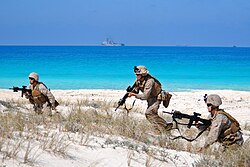
Naval infantry, such as the British Royal Marines, provide a versatile force capable of ship-based operations and specialized commando frogman tactics. Naval aviation continues to perform primary sea-based roles while supporting broader military objectives.
Carrier Technology Today
Current aircraft carrier operations are divided by launch systems: CATOBAR (Catapult Assisted Take-Off Barrier Arrested Recovery), operated by the US, France, and China; STOBAR (Short Take-Off Barrier Arrested Recovery), used by Russia and India; and STOVL (Short Take-Off and Vertical Landing), utilized by the UK's Queen Elizabeth-class carriers.
| System | Full Name | Primary Operators |
|---|---|---|
| CATOBAR | Catapult Assisted Take-Off Barrier Arrested Recovery | USA, France, China |
| STOBAR | Short Take-Off Barrier Arrested Recovery | Russia, India |
| STOVL | Short Take-Off and Vertical Landing | United Kingdom |
Frequently Asked Questions
What is the difference between a blue-water and brown-water navy?
A blue-water navy has the strategic capability to operate in the open ocean for extended periods, projecting power globally. A brown-water navy is designed for littoral or riverine operations, focusing on coastal defense and inland waterways.
When did the aircraft carrier replace the battleship?
The transition occurred during World War II. While battleships were still used at the Battle of Leyte Gulf in 1944, the carrier's ability to strike from long distances established it as the dominant force by the war's end.
What was the significance of HMS Dreadnought?
Launched in 1906, HMS Dreadnought represented a massive leap in naval firepower and design, making all previous battleships obsolete and triggering a new naval arms race.
Which is the oldest active marine force in the world?
The Spanish Infantería de Marina, established in 1537, is the oldest current marine force in existence.
What are the primary strategic roles of a navy?
The primary roles are the offensive projection of force (protecting sea-lanes, deterring piracy, and attacking enemy installations) and the defensive frustration of enemy seaborne projections.