National University of La Plata
The National University of La Plata (Spanish: Universidad Nacional de La Plata, UNLP) is a prestigious public non-sectarian research university located in La Plata, the capital of Buenos Aires Province, Argentina. With a commitment to academic excellence and national progress, the university serves over 90,000 regular students and employs a dedicated teaching staff of 10,000 across 17 departments and 106 degree programs.
Guided by its Latin motto, Pro scientia et patria ("For science and homeland"), UNLP has evolved from a provincial initiative into one of South America's most significant centers for higher learning, particularly renowned for its extensive paleontological and anthropological collections.
Key Facts
- Established: 1897 (originally as Universidad Provincial de La Plata).
- Location: La Plata, Buenos Aires Province, Argentina.
- Current President: Martín López Armengol.
- Student Population: 91,135 students.
- Academic Staff: 10,400 members.
- Global Ranking: Ranked =458 in the 2026 QS World University Rankings.
Historical Foundation and Nationalization
The Provincial Beginnings
The origins of the university are tied to the federalization of Buenos Aires in 1880, which left the Province of Buenos Aires without a central hub for higher education. To rectify this, provincial senators proposed a bill in 1889, leading to the enactment of Law Number 233 on January 2, 1890. This law envisioned a tertiary institution comprising four faculties: Law, Medicine, Chemistry and Pharmacy, and Mathematical and Physical Sciences.
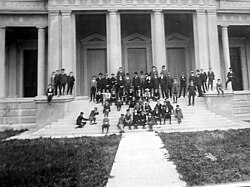
Despite the law, bureaucratic delays postponed the university's opening for seven years. It was not until February 8, 1897, that the founding bylaws were sanctioned. Dardo Rocha, the founder of La Plata, was appointed as the first rector, and classes officially commenced on April 18, 1897, in the Banco Hipotecario building.
Transition to a National Institution
The early years were challenging due to a limited budget and a lack of national recognition for its degrees, which led many students to prefer the University of Buenos Aires. To resolve this, Joaquín V. González, the Minister of Justice and Public Education, spearheaded a nationalization project. On January 1, 1905, key assets—including the Astronomical Observatory and the Faculty of Veterinary and Agronomy—were transferred to the national level.
The creation of the National University of La Plata was officially approved by the House of Representatives on August 15, 1905, and signed by President Manuel Quintana on September 25. Joaquín V. González subsequently became the university's first president, serving four terms until 1918.
Academic Evolution and University Reform
The Struggle for Autonomy
The early 20th century was marked by tensions regarding university governance. By 1920, critics described the institution as having an "oligarchic regime" due to the excessive power held by the president. This sparked a period of student activism and strikes, most notably in 1919 and 1920, the latter of which tragically resulted in the death of student David Viera.
Throughout the 1920s, groups like Renovación (Renewal) and the Federación Universitaria de La Plata (FULP) pushed for democratic reforms and cultural expansion, leading to the creation of the university's radio station, LR11 Radio University.
Political Turbulence and Intervention
The university faced significant instability during the "infamous decade" (1931–1943), characterized by electoral fraud and state intervention. During this time, state-appointed presidents often restricted student participation and dismissed opposing faculty and students. Later, between 1952 and 1955, the institution was renamed the Eva Perón National University, mirroring the renaming of the city of La Plata.
Artistic and Cultural Extension
UNLP is not only a center for science but also a hub for the arts. The university has fostered several distinguished ensembles:
- The University Choir: Founded in 1942, it was the first of its kind in Argentina and has performed globally, including at the inauguration of the Lincoln Center in New York.
- The String Quartet: Established in 1953, this ensemble has premiered works by renowned Argentine composers such as Ástor Piazzolla and Alberto Ginastera.
- The Wind Quintet: Officialized in 1982, this group focuses on classical music for the general public.
- Theatre Workshop: Created in 1986, it promotes experimental productions and aesthetic research.
Institutional Symbols and Identity
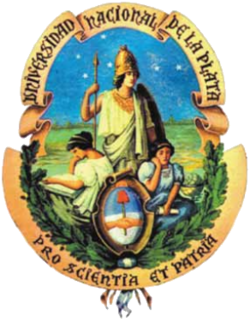
The university's identity is encapsulated in its coat of arms, adopted in 1897. It features a woman representing the City of La Plata holding the "Light of Science," accompanied by the Southern Cross constellation and the coat of arms of the Province of Buenos Aires. The oak leaf serves as the university emblem.
University Summary
| Category | Details |
|---|---|
| Type | Public non-sectarian research university |
| Founded | 1897 (Provincial); 1905 (National) |
| Motto | Pro scientia et patria (For science and homeland) |
| Total Students | 91,135 |
| Academic Units | 17 Departments / Numerous Faculties |
| QS World Ranking (2026) | =458 |
Notable Alumni and Staff
The university has been the academic home to many influential figures, including:
- Politics: Former Argentine Presidents Raúl Alfonsín, Néstor Kirchner, and Cristina Fernández de Kirchner.
- Science and Medicine: René Favaloro (inventor of the coronary artery bypass) and Julio Palmaz (inventor of the balloon-expandable stent).
- Arts and Letters: Writer Ernesto Sábato and painter Emilio Pettoruti.
- Human Rights: Nobel Peace laureate Adolfo Pérez Esquivel and activist Martín Almada.
Frequently Asked Questions
When was the National University of La Plata founded?
The institution began as the Universidad Provincial de La Plata on April 18, 1897, and was later nationalized on September 25, 1905.
What is the meaning of the university's motto?
The Latin motto "Pro scientia et patria" translates to "For science and homeland" in English.
Who are some of the most famous alumni of UNLP?
Notable alumni include three Argentine presidents (Alfonsín, N. Kirchner, and C. Kirchner), as well as medical pioneers like René Favaloro and authors such as Ernesto Sábato.
What makes the university's collections significant?
The university holds some of the most important paleontological and anthropological collections in South America.
What is the university's current global ranking?
According to the 2026 QS World University Rankings, the National University of La Plata is ranked =458 globally.