Pontifical Catholic University of Argentina
The Pontifical Catholic University of Argentina (Spanish: Pontificia Universidad Católica Argentina), commonly known as UCA, is a premier private institution of higher learning. With a strong Roman Catholic affiliation, UCA serves approximately 24,000 students across multiple campuses in Argentina, blending rigorous academic standards with a mission of integral human formation.
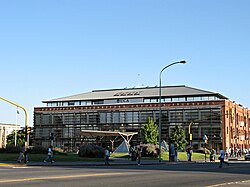
The university's primary hub is located in Puerto Madero, a modern financial district in Buenos Aires. This strategic location places the campus within walking distance of the Casa Rosada and provides seamless access to the city's underground transit system.
Key Facts
- Established: Formally founded on March 7, 1958.
- Main Campus: Puerto Madero, Buenos Aires, Argentina.
- Student Population: Approximately 24,000 students.
- Accreditation: Part-time MBA accredited by the Association of MBAs (AMBA) since 1998.
- Rankings: Recognized by QS World University Rankings as a top private university in Argentina.
- Leadership: Led by Grand Chancellor Abp. Jorge Ignacio García Cuerva and President Dr. Miguel Ángel Schiavone.
A History of Two Foundations
The journey of UCA is unique in that the institution was essentially founded twice, reflecting the evolving legal and social landscape of Argentine education.
The First Attempt (1910–1922)
The vision for a Catholic university was first discussed during the Eucharistic Congress of 1884. However, Law 1420 of Common Education, which mandated secular public education to separate Church and State, initially slowed progress. In 1910, the Argentine Episcopate established the Catholic University of Buenos Aires to provide an education that combined liberal professions with Catholic doctrine.
Despite the launch of a Faculty of Law, the institution struggled with the limited legislation regarding private higher education at the time. Because its degrees were not officially recognized by the government, the university was forced to close in 1922.
The Second Foundation (1958)
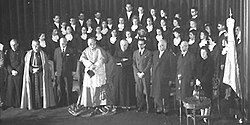
The path to a permanent institution opened in 1955 with Decree 6403, which established the freedom of education and allowed private universities to grant official academic qualifications. Following a decision by the bishops in 1956, the Catholic University of Argentina was formally established on March 7, 1958.
The university began its second life with three core faculties: Philosophy, Law and Political Science, and Social and Economic Sciences, aiming to integrate academic fields that contribute to the holistic formation of the individual.
Academic Structure and Reputation
UCA is widely regarded as one of Argentina's leading educational institutions. It has achieved significant recognition in global rankings, including being ranked as the top private institution in Argentina by QS World University Rankings in 2013 and maintaining a high preference rating among employers.
The university's Business School is particularly distinguished, earning a "Top Business School" label from EdUniversal with 4 out of 5 Palmes and ranking 3rd nationally by the same firm.
Faculties and Regional Presence
While the heart of the university is in Buenos Aires, UCA maintains a broad regional footprint with campuses in Santa Fe, Rosario, Paraná, Mendoza, and Pergamino.
| Location | Key Faculties / Institutes |
|---|---|
| Buenos Aires | Arts and Musical Sciences, Agricultural Sciences, Economics, Exact Sciences and Engineering, Medical Sciences, Law, Canon Law, Philosophy and Literature, Psychology, Theology, and various independent research institutes. |
| Rosario | Law and Social Sciences, Economics, School of Chemical and Engineering "Fray R. Bacon". |
| Mendoza | Humanities and Education, Economics "San Francisco". |
| Paraná | Faculty "Teresa of Avila". |
| Pergamino | Regional Center. |
Global Reach and Notable Affiliations
Since the creation of the Office of International Relations in 2000, UCA has aggressively pursued internationalization. The university maintains academic cooperation agreements with prestigious institutions across the Americas, Europe, Asia, and Oceania, including McGill University (Canada), University College London (UK), and Peking University (China).
The university's prestige is further reflected in its alumni and faculty. Notable alumni include former Argentine President Mauricio Macri, Queen Máxima of the Netherlands, and Rafael Grossi, Director General of the International Atomic Energy Agency. The faculty has included distinguished figures such as composer Alberto Ginastera and various high-ranking members of the clergy.
Frequently Asked Questions
Is UCA a recognized university in Argentina?
Yes, UCA is a highly prestigious private university and is consistently ranked among the best in Argentina by QS World University Rankings, particularly among private institutions.
Where is the main campus located?
The main campus is situated in Puerto Madero, the modern financial center of Buenos Aires, providing students with proximity to the city's business and political hubs.
What is the relationship between UCA and the Catholic Church?
UCA is a Roman Catholic institution. Its Grand Chancellor is ex officio the Archbishop of Buenos Aires. Notably, Cardinal Jorge Mario Bergoglio served as Grand Chancellor until his election as Pope Francis in 2013.
Does UCA have international accreditation?
Yes, specifically its part-time MBA program has been accredited by the London-based Association of MBAs (AMBA) since 1998.
Which campuses does UCA operate outside of Buenos Aires?
UCA has a presence in several other Argentine cities, including Rosario, Mendoza, Paraná, Santa Fe, and Pergamino.