National Geographic Society: A Legacy of Exploration and Education
Founded on the principle of increasing and diffusing geographical knowledge, the National Geographic Society has evolved from an elite academic club into a global powerhouse of science, education, and storytelling. As a 501(c)(3) charitable organization, the Society focuses its efforts on environmental protection, historical preservation, and global education.
From its early days of pioneering photojournalism to its modern role as a supporter of worldwide research, the Society continues to bridge the gap between complex scientific discovery and public understanding.

Key Facts
- Founded: January 13, 1888, in Washington, D.C.
- Purpose: Education, environmental protection, and historical preservation.
- Headquarters: Washington, D.C.
- Leadership: Led by Chairman Jean M. Case and CEO Jill Tiefenthaler.
- Commercial Arm: National Geographic Partners (a joint venture with The Walt Disney Company).
- Global Reach: Flagship magazine published in 40 local-language editions.
The History of the Society
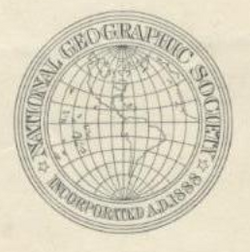
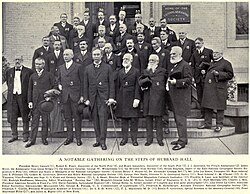
The National Geographic Society was established when 33 explorers and scientists met at the Cosmos Club in Washington, D.C. The group sought to create a formal organization dedicated to the study of geography. It was officially incorporated on January 27, 1888. The first president was Gardiner Greene Hubbard, a co-founder of AT&T, who was succeeded in 1897 by his son-in-law, Alexander Graham Bell.
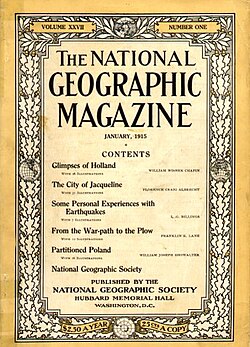
A pivotal shift occurred in 1899 when Gilbert Hovey Grosvenor became the first full-time editor of the society's magazine. Together with Alexander Graham Bell, Grosvenor revolutionized the publication by introducing the use of photographs to tell stories, a technique that defined the brand's visual identity for over a century.
Evolution of Media and Ownership
In recent decades, the Society has undergone significant structural changes. In 2015, it reorganized its media properties into National Geographic Partners. Initially, this for-profit entity was majority-owned by 21st Century Fox (73%). However, following The Walt Disney Company's acquisition of 21st Century Fox assets in March 2019, Disney assumed the majority stake. The Society currently retains a 27% interest in the partnership.
These transitions have led to shifts in staffing and distribution. In June 2023, the Society laid off its remaining staff writers for the magazine, moving toward a model reliant on freelance contributors. Additionally, the magazine ceased physical newsstand sales in the United States in 2024, focusing instead on multi-platform storytelling.
Core Activities and Contributions
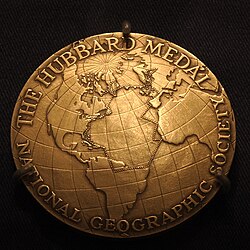
Beyond its media presence, the Society is deeply invested in field research and the recognition of scientific achievement. It grants prestigious awards, such as the Hubbard Medal and the Alexander Graham Bell Medal, the latter of which was awarded to GIS (Geographic Information System) pioneers Roger Tomlinson and Jack Dangermond in 2010.
The National Geographic Museum of Exploration
Located in Washington, D.C., the Society operates a museum that showcases the work of its explorers and scientists. The museum houses significant historical artifacts, including pottery recovered by Jacques Cousteau and the camera used by Robert Peary at the North Pole. After a major renovation that began in early 2023, the institution reopened on June 26, 2026, as the National Geographic Museum of Exploration.
The Explorers Program
The Society supports a diverse array of professionals through its Explorers program. Notable figures include American photographer and ecologist Jen Guyton and conservation scientist Suaad Al Harthi, the executive director of the Environment Society of Oman.
Publications and Multimedia
The flagship National Geographic magazine remains one of the world's most recognized publications, reaching approximately 60 million readers monthly across 40 language editions.
Educational and Youth Media
The Society provides tailored content for younger audiences through several specialized publications:
- National Geographic Explorer: A classroom-focused magazine.
- National Geographic Kids: Launched in 1975 (originally as National Geographic World), it has a U.S. circulation exceeding 1.5 million and numerous international editions, including Arabic, Albanian, and Polish.
- National Geographic Little Kids: Specifically designed for children aged 3–6.

Film and Television
The Society has a robust presence in cinema and broadcasting. Through its film division, it has produced documentaries and features such as Restrepo, The Way Back, and Jerusalem. Its television presence has spanned decades, moving from networks like CBS and ABC to PBS, and eventually to the dedicated National Geographic Channel in 2005.
Summary of Organization Structure
| Feature | Details |
|---|---|
| Legal Status | 501(c)(3) Charitable Organization |
| Primary Goals | Education, Environmental Protection, Historical Preservation |
| Commercial Entity | National Geographic Partners (Disney 73%, Society 27%) |
| Key Publications | National Geographic, NG Kids, NG Explorer, NG Little Kids |
| Museum Name | National Geographic Museum of Exploration |
Frequently Asked Questions
Who founded the National Geographic Society?
The Society was founded on January 13, 1888, by a group of 33 explorers and scientists, including Gardiner Greene Hubbard, who served as the first president.
What is the relationship between the Society and Disney?
The Society maintains a joint venture called National Geographic Partners to handle commercial activities. The Walt Disney Company owns a 73% stake in this venture, while the Society owns 27%.
Is the National Geographic magazine still printed?
Yes, the Society continues to publish a monthly magazine. However, as of 2024, it is no longer sold at physical newsstands in the United States, and the content is now primarily produced by freelance writers.
What can be seen at the National Geographic Museum?
The museum features exhibits on natural history and culture, including permanent artifacts such as Robert Peary's North Pole camera and shipwreck pottery recovered by Jacques Cousteau.
What are the different versions of the magazine for children?
The Society offers National Geographic Kids for general children, National Geographic Explorer for classrooms, and National Geographic Little Kids for children aged 3 to 6.