MS München: The Final Voyage and Search Operations
The MS München was a LASH (Lighter Aboard Ship) carrier—a specialized vessel designed to carry smaller barges, known as lighters, to streamline cargo handling. Due to their exceptional flotation capabilities, LASH carriers were widely regarded as practically unsinkable. However, in December 1978, the München encountered a catastrophic end during its 62nd voyage across the North Atlantic.
On 7 December 1978, the vessel departed Bremerhaven bound for Savannah, Georgia. On board were a crew of 28 and a cargo of steel products stored in 83 lighters. Notably, the ship was also transporting a replacement nuclear reactor-vessel head for Combustion Engineering, Inc. Despite a fierce storm that had been raging since November, the München continued its route, relying on its robust design to withstand the elements.
Key Facts
- Vessel Type: LASH carrier (Lighter Aboard Ship).
- Crew: 28 people.
- Cargo: Steel products in 83 lighters and a nuclear reactor-vessel head.
- Last Known Position: Approximately 44°N 24°W.
- Search Scale: Over 100 ships and 16 aircraft involved.
- Outcome: All crew members lost; search officially ended 20 December 1978.
The Final Communications
The first sign of trouble occurred on the night of 11–12 December. Between 00:05 and 00:07 GMT on 12 December, radio officer Jörg Ernst contacted a colleague, Heinz Löhmann, aboard the cruise ship MS Caribe. In a brief, poor-quality transmission on a "chat" frequency, Ernst reported bad weather and damage to the München, providing a position of 44°N 24°W. Because this was an informal communication, the ship's owner was not notified until 17 December.
Approximately three hours later, between 03:10 and 03:20, formal SOS calls were transmitted in Morse code. These were received by the Greek freighter Marion and relayed to the Soviet ship Mariya Yermolova and the German tug Titan. The München reported its position as 46°15′N 27°30′W, though this was likely 100 nautical miles off its actual location. One fragmented message mentioned a "50 degrees starboard," which was interpreted as a 50-degree list to the starboard side.
Automatic emergency signals began appearing at 04:43, with the last recorded call at 07:34. It is believed that US stations stopped monitoring the 2182 kHz frequency at that time, cutting off further communication.
International Search and Rescue Efforts
Search operations were officially initiated at 17:30 on 12 December, coordinated by HM Coastguard at Land's End, Cornwall. The effort was severely hampered by extreme weather, with wind speeds reaching 11-12 Beaufort. Initial reconnaissance was conducted by a Royal Air Force Hawker Siddeley Nimrod aircraft.
On 13 December, the search expanded to include a German Lockheed C-130 Hercules and six ships. That morning, Michael F. Sinnot, a Belgian radio amateur, intercepted a clear but noisy voice transmission on the unusual frequency 8238.4 kHz. He reported hearing the ship's name and callsign spoken in English with a German accent. Later that day, the US Naval Station Rota in Spain received ten weak, automated Mayday calls mentioning "28 persons on board," along with the Morse code call sign 'DEAT'.
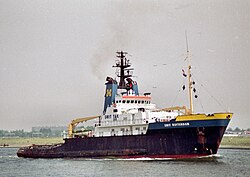
The Dutch salvage tug Smit Rotterdam was appointed as the Onscene Commander. Under Captain PF de Nijs, the tug coordinated a massive operation involving more than 100 ships and 16 aircraft, many of which were based in the Azores.
Discovery of Debris
As wind speeds dropped to Force 9 on 14 December, the search intensified. The British freighter King George recovered an empty life raft, and the Hapag-Lloyd freighter Erlangen identified three of the ship's lighters. Over the following days, further debris was found:
- 15 December: Two buoy-shaped objects spotted by a Nimrod aircraft; a second empty life raft recovered by the tug Titan.
- 16 December: A third empty life raft located by MS Badenstein and a yellow barrel sighted.
- 17 December: The Düsseldorf Express salvaged the emergency buoy, while the Starlight found two life belts.
- Later: The Sealand Consumer recovered a fourth empty life raft, and three life vests were spotted by the Starlight and Evelyn.
Conclusion of the Search
The international search operation officially concluded on the evening of 20 December. The West German government and Hapag-Lloyd extended the search for two additional days with support from US and British forces. In total, 13 aircraft from the UK, US, Portugal, and Germany, and nearly 80 naval and merchant ships participated in the effort.
The final piece of evidence was recovered on 16 February 1979, when the car transporter Don Carlos salvaged the damaged starboard-side lifeboat.
| Category | Details |
|---|---|
| Total Crew | 28 |
| Last Known Position (Approx) | 44°N 24°W |
| Search Coordination | HM Coastguard Land's End / Smit Rotterdam |
| Assets Deployed | ~80-100 ships, 13-16 aircraft |
| Key Debris Found | 4 life rafts, 3 lighters, emergency buoy, lifeboat |
Frequently Asked Questions
Why was the MS München considered unsinkable?
As a LASH carrier, the vessel possessed exceptional flotation capabilities due to its design for carrying lighters, which led to the widespread belief that it was practically unsinkable.
What was the significance of the nuclear reactor-vessel head?
The ship was transporting a replacement nuclear reactor-vessel head for Combustion Engineering, Inc. as part of its cargo.
Why was the initial report of damage not acted upon immediately?
The first communication regarding damage was a "chat" frequency transmission between two colleagues. Because it was a standard, informal communication, the information was not relayed to the ship's owner until December 17.
What weather conditions hindered the search?
Search efforts were severely hampered by a fierce North Atlantic storm, with wind speeds reported at 11-12 Beaufort during the initial phases of the operation.
Was any of the crew rescued?
No. Despite the recovery of four empty life rafts, several life vests, and a lifeboat, no survivors were found, and the search was eventually called off.