Mousterian Industry: The Stone Tool Legacy of Neanderthals and Early Humans
The Mousterian (also known as Mode III) represents a pivotal era of prehistoric technology. This archaeological industry of stone tools defines much of the latter part of the Middle Paleolithic, the middle period of the West Eurasian Old Stone Age. Spanning roughly from 160,000 to 40,000 BP (Before Present), the Mousterian reflects a sophisticated leap in how early humans manipulated their environment.
While primarily associated with Homo neanderthalensis in Europe, the Mousterian industry was also utilized by the earliest anatomically modern humans in West Asia and North Africa. This overlap suggests a shared technological approach to survival across diverse landscapes.
Key Facts
- Timeframe: Approximately 160,000 to 40,000 BP.
- Primary Users: Neanderthals (Europe) and early modern humans (North Africa and West Asia).
- Type Site: Le Moustier, France.
- Core Technology: Frequent use of the Levallois technique (a method of preparing a stone core to strike off flakes of a predetermined shape).
- Geographic Reach: Eurasia and Africa, including sites in Jordan and Saudi Arabia.
The Origins and Naming of the Mousterian
The industry takes its name from Le Moustier, a site in the Dordogne region of France consisting of three superimposed rock shelters. Archaeologists discovered a consistent style of knapping—the process of shaping stone by striking it—across unglaciated Europe, West Asia, and North Africa.
The Mousterian did not emerge in a vacuum. It was preceded by several earlier complexes, including the Acheulean, Clactonian, Micoquien, and the Acheulo-Yabrudian. If the earlier Levallois or Levallois–Mousterian phases are included, the technological lineage extends back as far as 300,000 to 200,000 BP.
Technological Characteristics
The Mousterian toolkit was versatile, consisting primarily of hand axes, racloirs (scrapers), and points. A defining feature of this period was the use of prepared-core techniques, most notably the Levallois method, to produce precise flint and chert flakes.
In Europe, these tools were the product of Neanderthals. Some specific assemblages, such as those found at Pech de l'Aze, feature exceptionally small points. Some researchers suggest these miniature tools may have been designed to leverage the superior grip strength of Neanderthals.
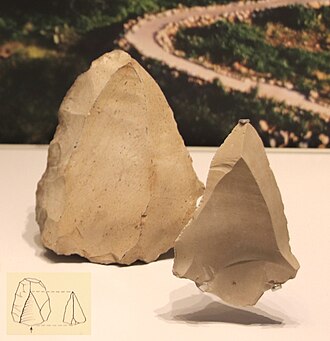
Conversely, in North Africa and the Near East, these tools were crafted by anatomically modern humans. In the Eastern Mediterranean, the tools produced by modern humans (such as the Qafzeh type) are virtually indistinguishable from those made by Neanderthals. In North Africa, the industry is estimated to be as old as 315,000 years.
Industry Variants
The Mousterian is not a monolithic style but includes several variants, such as:
- Denticulate: Tools with tooth-like edges for sawing.
- Charentian: Including the Ferrassie and Quina styles, named after the Charente region.
- Typical Mousterian: The standard industry form.
- Mousterian Traditional Acheulian (MTA): Categorized into Type-A and Type-B.
Geographic Distribution and Major Sites
The Mousterian footprint is vast, stretching from the Atlantic coast of France to the depths of Siberia and the plains of North Africa.
In Croatia, significant finds have been recovered from Krapina, Vindija, and Veternica. Interestingly, underwater excavations at Kaštel Štafilić-Resnik have yielded centripetal cores and side scrapers, proving that Mousterian activity occurred in areas now submerged by rising sea levels.
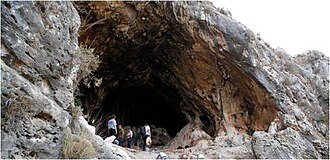
| Region | Key Sites | Associated Hominins |
|---|---|---|
| Europe | Le Moustier, Atapuerca, Gorham's Cave, Vindija Cave, Creswell Crags | Neanderthals |
| West Asia / Levant | Tabun, Kebara, Amud, Qafzeh | Neanderthals & Modern Humans |
| North Africa | Jebel Irhoud, Haua Fteah | Modern Humans |
| Central/North Asia | Denisova Cave, Teshik-Tash | Various Hominins |
The Transition to Later Cultures
The Mousterian era gradually gave way to new technological traditions. Between 45,000 and 40,000 BP, the Mousterian coexisted with the emerging Châtelperronian industry. Eventually, it was succeeded by the Aurignacian (c. 43,000–28,000 BP), which is strongly associated with Homo sapiens.
Evidence suggests that Neanderthal remains and Mousterian artifacts disappeared from European sites roughly between 39,000 and 41,000 years ago, marking the end of their dominance in the region.
Frequently Asked Questions
Who created the Mousterian tools?
In Europe, the Mousterian industry was created by Neanderthals. However, in North Africa and West Asia, the tools were produced by early anatomically modern humans.
What is the Levallois technique?
The Levallois technique is a sophisticated method of stone knapping where the core is carefully prepared so that a single, well-shaped flake can be struck off with precision.
How long did the Mousterian period last?
The classic Mousterian industry lasted from approximately 160,000 to 40,000 BP, though related prepared-core techniques may date back as far as 300,000 BP.
Where is the type site for this culture?
The type site is Le Moustier, located in the Dordogne region of France, where three superimposed rock shelters provided the foundational evidence for this industry.
What tools were most common in the Mousterian toolkit?
The most common tools included hand axes, racloirs (scrapers used for working leather), and various points used for spearheads.