Motorsport: The Thrill of Powered Competition
Motorsport, also referred to as motorsports or powersports, encompasses a vast array of sporting events and competitions centered on the use of powered vehicles. While most people immediately think of cars, the term broadly includes motorcycles, motorboats, and powered aircraft. Depending on the vehicle, these are often categorized more specifically as automobile sport, motorcycle sport, power boating, or air sports.
Within the world of motorsport, different activities are organized into disciplines—specific manifestations of the sport with their own unique objectives and rules. For example, circuit racing and rallying are distinct disciplines. These are further broken down into categories based on vehicle type, propulsion method, or surface, such as formula racing or stock car racing.
Key Facts
- FIA (Fédération Internationale de l'Automobile) is the oldest and most prominent international governing body for four-wheeled land vehicles.
- The first prearranged match race of self-powered road vehicles took place in England on August 30, 1867.
- The 1894 Paris to Rouen contest is widely accepted as the world's first motorsport event involving automobiles.
- Circuit racing evolved from point-to-point racing to improve safety and spectator appeal.
- Karting is considered the most economical entry point into four-wheel motorsport.
The Evolution of Racing
The origins of motorsport date back to the mid-19th century. One of the earliest recorded matches occurred in 1867 in North West England, where a steam locomotive driven by Isaac Watt Boulton competed against Daniel Adamson's carriage over an eight-mile route. In the United States, the Wisconsin legislature incentivized early competition by offering a purse for the first US motor race in 1878, which spanned 200 miles from Green Bay to Madison.
The transition to what we recognize as modern automobile sport began in 1894 with the Paris to Rouen contest. By 1900, the Gordon Bennett Cup was established, and motorsport even appeared as a demonstration event at the 1900 Summer Olympics. Following the World Wars, the sport diverged: Europe focused on Grand Prix races over closed courses, while the United States saw the rise of dirt track, stock car, and drag racing.
Governing Bodies and Regulation
To maintain safety and fairness, sanctioning bodies establish general rules for each discipline. The Fédération Internationale de l'Automobile (FIA), founded in 1904, serves as the primary international authority for vehicles with four or more wheels. For vehicles with one to three wheels, the Fédération Internationale de Motocyclisme (FIM) holds authority. Both are recognized by the International Olympic Committee.
While the FIA maintains a global hierarchy through National Sporting Authorities (ASNs), some organizations remain unaffiliated. In the US, bodies like SCORE International and the National Auto Sport Association operate outside the FIA system, though they may collaborate on international matters.
Automobile Racing Disciplines
Circuit Racing
Circuit racing involves competitors racing on closed, marshalled loops. This replaced city-to-city racing to ensure better safety and spectator access. The first purpose-built track, Aspendale Racecourse in Australia, opened in 1906.
- Formula Racing: Open-wheel cars with minimal bodywork. This includes the world-famous Formula One and Formula Two, as well as Formula E, which uses exclusively electric-powered cars.
- IndyCar: Originating in 1909, this series is famous for the Indianapolis 500.
- Sports Car Racing: Divided between production-based Grand Touring (GT) cars and purpose-built racing prototypes. The 24 Hours of Le Mans is the flagship event of this category.
- Stock Car Racing: Originally using production cars, modern series like NASCAR use purpose-built prototypes that maintain a production car silhouette.
- Touring Car Racing: Modified production cars that must meet minimum production quotas and seat requirements.
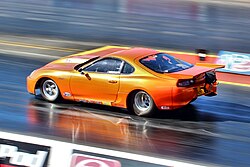
Off-Road Racing
Off-road racing takes place on unsealed surfaces or open terrain. This includes the Baja 1000, organized by SCORE International, and the FIA-authorized Extreme E electric series, which plans to transition to hydrogen (Extreme H) by 2025.
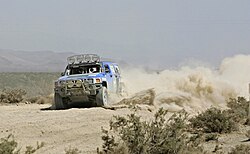
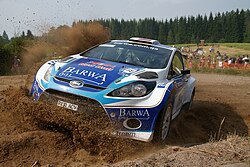
Other off-road variations include Rallycross (short sprints on mixed asphalt and dirt), Autograss, and Lawn Mower Racing.
Time Trials and Sprints
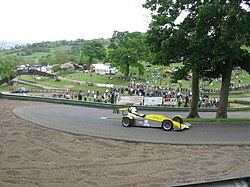
Unlike head-to-head racing, time trials involve competing against the clock. Hillclimbing is the most prominent form, where drivers tackle uphill gradients. These events range from short sprints to long courses like the 12.42-mile Pikes Peak in Colorado.
Other Specialized Disciplines
Karting uses small, low vehicles called go-karts and is accessible to drivers as young as eight. Other niche activities include drifting, autocross, demolition derbies, and land speed record attempts.
Summary of Motorsport Categories
| Category | Primary Vehicle Type | Surface/Environment | Key Example |
|---|---|---|---|
| Formula | Open-wheel single-seater | Closed Circuit | Formula One |
| Rallying | Modified production/Prototypes | Mixed/Off-road | Dakar Rally |
| Stock Car | Silhouette prototypes | Oval/Closed Circuit | NASCAR |
| Endurance | GT cars/Prototypes | Closed Circuit | 24 Hours of Le Mans |
| Karting | Go-karts | Small Circuits | CIK-FIA events |
Beyond the Automobile
Motorsport extends far beyond cars. Motorcycle sport includes disciplines such as Motocross, Enduro, and Speedway. Powerboating is governed internationally by the Union Internationale Motonautique (UIM), while Air sports encompass traditional air racing and modern drone racing. Other unique forms include snowmobile racing and radio-controlled model racing.
Frequently Asked Questions
What is the difference between Formula racing and Stock car racing?
Formula racing uses open-wheel, single-seater cars built specifically for racing with minimal bodywork. Stock car racing uses vehicles that typically maintain the silhouette of a production road car, although modern versions are purpose-built prototypes.
Who is the primary governing body for world motorsport?
The Fédération Internationale de l'Automobile (FIA) is the most prominent international authority for automobiles and land vehicles with four or more wheels.
What is the most accessible form of motorsport for beginners?
Karting is generally accepted as the most economical and accessible form of four-wheel motorsport, with competition open to individuals from age eight onward.
How does hillclimbing differ from circuit racing?
While circuit racing involves multiple cars competing head-to-head on a loop, hillclimbing is a time trial where contestants complete an uphill course individually against the clock.
What is Formula E?
Formula E is an FIA-sanctioned open-wheel racing championship that uses exclusively electric-powered cars, featuring a spec chassis and battery combination.