Hot Rods: The History and Culture of American Performance Cars
A hot rod is typically an American automobile that has been rebuilt or modified with larger, more powerful engines optimized for speed and acceleration. In the simplest terms, it is a car that has been stripped down, "souped up," and engineered to go much faster. Beyond the mechanical upgrades, hot rodding evolved into a vibrant cultural movement defined by hands-on craftsmanship, individual expression, and a tight-knit community.
Originating in the United States during the mid-20th century, the movement became a symbol of youth culture and street racing. It was closely linked to subcultures like the greasers and eventually left a lasting mark on global music, film, and visual design.
Key Facts
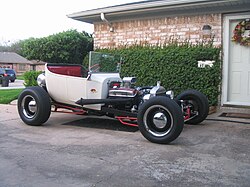
- Origins: Emerged in Southern California in the late 1930s, with early racers using dry lake beds.
- Core Philosophy: Reducing weight and increasing horsepower through engine swaps and body modifications.
- Iconic Engines: The Ford flathead V8 (the "flatty") and later the Chevrolet small-block 350.
- Evolution: Transitioned from racing-focused "hot rods" to aesthetics-focused "street rods" following the 1973 Oil Crisis.
- Cultural Reach: Influenced the "California sound" of the 1960s and the visual style of films like American Graffiti.
The Evolution of the Hot Rod
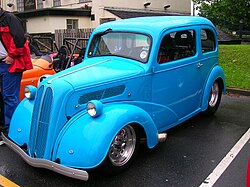
Early Roots (1920s–1945)
The ancestors of the hot rod were the speedsters of the 1910s and 1920s—racecars often based on the Ford Model T with custom bodies. During the Prohibition era, bootleggers also modified cars to outrun law enforcement, contributing to the performance trend. By the late 1930s, enthusiasts in Southern California began racing on dry lake beds under the guidance of groups like the Southern California Timing Association.
After World War II, the movement surged as returning soldiers brought home advanced technical training. Early builders focused on weight reduction by removing fenders, hoods, bumpers, and windshields. A common modification was the engine swap, such as installing the "60 horse" Ford flathead V8 into a Jeep chassis.
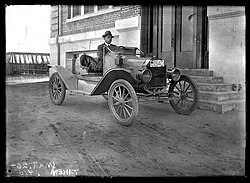
The Golden Age of Drag Racing (1945–1960)
Post-war hot rodders utilized abandoned military airports for racing. As street racing became a safety concern, the National Hot Rod Association (NHRA) was founded in 1951 to move the sport into controlled environments. During this era, the Chrysler FirePower (the "early hemi") began to replace the Ford flathead V8.
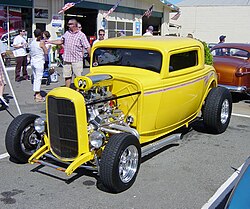
Technical advancements included the shift from mechanical to hydraulic brakes (known as "juice") and the adoption of sealed-beam headlights. The "Deuce" (1932 Ford) became a staple, often featuring a steeply chopped roof and Edelbrock intake manifolds.
The Shift to Street Rods (1960–Present)
The 1973 Oil Crisis shifted the automotive industry toward fuel efficiency, which paradoxically sparked a renewed interest in customization. As the focus moved from raw racing to cruising and aesthetics, these vehicles became known as street rods, leading to the formation of the National Street Rod Association (NSRA).
By the 1970s, the 350 cubic inch (5.7 L) Chevrolet small-block became the engine of choice, followed by the Ford Windsor. In the 1980s, as factory engine displacements shrank, builders began modifying smaller engines—such as the 215 cubic inch aluminum-block Buick or Oldsmobile V8—to achieve higher displacements.
Lifestyle and Kustom Kulture
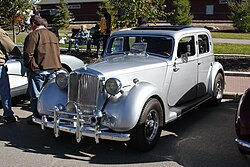
Hot rodding is more than a mechanical hobby; it is a lifestyle. It is deeply intertwined with Kustom Kulture, an American subculture that blends custom car art, fashion, and graphic design. Artists like Ed "Big Daddy" Roth popularized the movement's visual language through flame motifs and exaggerated cartoon characters.
The community is sustained through car clubs, "cruise-ins," and publications like Hot Rod magazine (founded in 1948) and The Rodder’s Journal. Recently, there has been a revival of "traditional" hot rodding, where builders prioritize period-correct parts and historically grounded aesthetics over modern modifications.
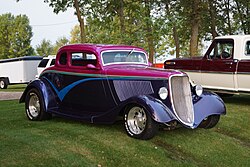
![1932 3-window with a classic-style[1] flame job and Moon tank, reminiscent of Chapouris' California Kid](/images/ac/55/ac5528738095057fb7c5db52d50cb10316a5003661df480677b3c5292a895e13.jpg)
Global and Cultural Impact
Music and Film
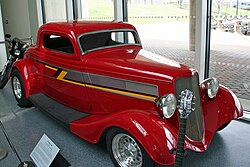
In the 1950s and 60s, hot rods became symbols of freedom in Rockabilly and early rock and roll. The Beach Boys and Jan and Dean integrated car culture into their lyrics, helping define the "California sound." In the 1980s, the band ZZ Top used customized cars, including the famous "CadZZilla," as symbols of mechanical excess.
In cinema, George Lucas's American Graffiti (1973) captured the social world of Northern California hot rodders. Even the Star Wars universe was influenced by this culture; the Millennium Falcon was designed with exposed mechanics and surface wear inspired by hot rods.

International Influence: Sweden and Finland
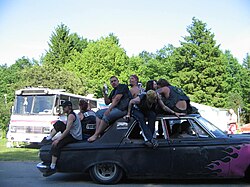
A vibrant hot rod scene exists in Scandinavia, particularly in Sweden and Finland. Due to a lack of original American "vintage tin," Swedish builders often create homemade chassis (replicating Model Ts or As) paired with fiberglass tubs and V8 engines. Some utilize Volvo Duett chassis to navigate strict crash-test regulations from 1969 to 1982.
Summary of Hot Rod Evolution
| Era | Primary Focus | Common Engines | Key Characteristics |
|---|---|---|---|
| 1920s–1945 | Speed & Weight Reduction | Ford Model T/A/B | Stripped bodies, dry lake racing |
| 1945–1960 | Drag Racing & Performance | Ford Flathead V8, Chrysler Hemi | Chopped roofs, hydraulic brakes |
| 1960–Present | Aesthetics & Cruising | Chevy Small-Block, Ford Windsor | Street rods, high-end finishes |
Frequently Asked Questions
What is the difference between a hot rod and a street rod?
A hot rod is traditionally focused on performance, speed, and racing, often featuring stripped-down bodies. A street rod is a modified classic car focused more on aesthetics, comfort, and cruising, a trend that gained momentum after the 1973 Oil Crisis.
What is a "Deuce" in hot rod terminology?
A "Deuce" refers to a 1932 Ford. It is one of the most iconic platforms for hot rodding due to its styling and the availability of the flathead V8 engine.
What is "channeling" a body?
Channeling is a modification where the body of the car is lowered over the chassis frame, giving the vehicle a lower profile without necessarily altering the suspension.
How did the military influence hot rodding?
After World War II, many returning soldiers possessed technical and mechanical training acquired during the war. Additionally, abandoned military airports provided the space necessary for the growth of organized drag racing.
What is Kustom Kulture?
Kustom Kulture is a broader American subculture that encompasses the art, fashion, and graphic design associated with custom cars, popularized by figures like Ed "Big Daddy" Roth.