Land Speed Record: The Evolution of Absolute Velocity on Earth
The land speed record (LSR), also known as the absolute land speed record, represents the pinnacle of human engineering and courage: the highest speed ever achieved by a person in a vehicle on land. This pursuit is not merely about speed, but about the relentless push against the laws of physics and aerodynamics.
Since 1964, the Fédération Internationale de l'Automobile (FIA)—the governing body for automobile racing—and the Fédération Internationale de Motocyclisme (FIM)—the governing body for motorcycle racing—have operated under an agreement to recognize a single absolute LSR. This record is granted to the highest speed achieved across any of their categories. While a three-wheeled vehicle, the Spirit of America, set an FIM-validated record in 1963, all subsequent absolute records have been set by FIA Category C "Special Vehicles," utilizing either jet engines (Class JE) or rocket power (Class RT).
Key Facts
- Current Record: 1,227.986 km/h (763.035 mph) set by ThrustSSC on October 15, 1997.
- Validation Process: Records are measured over 1 kilometer or 1 mile, averaged over two runs in opposite directions within one hour.
- Validation Threshold: A new mark must exceed the previous record by at least one percent to be officially recognized.
- The Sound Barrier: ThrustSSC was the first land vehicle to break the speed of sound.
- Primary Locations: Historic attempts have centered on Daytona Beach, the Bonneville Salt Flats, and the Black Rock Desert.
The History of Wheel-Driven Speed (1898–1964)
The early era of land speed attempts was defined by the transition from electric and steam power to the internal combustion engine. The very first records were set in France using electric vehicles, with Camille Jenatzy's La Jamais Contente becoming the first purpose-designed racer to break 100 km/h in 1899.
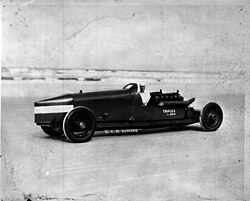
As technology evolved, steam power briefly dominated, notably with the Stanley Rocket in 1906, which became the fastest steam-powered land vehicle until 2009. However, the internal combustion engine soon took over, leading to a golden age of aero-engined cars. Drivers like Malcolm Campbell and Henry Segrave pushed the boundaries, with Campbell eventually breaking the 300 mph barrier at the Bonneville Salt Flats in 1935.
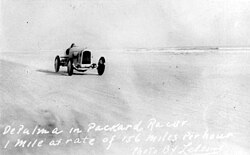
By the mid-20th century, the limits of wheel-driven traction were being reached. The final wheel-driven absolute record was set by Donald Campbell in the Bluebird CN7 in 1964, utilizing a Bristol Proteus gas turbine engine to reach 403.10 mph.
The Era of Jet and Rocket Propulsion (1963–Present)
The shift to thrust-powered vehicles fundamentally changed the nature of the LSR. No longer relying on the friction between tires and the ground for propulsion, these vehicles used turbojets and rockets to achieve staggering velocities.
The 1960s saw a fierce rivalry between Craig Breedlove and Art Arfons. Breedlove's Spirit of America and Arfons' Green Monster traded records rapidly, eventually pushing the mark toward 600 mph. In 1970, Gary Gabelich used rocket power in the Blue Flame to exceed 1,000 km/h.
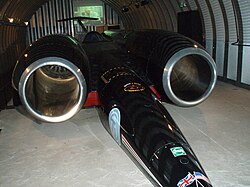
The ultimate milestone was reached in 1997 by Andy Green. Driving the ThrustSSC, powered by two Rolls-Royce Spey turbofans, Green became the first human to break the sound barrier on land, reaching a staggering 1,227.986 km/h.
Women's Land Speed Records
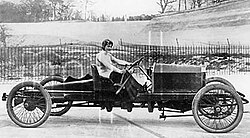
While the FIA does not officially recognize separate gender-based records, several women have made historic contributions to speed. In 1906, Dorothy Levitt was dubbed the "Fastest Girl on Earth" after recording 154 km/h in a Napier motorcar.
Later, in the 1960s, Paula Murphy and Betty Skelton pushed the boundaries of jet-powered speed, with Skelton reaching 446.63 km/h in 1965. In 1976, Kitty O'Neil set a women's absolute record of 825.127 km/h in the SMI Motivator, despite using only 60 percent of the vehicle's power due to sponsor restrictions.
More recently, Jessi Combs advanced the four-wheel record to 632.40 km/h in 2013. Tragically, Combs died during a record attempt on August 27, 2019. In 2020, the Guinness Book of Records posthumously credited her with a record of 841.338 km/h, noting she was the first woman to break the record in 40 years.
LSR Evolution Summary
| Era/Milestone | Key Vehicle | Power Source | Approx. Top Speed |
|---|---|---|---|
| First 100 km/h | La Jamais Contente | Electric | 105.88 km/h |
| First 300 mph | Campbell-Railton Blue Bird | Internal Combustion | 301.129 mph |
| First 1,000 km/h | Blue Flame | Rocket | 1,014.656 km/h |
| First Supersonic | ThrustSSC | Turbofan | 1,227.986 km/h |
Frequently Asked Questions
How is a land speed record officially validated?
To be validated by the FIA, a vehicle must complete two runs over a measured course (1 km or 1 mile) in opposite directions within one hour. The final record is the average of these two "passes," and the new speed must exceed the previous record by at least one percent.
What is the difference between a jet and a rocket car?
Jet-powered cars use turbines to compress atmospheric air and mix it with fuel for combustion. Rocket cars carry both their fuel and an oxidizer on board, allowing them to generate thrust without needing to intake outside air.
Who holds the absolute land speed record?
The absolute land speed record is held by Andy Green, who drove the ThrustSSC to a speed of 1,227.986 km/h (763.035 mph) on October 15, 1997.
Why are the Bonneville Salt Flats used for speed records?
The Bonneville Salt Flats provide a vast, exceptionally flat, and hard surface that allows vehicles to reach extreme speeds and provides the long distances necessary for acceleration and safe braking.
Does the FIA recognize a separate women's land speed record?
No, the FIA does not recognize separate records based on gender. However, other entities, such as the Guinness Book of Records, have tracked and credited women's land speed achievements.