Mosby's Confederacy: The Partisan Warfare of the 43rd Battalion
During the American Civil War, a unique and elusive force operated behind Union lines in Northern Virginia, creating a pocket of resistance so effective it became known as Mosby's Confederacy. Led by Colonel John S. Mosby, the 43rd Battalion Virginia Cavalry specialized in partisan warfare—a style of irregular combat designed to harass the enemy, disrupt communications, and vanish before a counterattack could be mounted.
Mosby's strategy was rooted in the belief that a small, fast-moving force could neutralize a much larger army by threatening multiple points simultaneously. By targeting supply trains and capturing intelligence, Mosby aimed to isolate Union corps from their bases and confuse their strategic plans.
![Map depicting Mosby's Confederacy and nearby areas printed in 1867, showing contemporary place names.[4]](/images/2c/e7/2ce72a1c932ff3ffc1b27d4b468fa1c55a783cd3412acf86bc5d4da4912c1fc3.jpg)
Key Facts
- Operating Area: Centered in Fauquier and Loudoun counties, extending from the Shenandoah Valley to Alexandria.
- Tactics: High-speed raids using small groups (typically 20 to 80 men) who blended into the local civilian population.
- Primary Weaponry: Dual .44 Colt army revolvers; cavalry sabres were largely rejected as ineffective.
- Personnel: A mix of young volunteers and experienced riders, including some as young as 14.
- Impact: By October 1864, the unit had captured or neutralized 1,200 enemy troops and seized 1,600 horses and mules.
Unit Organization and Growth
The 43rd Battalion was not formed all at once but grew through the organization of individual companies across Virginia between 1863 and 1865. This decentralized growth allowed the unit to integrate deeply with local Southern sympathizers who provided food, shelter, and intelligence.
| Company | Date Organized | Location |
|---|---|---|
| Company A | June 10, 1863 | Rector's Cross Roads, VA |
| Company B | October 1, 1863 | Scuffleburg, VA |
| Company C | December 7, 1863 | Rectortown, VA |
| Company D | March 28, 1864 | Paris, VA |
| Artillery Company | July 4, 1864 | Paris, VA |
| Company E | July 18, 1864 | Upperville, VA |
| Company F | September 13, 1864 | Piedmont Station, VA |
| Company G | November 28, 1864 | Salem, VA |
| Company H | April 5, 1865 | Loudoun County, VA |
The Partisan Way of War
Recruitment and the Use of Youth
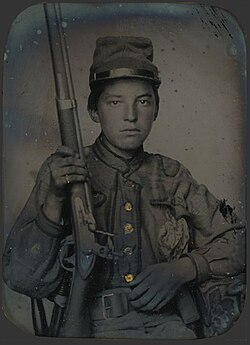
Mosby sought men characterized by intelligence, valor, and resourcefulness. He held a particular preference for youth, believing that unmarried boys made the best soldiers because they lacked the anxieties associated with families. This led to the inclusion of very young soldiers; some paroled after the war were only 14 years old.
Uniforms and Deception
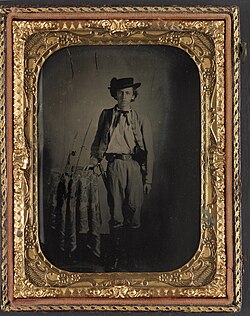
Because the Rangers operated as partisans—irregular soldiers who blend into the civilian population—their attire was often inconsistent. While the general requirement was to wear "something gray," the use of disguises was a point of contention. Some accounts claim the men never wore Union blue to avoid being shot as spies, while Union diaries record Mosby and his men wearing blue overcoats to deceive the enemy during night raids.
Weaponry and Combat Tactics
The 43rd Battalion eschewed the traditional cavalry sabre, which Mosby viewed as useless against a revolver. Instead, each man carried at least two .44 Colt army revolvers. The tactical goal was shock and surprise: riders would gallop close to the enemy, firing only when the opponent's eyes were visible, ensuring lethal accuracy.
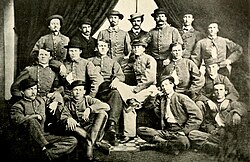
While some captured Union carbines, they were found to be too unwieldy for horseback combat and were occasionally used as clubs. Similarly, attempts to use field artillery, such as the 12-pound brass Napoleon, failed because the pieces were too cumbersome for hit-and-run operations.
![Captain Montjoy, wood engraving 1867[10]](/images/0f/95/0f95901efff80d325bdbf239599128cb1a088699434a54e77b8262f89ea45d37.jpg)
The Role of the Horse
Success depended on the quality of their mounts. Every man maintained at least two horses to ensure they could sustain the grueling pace of raiding and retreating. The bond between the riders and their horses was profound, as the animals were pushed to their absolute limits during pursuits.
![Lt. Col. William Chapman, who with six shots emptied five Yankee saddles, wood engraving 1867[16]](/images/44/ae/44ae9bb82ac9c575c0c9373840f868bf52d716bf082767ad87c73a69300677a7.jpg)
Operational History and Legacy
From 1863 to 1865, the battalion executed dozens of raids, including the notable Greenback Raid and the Rout of Blazer's Command. Their effectiveness was such that by late 1864, they had captured significant livestock, wagons, and high-ranking officers, including Brigadier General Edwin H. Stoughton.
Following General Robert E. Lee's surrender on April 9, 1865, Mosby refused to surrender his command to Union forces in Winchester. Instead, he gathered his men at Salem in Fauquier County on April 21 and formally disbanded the organization, allowing his men to return to their homes. Mosby himself eventually surrendered in Lynchburg on June 17, 1865, after the Union had placed a bounty on his capture.
Frequently Asked Questions
What was "Mosby's Confederacy"?
It was the area of Northern Virginia, primarily in Fauquier and Loudoun counties, where Colonel John S. Mosby and his 43rd Battalion operated with high efficiency, supported by local Southern sympathizers.
Why did Mosby's men prefer revolvers over sabres?
Mosby believed sabres were ineffective compared to the firepower and speed of a skillfully handled revolver, which allowed his men to engage enemies at close range with devastating effect.
Did the 43rd Battalion use child soldiers?
Yes. Mosby believed youth brought a lack of fear and anxiety to the battlefield. Some members of the unit were in their mid-teens, with some as young as 14.
How did the unit disband?
Rather than formally surrendering the battalion to Union commanders, Colonel Mosby read a farewell address to his men on April 21, 1865, and disbanded the organization.
What was the primary goal of Mosby's raids?
The goal was to weaken invading Union armies by harassing their rear, destroying supply trains, capturing dispatches, and breaking the lines of communication between different army corps.