Monk Parakeet: The Resilient Urban Colonizer
The monk parakeet (Myiopsitta monachus) is a vibrant and highly adaptable parrot known for its ability to thrive in diverse environments, from its native South American landscapes to the bustling city centers of Europe and North America. Often referred to as the Quaker parrot in the pet trade, this species has become one of the most successful avian colonizers in the world.
Key Facts
- Scientific Name: Myiopsitta monachus
- Conservation Status: Least Concern (IUCN 3.1)
- Average Size: 29 cm in length with a 48 cm wingspan
- Distinctive Feature: Unique ability to build large, communal stick nests
- Global Presence: Native to South America; invasive in parts of Europe, the Middle East, and North America
Taxonomy and Classification
The monk parakeet belongs to the genus Myiopsitta. For many years, the cliff parakeet (Myiopsitta luchsi) was considered a subspecies of the monk parakeet. However, due to differences in morphology, behavior, and geography, the International Ornithological Committee elevated the cliff parakeet to a full species in 2015. This change was later adopted by BirdLife International in 2020 and the South American Classification Committee in 2024, though some taxonomies, such as Clements, still treat it as a subspecies.
These two species are considered allopatric, meaning they occupy separate geographical areas, with their elevational ranges barely avoiding overlap.
Physical Description and Identification
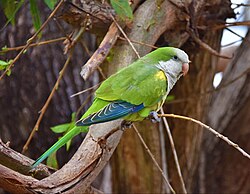
The nominate subspecies of the monk parakeet typically measures 29 cm (11 in) in length and weighs approximately 100 g (3.5 oz). They are characterized by bright-green upperparts and a long, tapering tail. Their forehead and breast are a pale grey with darker scalloping, while the remaining underparts range from light-green to yellow. Their bills are a striking orange, and their flight feathers (remiges) are dark blue.
Females are generally 10–20% smaller than males. While there is subtle sexual dimorphism in the coloration of the crown and wing coverts, these differences are not visible to the human eye and require DNA or feather testing for reliable sexing.
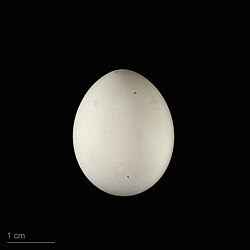
Their vocalizations are loud and throaty, consisting of calls such as "chape(-yee)" or "quak quaki quak-wi quarr," and sharp screeches.
Behavior and Ecology
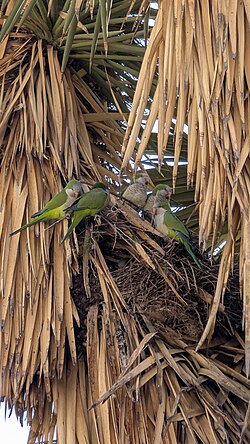
Monk parakeets are highly social birds that form strong colonies. Unlike most parrots that nest in tree cavities, monk parakeets build elaborate stick nests. These structures can be found in a variety of locations, from natural trees to man-made structures like air conditioners and utility poles.

Global Distribution and Invasive Impact
Europe
Spain hosts more than 80% of Europe's feral monk parakeet population. In major cities, the numbers are significant: Madrid had approximately 10,800 birds as of 2015, and Barcelona had an estimated 5,000. In Seville, the population grew from 1,200 in 2013 to 6,300 by 2021. Because they can harm local fauna (such as sparrows and pigeons) and damage crops, Spain outlawed their possession and trafficking in 2013.


Other European countries with documented populations include Portugal, France, Italy, Greece, Great Britain, Belgium, and the Netherlands.
The Americas
In the United States, thousands of birds were imported as pets between the 1960s and 1980s. Escaped or released birds established wild populations, with Florida alone estimating between 150,000 and 500,000 individuals. Other thriving populations exist in Texas (Austin, Dallas, and Houston) and Chicago, where roughly 1,000 birds reside in city parks.

In Mexico, the species was first recorded in Mexico City between 1994 and 1995; by 2015, they were reported in 97 cities across all regions of the country. In Puerto Rico, they are now the most widespread parrot species on the island, common in San Juan and other urban coastal plains.
Middle East
Documented populations have also established themselves in Israel, where they are noted for causing substantial damage.
Summary of Monk Parakeet Characteristics
| Feature | Details |
|---|---|
| Average Length | 29 cm (11 in) |
| Average Weight | 100 g (3.5 oz) |
| Primary Color | Bright green with grey breast |
| Nesting Habit | Communal stick nests |
| Conservation Status | Least Concern |
| Key Invasive Regions | Spain, USA, Mexico, Israel |
Frequently Asked Questions
How can you tell a male monk parakeet from a female?
It is nearly impossible to tell them apart by sight. While females are typically 10–20% smaller and there are subtle color differences in the crown and wing coverts, these are not noticeable to humans. Reliable sexing requires DNA or feather testing.
Why are monk parakeets considered invasive in Europe?
They are considered invasive because they compete with local bird species like pigeons and sparrows for resources and can cause significant damage to agricultural crops.
Do monk parakeets survive cold winters?
Yes, they are remarkably resilient. For example, the population in Chicago thrives despite harsh winters, partly due to their ability to build insulated communal nests.
Where do monk parakeets build their nests?
Unlike most parrots, they build nests out of sticks. These can be found in trees, but in urban areas, they often nest on man-made structures, including air conditioning units and utility poles.
Is the cliff parakeet the same as the monk parakeet?
Historically they were grouped together, but most modern ornithological authorities now classify the cliff parakeet (Myiopsitta luchsi) as a separate species due to morphological and behavioral differences.