Monckton Coke Works: The History of Britain's Last Independent Coking Plant
Located between the towns of Royston and South Hiendley in South Yorkshire, England, the Monckton Coke Works stood as a testament to Britain's industrial heritage for 130 years. Established to process coal from local collieries, it evolved from a regional supplier into the last independent coking plant in the United Kingdom, operating separately from the integrated coke ovens typically found within major steelworks.
Key Facts
- Operational Lifespan: 1874 to 2014.
- Peak Production: Approximately 200,000 tonnes of coke per year.
- Technical Process: Coal baked at 1,280 °C (2,340 °F) for 20 hours.
- Key Products: Metallurgical coke, ammonia, tar, benzole, and Coke Oven Gas (COG).
- Final Owner: Hargreaves.
- Reason for Closure: Competition from cheaper coke imports from the Far East.
Evolution of the Plant and Infrastructure
The facility began operations in 1874, utilizing coal from adjacent collieries such as Monckton and New Monckton. By 1901, the operation was registered as the Monckton Coke and Chemical Company Ltd, a subsidiary of New Monckton Collieries, managing a bank of 180 beehive ovens—traditional dome-shaped structures used for carbonizing coal.
Between 1976 and 1979, the site underwent a significant modernization. The beehive ovens were replaced by 42 continuous ovens, which allowed for a more streamlined production process. These modern ovens remained the core of the operation until the plant's final closure in 2014.
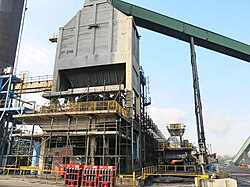
Ownership and Transitions
The plant changed hands several times throughout the late 20th and early 21st centuries. In 1994, RJB Mining acquired the site from ICI for £4.7 million, sourcing coal from the Clipstone Colliery in Nottinghamshire. Later, in 2005, Hargreaves purchased the works from UK Coal for £12 million.
The Coking Process and Byproducts
The production of coke involved dropping raw coal from an overhead loader into ovens where it was roasted for 20 hours. Each oven processed 15.5 tonnes of coal at a temperature of 1,280 °C (2,340 °F), yielding 11 tonnes of coke.
Beyond the primary output of coking coal, the plant captured several valuable byproducts:
- Chemicals: Ammonia, tar, and benzole were extracted and sold.
- Coke Oven Gas (COG): Initially sold to a local glass manufacturer, the gas was later used to power a 12.7 megawatt steam condenser turbine. This system fed steam back into the coking process, with the remaining electricity sold to the National Grid.
- Waste Management: Starting in 2006, the plant incorporated waste tyres into the coking process, receiving financial incentives for recycling old tyres.
Production Output and Market Reach
During the 20th century, the plant maintained a rigorous daily output, consuming an average of 790 tonnes of coal to produce 535 tonnes of coke and 9,700,000 cubic feet of COG. This resulted in an annual yield of roughly 200,000 tonnes of coke.
The primary market for this coke was the metallurgical industry. While some was sold domestically for house fires under brands like Sunbrite, Monckton Boiler Beans, and Cosycoke, much of the production was exported. In the 1990s, coke was shipped to Norway, and between 2010 and 2014, a contract with a South African company saw exports exceed 100,000 tonnes annually.
Coal Sourcing and Logistics
While local mines provided coal until the 1960s, the plant later relied on rail deliveries from Grimethorpe and Clipstone. In its final years, the Maltby Main Colliery (also owned by Hargreaves) provided 25% of its annual 1,000,000-tonne output to Monckton, while the remaining 75% went to the Drax Power Station. The closure of Maltby in 2013 preceded the closure of Monckton in 2014.
| Metric | Value/Detail |
|---|---|
| Daily Coal Consumption | 790 tonnes |
| Daily Coke Production | 535 tonnes |
| Annual Coke Production | ~200,000 tonnes |
| Baking Temperature | 1,280 °C (2,340 °F) |
| Baking Duration | 20 hours |
| Daily COG Output | 9,700,000 cubic feet |
Closure and Site Remediation
The closure of Monckton Coke Works marked the end of independent coking in Britain. The plant could no longer compete with the lower costs of coke imported from the Far East. Because the refractory bricks (heat-resistant bricks lining the ovens) crack upon cooling, the site could not be mothballed for future use.
Hargreaves invested several million pounds in remediating the site. While the company still maintains an operational presence there, it is no longer related to coal or coke production, and there have been stated interests in developing the land for housing.
Frequently Asked Questions
Why was Monckton Coke Works considered "independent"?
Unlike most coking plants in Britain, which were built on-site at steelworks to serve specific steel-making needs, Monckton operated as a standalone entity selling its products to various domestic and international markets.
What happened to the site after it closed in 2014?
The site underwent several million pounds of remediation by Hargreaves. Although coal production has ceased, Hargreaves still operates out of the site for other purposes and has expressed interest in building houses there.
What were the main byproducts of the coking process at Monckton?
In addition to metallurgical coke, the plant produced ammonia, tar, benzole, and Coke Oven Gas (COG).
How did the plant handle its energy needs in later years?
The plant used a 12.7 megawatt steam condenser turbine powered by Coke Oven Gas to generate steam for the coking process, selling any excess electricity to the National Grid.
Why couldn't the plant be put on hold (mothballed)?
Mothballing was impossible because the refractory bricks used in the ovens crack when they cool down, meaning they would have required total replacement to restart operations.