Mirabilis jalapa: The Enchanting Marvel of Peru
Known widely as the four o'clock flower or the marvel of Peru, Mirabilis jalapa is a striking ornamental plant celebrated for its vibrant colors and unique blooming habits. Its name reflects both its beauty and its origin; "Mirabilis" is Latin for wonderful or admirable, while "jalapa" refers to its roots in the Americas, specifically associated with Xalapa, Mexico, or Jalapa, Guatemala.
Historically believed to have been cultivated by the Aztecs for both medicinal and ornamental use, this plant has since traveled the globe. It arrived in Europe in 1525 and has since become a staple in tropical and subtropical gardens worldwide. In the United States, it holds a special place in Connecticut, where it is recognized as the children's state flower under the name Michaela Petit's Four O'Clocks.
Key Facts
- Common Names: Four o'clock flower, Marvel of Peru, Belle de Nuit.
- Blooming Cycle: Flowers typically open between 4:00 PM and 8:00 PM, remaining open through the night.
- Native Range: Dry tropical regions of North, Central, and South America (Mexico, Guatemala, Chile, and Peru).
- Unique Feature: A single plant can produce flowers of multiple different colors simultaneously.
- Pollinators: Primarily long-tongued moths of the family Sphingidae (sphinx or hawk moths).
Botanical Description and Characteristics
Mirabilis jalapa is a perennial (a plant that lives for more than two years) and herbaceous (non-woody) bushy plant. It typically reaches heights of 1 meter, though some specimens can grow up to 2 meters. In colder temperate zones, it is often grown as an annual. The plant features thick, quadrangular stems that can root at the nodes, often resulting in a prostrate or spreading growth habit.
The most captivating feature of the plant is its flowers. Unlike many blossoms, these are not formed from petals but are actually a pigmented modification of the calyx (the outer protective layer of a flower bud). The flowers are funnel-shaped and pentalobed, emitting a strong, sweet fragrance at night to attract nocturnal pollinators.
The plant is famous for its genetic diversity in color. A single plant may produce flowers in yellow, red, magenta, pink, or white. Some flowers exhibit complex patterns, including sectors (large sections of color), flakes (stripes), and spots. Interestingly, some varieties undergo a color change as they mature; for instance, yellow flowers may transition to dark pink, and white flowers may turn light violet.
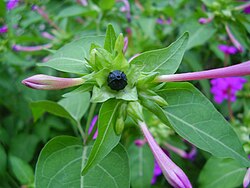
The fruit of the plant is spherical, wrinkled, and black upon maturity, having transitioned from a greenish-yellow hue.
Cultivation and Habitat
This species thrives in full sun and prefers light, well-draining soil rich in humus with a neutral pH. While the aerial parts of the plant may wither during the heat of the day or die back during the first frosts of winter, the underground tuberous roots remain vital, allowing the plant to regrow in the spring. In North America, it is particularly hardy in USDA zones 7–10.
Gardeners often find that the plant self-seeds rapidly, allowing it to spread quickly if not managed. For those growing in containers, a mixture of 80% soil and 20% garden soil in a deep pot is recommended, with tubers planted at a depth of 10 cm. Seeds typically germinate quickly at temperatures around 18 °C.
In its native and naturalized habitats, Mirabilis jalapa is often found in ruderal debris areas (land disturbed by human activity) and weedy sugarcane fields. Its rapid growth and high seed production allow it to dominate up to 30% to 50% of some cane plots.
Scientific and Genetic Significance
Mirabilis jalapa has served as a vital model organism for genetic research. Around 1900, Carl Correns used the plant's variegated leaves to study cytoplasmic inheritance, proving that some traits are passed on via a uni-parental mode of inheritance from factors outside the cell nucleus, challenging the universality of Mendel's theories.
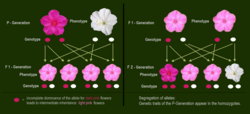
The plant also demonstrates incomplete dominance. This occurs when the offspring of two different varieties (such as dark-pink and white flowers) result in a blended phenotype (light-pink flowers), meaning neither gene completely dominates the other. Despite this, the plant still follows Mendelian principles of segregation and uniformity in subsequent generations.
Chemical Composition and Practical Uses
The plant is a rich source of various chemical compounds. The flowers contain eight betaxanthins (pigments), while the roots contain rotenoids. Analysis of the aerial parts has revealed the presence of sterols such as β-sitosterol and stigmasterol, as well as ursolic and oleanolic acids.
These chemical properties lend themselves to several practical applications:
- Culinary and Cosmetic: The flowers produce an edible crimson dye used for cakes and jellies. Powdered seeds are sometimes used as cosmetics or dyes, though the seeds themselves are considered poisonous.
- Medicinal: In various traditional medicines, the plant is used as a diuretic, purgative, and for wound healing. Root decoctions are used in some cultures to treat skin conditions, diarrhea, and liver infections.
- Environmental: The plant has potential for bioremediation, the process of using living organisms to remove contaminants, specifically for soils polluted with moderate concentrations of cadmium.
- Laboratory: Flower extracts can serve as an economical and accurate natural pH indicator for acid-base titrations.
Summary of Mirabilis jalapa
| Feature | Details |
|---|---|
| Scientific Name | Mirabilis jalapa |
| Family | Nyctaginaceae |
| Native Regions | Mexico, Guatemala, Chile, Peru |
| Bloom Time | Late afternoon to morning (Nocturnal fragrance) |
| Flower Colors | Yellow, Red, Magenta, Pink, White (often mixed) |
| Primary Use | Ornamental, Medicinal, Bioremediation |
| Growth Habit | Perennial herbaceous shrub (1-2m) |
Frequently Asked Questions
Why is it called the "Four O'Clock" flower?
The plant earns this name because its flowers typically open in the late afternoon or early evening, specifically between 4:00 PM and 8:00 PM, and remain open throughout the night before closing in the morning.
Can one plant have flowers of different colors?
Yes, one of the most unique aspects of Mirabilis jalapa is that flowers of different colors can grow simultaneously on the same plant. Additionally, a single flower can feature a combination of colors in the form of spots, stripes, or sectors.
Is the plant safe for consumption?
While the flowers are used to create edible food coloring for jellies and cakes, and cooked leaves are sometimes used as emergency food, the seeds are considered poisonous and should not be eaten.
How does the plant survive winter in colder climates?
In temperate regions, the aerial parts of the plant will die back during the first frosts. However, the plant survives underground via tuberous roots, which remain vital and allow the plant to regrow in the spring.
What is the plant's role in scientific research?
It has been used as a model organism to study cytoplasmic inheritance (inheritance outside the nucleus) and incomplete dominance, where offspring show a blend of parental traits rather than one dominant trait.